Gastric Bypass (Roux-en-Y) for GERD — The Antireflux Operation of Choice in Obesity, After Sleeve, and for Failed Fundoplication


Overview
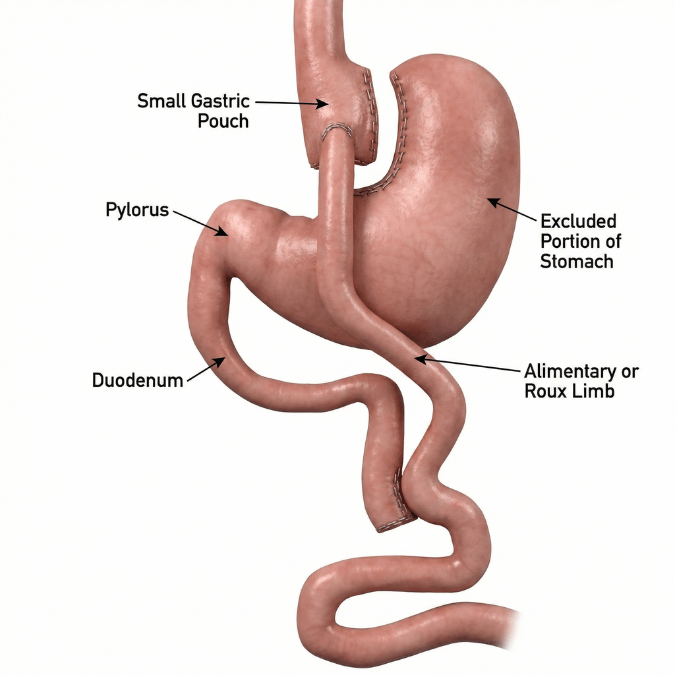
Roux-en-Y gastric bypass is a laparoscopic or robotic operation in which a small (~30-mL) gastric pouch is created at the top of the stomach and connected to a limb of small intestine (the Roux limb), diverting food away from the acid-producing remnant stomach and the bile-carrying duodenum (Suter, Obesity Surgery, 2020). Although it is best known as a weight-loss operation, both the American College of Gastroenterology and the Society of American Gastrointestinal and Endoscopic Surgeons recognize it as the antireflux operation of choice in defined high-risk settings (Katz et al., American College of Gastroenterology, 2022).
There are three situations in which gastric bypass is the preferred antireflux procedure, and they share a common theme — each is a setting where a standard fundoplication or LINX is most likely to fail:
- GERD with obesity. Reflux is up to six times more common when BMI exceeds 35, and the elevated intra-abdominal pressure of obesity strains the hiatus, driving fundoplication disruption, herniation, and recurrence; reflux recurrence after fundoplication rises from roughly 4.5% in patients with BMI under 25 to about 31% in those with BMI over 30 (Katz et al., American College of Gastroenterology, 2022; Xing et al., Obesity Surgery, 2026). Bypass sidesteps these problems and treats the obesity at the same time.
- GERD after a prior sleeve gastrectomy. The sleeve creates a narrow, high-pressure gastric tube that frequently causes persistent or de novo reflux — at 8-year follow-up, conclusive GERD was present in 94.7% of sleeve patients versus 25.0% after bypass — and conversion to RYGB is the established "gold standard" for refractory post-sleeve reflux (Navarini et al., World Journal of Surgery, 2026; Cymbal et al., Surgery for Obesity and Related Diseases, 2026).
- Salvage after failed fundoplication(s). Each successive redo fundoplication yields diminishing returns — excellent results in about 90% after the first operation, 75% after the second, and under 60% after the third — whereas conversion to bypass delivers durable reflux control even in these complex, re-operated patients (Coakley et al., Surgical Endoscopy, 2018; Weber et al., Surgical Endoscopy, 2019).
The supporting outcome data are strong. The largest systematic review to date (28,027 patients across 14 studies) found 47.0% remission of GERD symptoms, 79.4% discontinuation of PPIs, a mean DeMeester score improvement of 16.49 points, and worsening or new-onset reflux in only 4.5% of patients after RYGB (Sargsyan et al., Obesity Surgery, 2025). A network meta-analysis of randomized trials ranked RYGB highest for the probability of GERD remission among bariatric options (Xing et al., World Journal of Gastroenterology, 2026).
Equally important is an honest account of the limits. There is no randomized trial directly comparing RYGB with fundoplication, and a nationwide Swedish cohort of 2,454 patients with preoperative reflux found recurrence in 48.8% within two years of bypass — leading its authors to caution that antireflux efficacy may have been overestimated (Katz et al., American College of Gastroenterology, 2022). Current guidance therefore frames RYGB as a highly effective weight-loss operation with the added benefit of reflux control, and stresses that patients must be counseled about, and willing to accept, the risks and lifelong demands of bariatric surgery before choosing it (Katz et al., American College of Gastroenterology, 2022)
How the Procedure Works
Reflux occurs when acid and bile move retrograde across a weakened, often hernia-displaced gastroesophageal junction. Rather than reinforcing the valve, RYGB reduces reflux through four complementary mechanisms (Castillo-Larios et al., Surgical Endoscopy, 2023; Suter, Obesity Surgery, 2020):
- A low-acid pouch: The small proximal pouch contains very few acid-secreting parietal cells, so far less acid is available to reflux.
- Bile diversion: The Roux-en-Y reconstruction routes bile and pancreatic secretions down a separate limb that rejoins the food stream far downstream, nearly eliminating bile (non-acid) reflux.
- Accelerated pouch emptying: The pouch empties rapidly, reducing the reservoir of refluxable content.
- Weight loss and reduced intra-abdominal pressure: Substantial weight loss lowers the abdomino-thoracic pressure gradient that drives reflux and strains the hiatus.
Any hiatal hernia is reduced and the diaphragmatic crura are repaired at the same operation, restoring normal gastroesophageal junction anatomy (Katz et al., American College of Gastroenterology, 2022). In salvage cases, bypass also avoids the esophageal outflow obstruction and dysphagia risk of a re-operated wrap and is especially useful when the prior fundoplication or the gastroesophageal junction is damaged (Weber et al., Surgical Endoscopy, 2019).
Benefits
- Solves the three hardest reflux problems — obesity, the post-sleeve stomach, and the multiply-failed fundoplication — in a single operation (Katz et al., American College of Gastroenterology, 2022; Cymbal et al., Surgery for Obesity and Related Diseases, 2026; Weber et al., Surgical Endoscopy, 2019).
- High symptom remission and PPI discontinuation — 47% GERD remission and 79.4% PPI discontinuation in pooled data, with only 4.5% experiencing worsening or new-onset reflux (Sargsyan et al., Obesity Surgery, 2025).
- Objective acid control — a mean DeMeester score improvement of 16.49 points confirms genuine physiologic improvement, not symptom masking (Sargsyan et al., Obesity Surgery, 2025).
- Dual benefit of substantial, durable weight loss alongside reflux control — unique among antireflux operations (Suter, Obesity Surgery, 2020).
- Reflux control comparable to fundoplication on quality of life, symptom relief, and satisfaction, with greater weight loss and lower hiatal hernia recurrence (Macanhã Scremin et al., Obesity Surgery, 2026; Xing et al., Obesity Surgery, 2026).
- Superior salvage for failed reflux surgery — better reflux control than redo fundoplication, with ~87% symptom resolution after conversion in long-term series (Castillo-Larios et al., Surgical Endoscopy, 2023; Coakley et al., Surgical Endoscopy, 2018).
Who Is a Candidate
Gastric bypass for GERD is the preferred operation in three groups, and an option in several others (Katz et al., American College of Gastroenterology, 2022; Pletch and Lidor, Current Gastroenterology Reports, 2024):
- Patients with Obesity (generally BMI ≥ 35) and objectively confirmed GERD — the core guideline-preferred indication (Katz et al., American College of Gastroenterology, 2022). The ASMBS suggests that patients with LA grade C/D esophagitis or acid exposure time above 6% are better served by RYGB than by sleeve gastrectomy (Pletch and Lidor, Current Gastroenterology Reports, 2024).
- Patients with refractory GERD after a prior sleeve gastrectomy — conversion to RYGB is the gold standard, and meeting current ACG GERD diagnostic criteria predicts which patients benefit most (Cymbal et al., Surgery for Obesity and Related Diseases, 2026; Wunker et al., Society of American Gastrointestinal and Endoscopic Surgeons, 2025).
- Patients with reflux after one or more failed fundoplications — bypass is the preferred salvage, especially with obesity, poor esophageal motility, delayed gastric emptying, or multiple prior hiatal operations, where redo fundoplication performs worst (Weber et al., Surgical Endoscopy, 2019; Castillo-Larios et al., Surgical Endoscopy, 2023).
Because RYGB produces major, permanent anatomic change and carries the risks and lifelong nutritional demands of bariatric surgery, candidacy requires objective confirmation of pathologic GERD, exclusion of Achalasia and other motility disorders, and thorough counseling on the commitment involved (Katz et al., American College of Gastroenterology, 2022; Pletch and Lidor, Current Gastroenterology Reports, 2024). Salvage conversions are technically demanding and should be performed by experienced foregut/bariatric surgeons (Suter, Obesity Surgery, 2020).
How the Procedure Is Performed
Gastric bypass is performed under general anesthesia, laparoscopically or robotically, through several small incisions (Suter, Obesity Surgery, 2020):
- Access and exposure: Small incisions are made and the upper stomach and esophageal hiatus are exposed. In sleeve-conversion and failed-fundoplication cases, adhesions and the prior repair are carefully taken down first.
- Hiatal hernia repair: Any hiatal hernia is reduced and the diaphragmatic crura are closed, returning the gastroesophageal junction to the abdomen.
- Creating the gastric pouch: A small (~30-mL) pouch is divided from the top of the stomach (or fashioned from the proximal sleeve in a conversion), isolating the acid-producing remnant from the food stream.
- Creating the Roux limb (gastrojejunostomy): The small intestine is divided and the distal (Roux) limb is connected to the pouch, so food bypasses the remnant stomach and duodenum.
- Restoring intestinal continuity (jejunojejunostomy): The bile-carrying limb is reconnected downstream, diverting bile away from the esophagus and pouch.
- Confirmation and closure: The connections are leak-tested, instruments are removed, and the incisions are closed. The operation typically takes one to two hours; salvage and conversion cases run longer.
Risks and Considerations
Gastric bypass is a major gastrointestinal operation with a well-defined risk profile that must be weighed against its benefits, and the risks are higher in salvage and conversion cases (Katz et al., American College of Gastroenterology, 2022; Coakley et al., Surgical Endoscopy, 2018):
- Recurrent reflux over time — despite excellent early control, reflux recurred in 48.8% within two years in a large national cohort, a limitation to discuss candidly (Katz et al., American College of Gastroenterology, 2022).
- Occasional new-onset GERD after bypass in a minority of patients (Katz et al., American College of Gastroenterology, 2022).
- Early surgical complications — anastomotic leak, bleeding, and venous thromboembolism; redo/conversion series report major complication rates as high as 29–32% (Coakley et al., Surgical Endoscopy, 2018).
- Longer operative time, length of stay, and more minor complications in conversion cases, though major complications, readmissions, and reinterventions are comparable to other approaches (Castillo-Larios et al., Surgical Endoscopy, 2023).
- Late complications — marginal (anastomotic) ulcer, internal hernia, anastomotic stricture, and small-bowel obstruction (Katz et al., American College of Gastroenterology, 2022).
- Lifelong nutritional deficiencies — iron, vitamin B12, calcium, and fat-soluble vitamins require lifelong supplementation and monitoring; dumping syndrome and permanent dietary change are expected.
Recovery Timeline
- Hospital stay: Typically one to two nights (longer for complex conversions).
- Diet: A staged bariatric diet — clear liquids advancing through full liquids and pureed foods to solids over several weeks — protects the healing connections.
- Activity: Early walking to prevent blood clots; heavy lifting restricted for several weeks.
- Return to work: Many patients return to desk work within one to two weeks, depending on the complexity of surgery.
Long-Term Expectations
Most appropriately selected patients achieve durable improvement in reflux symptoms, stop daily PPIs, and lose substantial weight, with objective acid control confirmed on physiologic testing and a durable antireflux effect maintained at 8-year follow-up relative to sleeve gastrectomy (Sargsyan et al., Obesity Surgery, 2025; Navarini et al., World Journal of Surgery, 2026). GERD is nonetheless a chronic disease and reflux can recur over the years in a meaningful minority, so lifelong follow-up — nutritional monitoring plus reflux surveillance — is essential (Katz et al., American College of Gastroenterology, 2022). Compared with fundoplication, long-term reflux control and reoperation rates are broadly similar, with RYGB favored on weight loss and hernia-recurrence outcomes (Macanhã Scremin et al., Obesity Surgery, 2026; Xing et al., Obesity Surgery, 2026).
Why Choose Dr. de la Cruz-Muñoz
Treating reflux in the three hardest settings — the patient with obesity, the patient with a problematic sleeve, and the patient whose fundoplication has already failed once or more — demands a surgeon fluent in both foregut and metabolic surgery. That dual expertise is exactly what distinguishes Dr. Nestor de la Cruz-Muñoz, MD, FACS, DABOM. Every antireflux decision is individualized on the basis of objective esophageal physiologic testing (high-resolution manometry and ambulatory pH-impedance monitoring) together with the patient's weight and surgical history. For patients with obesity and GERD, for those with refractory reflux after a sleeve, and for those facing a multiply-failed wrap, Roux-en-Y gastric bypass is frequently the single operation that durably solves the problem — delivering reflux relief, freedom from daily PPIs, and substantial weight loss. This physiology-first, full-toolbox philosophy — spanning LINX, Nissen and partial fundoplication, hiatal hernia repair, and metabolic surgery — ensures each patient is matched to the operation most likely to succeed and most capable of safely handling complex re-operative anatomy.
Total Body Weight Loss (TBWL) Expectations
Because this is a true metabolic operation, most patients also achieve substantial, durable weight loss in addition to reflux relief — a benefit unique to bypass among antireflux procedures and a major reason it is preferred in patients with obesity and in sleeve conversions (Suter, Obesity Surgery, 2020; Xing et al., World Journal of Gastroenterology, 2026). Weight loss further reinforces reflux control by lowering intra-abdominal pressure (Suter, Obesity Surgery, 2020).
Expected Metabolic Improvements
Conversion and primary RYGB also resolve or improve obesity-related comorbidities; in sleeve-to-bypass conversion series, GERD resolution reached roughly four in five patients at one year and over nine in ten at two years, alongside improvements in type 2 diabetes and hypertension (Cymbal et al., Surgery for Obesity and Related Diseases, 2026). Notably, GERD improvement after conversion occurs independent of the amount of weight lost (Cymbal et al., Surgery for Obesity and Related Diseases, 2026).
Weight Regain Prevention Strategy
GERD / Reflux Considerations
The decision to use RYGB for reflux is driven by three recurring scenarios where valve-based operations are most likely to fail (Katz et al., American College of Gastroenterology, 2022):
- In obesity, RYGB is the preferred antireflux operation because fundoplication is technically harder and fails more often as BMI rises, and bypass uniquely treats the weight that drives the reflux (Xing et al., Obesity Surgery, 2026).
- After sleeve gastrectomy, RYGB is the gold-standard conversion for refractory reflux — sleeve patients are far more likely to have persistent/de novo GERD and need ongoing PPIs, and conversion reliably relieves symptoms and gets most patients off antacids (Navarini et al., World Journal of Surgery, 2026; Lorentzen et al., Gastroenterology, 2021).
- After failed fundoplication(s), conversion to RYGB outperforms redo fundoplication, with ~78.8–87% freedom from reflux and the greatest benefit in patients with obesity or multiple prior hiatal operations (Castillo-Larios et al., Surgical Endoscopy, 2023; Coakley et al., Surgical Endoscopy, 2018).
- Sleeve gastrectomy is the wrong operation for a reflux-prone patient, and adding an antireflux procedure to a bariatric operation does not improve GERD outcomes the way choosing RYGB does (Xing et al., World Journal of Gastroenterology, 2026).
- No randomized trial directly compares RYGB with fundoplication, so the comparison rests on high-quality observational and meta-analytic evidence, and patients should be counseled accordingly (Katz et al., American College of Gastroenterology, 2022).
Revision Options
Gastric bypass is itself most often the revisional/salvage antireflux operation — the endpoint for a reflux-generating sleeve or a failed wrap (Cymbal et al., Surgery for Obesity and Related Diseases, 2026; Weber et al., Surgical Endoscopy, 2019). If reflux persists or recurs after RYGB, management follows repeat objective testing and may include optimized medical therapy, evaluation for a marginal ulcer or recurrent hiatal hernia, hiatal hernia re-repair, or pouch/limb revision at an experienced foregut and bariatric center (Katz et al., American College of Gastroenterology, 2022).
Body Composition & Muscle Preservation
Insurance & Qualification Requirements
Coverage can be complex, because RYGB for GERD sits at the intersection of foregut and bariatric surgery — some payers require bariatric-program criteria even when the primary indication is reflux, a recognized barrier to offering this evidence-based operation (Ibele et al., Surgical Endoscopy, 2023). Typical requirements include objective confirmation of GERD (abnormal pH study, erosive esophagitis, or Barrett's esophagus), documentation of BMI and obesity-related comorbidities, a trial of medical therapy, preoperative upper endoscopy, and often high-resolution manometry to exclude a motility disorder (Pletch and Lidor, Current Gastroenterology Reports, 2024; Katz et al., American College of Gastroenterology, 2022). For conversions and salvage cases, documentation of the prior operation and its objective failure supports authorization.
Preparing for Surgery (Pre-Op Requirements)
- Upper endoscopy (EGD) to grade esophagitis, assess hiatal hernia and prior anatomy, and exclude Barrett's esophagus — especially important before any stomach-bypassing operation (Pletch and Lidor, Current Gastroenterology Reports, 2024).
- Ambulatory pH or pH-impedance monitoring to confirm pathologic acid exposure and quantify reflux severity; meeting objective ACG criteria predicts benefit from conversion (Cymbal et al., Surgery for Obesity and Related Diseases, 2026).
- High-resolution esophageal manometry to exclude achalasia and assess peristalsis.
- Barium esophagram to characterize anatomy, hiatal hernia, and prior repair when indicated.
- Bariatric-program evaluation — nutritional assessment, medical optimization, and counseling on the lifelong dietary and supplement commitments of gastric bypass (Katz et al., American College of Gastroenterology, 2022).
Post-Op Nutrition Overview
- Diet: Follow the staged bariatric diet — liquids advancing to pureed and then solid foods over several weeks — with lifelong attention to protein intake and prescribed vitamin/mineral supplementation (iron, B12, calcium, vitamin D).
- Activity: Walk early to prevent blood clots; avoid heavy lifting and strenuous core exertion for several weeks to protect the repair.
- Follow-up: Lifelong follow-up with periodic laboratory monitoring for nutritional deficiencies and ongoing assessment of reflux control.
Post-Op Activity & Exercise Guidance
- Activity: Walk early to prevent blood clots; avoid heavy lifting and strenuous core exertion for several weeks to protect the repair.
Special Considerations for International Patients
Quick Procedure Details
Featured Procedures

Conditions


FAQ
Obesity both worsens reflux and makes a standard fundoplication more likely to fail — recurrence after fundoplication climbs from about 4.5% in patients with a BMI under 25 to roughly 31% in those over 30 (Xing et al., Obesity Surgery, 2026). Gastric bypass avoids this and attacks reflux through several mechanisms at once: the small pouch makes very little acid, the rerouted intestine diverts bile, the pouch empties quickly, and weight loss lowers the pressure that drives reflux (Suter, Obesity Surgery, 2020). In the largest analysis to date (over 28,000 patients), bypass produced 47% GERD remission and let nearly 80% of patients stop PPIs, with worsening reflux in only 4.5% (Sargsyan et al., Obesity Surgery, 2025). Both the American College of Gastroenterology and SAGES consider it the antireflux operation of choice in obesity (Katz et al., American College of Gastroenterology, 2022).
Yes — conversion to gastric bypass is considered the gold standard for refractory GERD after a sleeve (Cymbal et al., Surgery for Obesity and Related Diseases, 2026). The sleeve creates a narrow, high-pressure stomach tube that commonly causes persistent or new reflux; at 8 years, conclusive GERD was found in about 95% of sleeve patients versus 25% after bypass (Navarini et al., World Journal of Surgery, 2026). Conversion relieves reflux in most patients and gets the majority off antacid medication, and the benefit occurs independent of how much additional weight is lost — patients who meet objective ACG reflux criteria benefit most (Cymbal et al., Surgery for Obesity and Related Diseases, 2026). In conversion series, GERD resolution reaches roughly four in five patients at one year and over nine in ten at two years (Cymbal et al., Surgery for Obesity and Related Diseases, 2026).
In this situation, usually yes. Redo fundoplication gives diminishing returns — good results in about 90% of patients after the first operation, 75% after the second, and under 60% after the third — and carries rising risks of vagal injury and dysphagia in scarred tissue (Coakley et al., Surgical Endoscopy, 2018). Converting a failed fundoplication to gastric bypass delivers durable reflux control, with about 78.8–87% of patients free of reflux at long-term follow-up, and bypass is independently protective against recurrent reflux on multivariable analysis (Castillo-Larios et al., Surgical Endoscopy, 2023; Coakley et al., Surgical Endoscopy, 2018). Bypass is especially favored when there is obesity, poor esophageal motility, delayed gastric emptying, or multiple prior operations at the hiatus — the very factors that predict a poor outcome with another wrap (Weber et al., Surgical Endoscopy, 2019). These are technically demanding operations best done at an experienced center.
For most patients reflux improves dramatically and durably, and the majority stop daily PPIs, with a protective effect still evident at 8 years compared with sleeve gastrectomy (Sargsyan et al., Obesity Surgery, 2025; Navarini et al., World Journal of Surgery, 2026). It is important to be realistic, though: GERD is a chronic disease and reflux can return. A large national cohort found recurrence in nearly half of patients within two years, which is why current guidelines frame bypass as a highly effective weight-loss operation with the added benefit of reflux control rather than a guaranteed cure (Katz et al., American College of Gastroenterology, 2022). Gastric bypass is a major, permanent operation with lifelong dietary and vitamin requirements — benefits and commitments that should be weighed carefully before proceeding (Katz et al., American College of Gastroenterology, 2022).