Reflux After Sleeve Gastrectomy

Videos
Overview
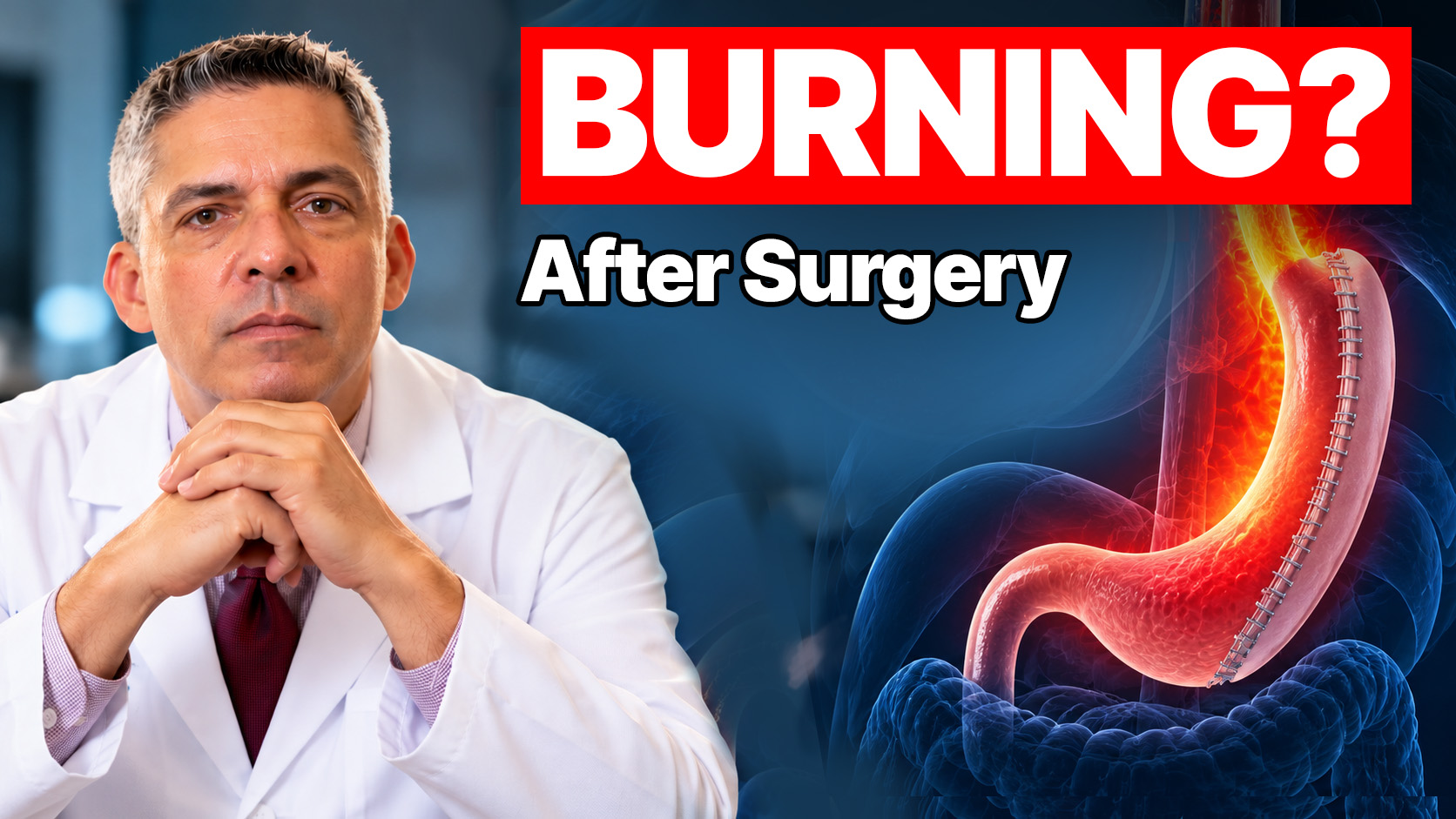
Sleeve gastrectomy is the most commonly performed weight-loss operation in the world, and it works very well for weight loss and metabolic health. Its best-known long-term weakness is acid reflux (gastroesophageal reflux disease, or GERD). A meta-analysis of 46 studies and 10,718 sleeve patients found that reflux appeared for the first time (de novo) in 23% of patients and worsened in another 19% of those who already had it; long-term, esophagitis was found in 28% and Barrett's esophagus in 8%, and 4% of all patients eventually needed conversion to gastric bypass for severe reflux (Yeung et al., Annals of Surgery, 2020).
Randomized trials comparing the sleeve with Roux-en-Y gastric bypass tell the same story. In the Swiss SM-BOSS trial, reflux went into remission in 60% of bypass patients but only 25% of sleeve patients, and it worsened in 32% after the sleeve versus 6% after the bypass (Peterli et al., JAMA, 2018). At 10 years in the Finnish SLEEVEPASS trial, endoscopic esophagitis was found in 31% of sleeve patients versus 7% of bypass patients, although the rate of Barrett's esophagus was low (4%) and similar after both operations (Salminen et al., JAMA Surgery, 2022).
One of the most important facts about reflux after a sleeve is that symptoms do not reliably reflect damage. In a long-term Italian study, new Barrett's esophagus was found in 17.2% of sleeve patients at about five years, and endoscopic findings did not correlate with symptoms; the authors concluded that endoscopic surveillance should be offered whether or not a patient has heartburn (Genco et al., Surgery for Obesity and Related Diseases, 2017).
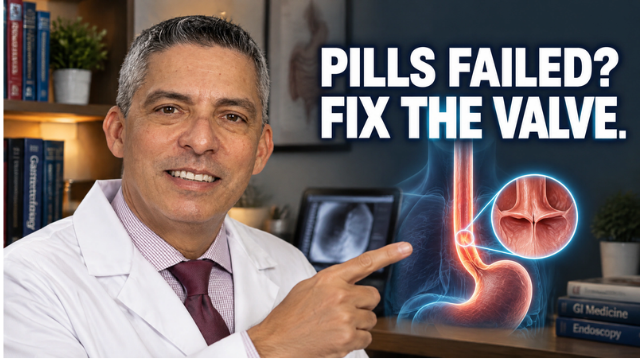
The good news is that reflux after a sleeve is very treatable once the cause is identified. Depending on what is driving it, the answer may be medication, repair of a hiatal hernia, treatment of a narrowing in the sleeve, ligamentum teres cardiopexy, the LINX device, or conversion of the sleeve to a gastric bypass, which remains the most reliable fix. In the video above, Dr. de la Cruz-Muñoz explains why this happens and how each option works.
Why Reflux Happens After a Sleeve
A sleeve gastrectomy removes most of the stomach, including the fundus, and turns the remaining stomach into a narrow tube. Several features of that new anatomy can push acid and food back into the esophagus:
- Higher pressure inside the stomach. A long, narrow tube with little stretch generates higher pressure when you eat, and that pressure looks for the path of least resistance, which is upward into the esophagus.
- Loss of the natural valve. Removing the fundus changes the angle of His and can weaken the muscle fibers that help the lower esophageal sphincter seal the top of the stomach.
- Hiatal hernia. A hiatal hernia, either present before surgery or developing afterward when the upper sleeve slides into the chest, is one of the most common drivers. In Dr. de la Cruz-Muñoz's own research, many hiatal hernias found during sleeve gastrectomy were not identified beforehand on an upper GI series or symptom questionnaire (Ribieras, … de la Cruz-Muñoz, Surgery for Obesity and Related Diseases, 2023).
- Narrowing or twisting of the sleeve. A stricture or a functional twist at the middle of the sleeve (the incisura) creates back-pressure, so food and acid go up instead of down.
- Retained or dilated upper stomach. A pouch of stomach left near the top of the sleeve (a "neofundus") can hold acid right next to the valve.
- Weight regain. Regaining weight raises abdominal pressure and makes reflux worse; see weight regain after sleeve gastrectomy.
Risk Factors
- Reflux, heartburn or regular use of acid-reducing medicine before the sleeve
- A hiatal hernia that was not found or not repaired at the time of the sleeve
- A narrow or twisted sleeve, or a stricture after bariatric surgery
- Weight regain after surgery
- Large late-evening meals, lying down soon after eating, alcohol, smoking, carbonated drinks and caffeine
- Longer time since surgery: reflux after a sleeve tends to become more common as the years go by (Yeung et al., Annals of Surgery, 2020)
Who It Affects
Reflux after a sleeve can affect anyone who has had a sleeve gastrectomy, including patients who never had heartburn before. Roughly one in four sleeve patients develops new reflux, and people who already had reflux are more likely to see it get worse (Yeung et al., Annals of Surgery, 2020). It can appear within the first year or many years later, and it is one of the most common reasons sleeve patients come for revisional bariatric surgery (Clapp et al., Surgery for Obesity and Related Diseases, 2024).
Complications
Untreated reflux after a sleeve is more than an annoyance. Over time, acid exposure can lead to:
- Erosive esophagitis: inflammation and ulcers in the lining of the esophagus
- Barrett's esophagus: a change in the esophageal lining that is a known precursor of esophageal adenocarcinoma (Fisher et al., IFSO Position Statement, Obesity Surgery, 2021)
- Esophageal stricture: scarring that narrows the esophagus and makes food stick
- Laryngopharyngeal reflux: hoarseness, chronic cough, throat clearing and, when regurgitation is severe, aspiration into the lungs
- Poor sleep, dental erosion and a real loss of quality of life
Symptoms
- Heartburn or burning behind the breastbone
- Regurgitation of acid or food, especially when bending over or lying down
- Waking at night coughing or choking
- Sour or bitter taste in the mouth
- Chest pain or pressure after eating
- Hoarseness, sore throat or chronic cough
- Nausea, vomiting or difficulty swallowing
- Needing acid-reducing medicine every day to feel normal
Some patients have significant esophageal damage with very few symptoms, which is why routine endoscopy after a sleeve matters (Genco et al., Surgery for Obesity and Related Diseases, 2017). To understand the difference between ordinary heartburn and true reflux disease, see GERD vs. heartburn vs. acid reflux.
Diagnosis
The goal of testing is to confirm that reflux is really the problem and, just as important, to find out why it is happening, because the cause determines the right fix.
- Upper endoscopy (EGD) looks for esophagitis, Barrett's esophagus, a hiatal hernia, and narrowing or twisting of the sleeve. International guidelines recommend endoscopic surveillance after sleeve gastrectomy even in patients without symptoms (Brown et al., IFSO Position Statement, Obesity Surgery, 2020) (Fisher et al., IFSO Position Statement, Obesity Surgery, 2021).
- Upper GI contrast study shows the shape of the sleeve, a hiatal hernia, a twist, a stricture or a retained upper pouch.
- Ambulatory pH or impedance-pH monitoring (catheter or wireless capsule) measures how much acid actually reaches the esophagus, ideally off acid-reducing medicine.
- High-resolution esophageal manometry checks how well the esophagus squeezes; it is required before procedures such as LINX or a cardiopexy.
- CT scan is occasionally used to clarify complex anatomy before revisional surgery.
Conditions That Can Look Similar
- Sleeve stricture or twist: food intolerance and vomiting that can mimic reflux
- Bile reflux: more typical after a one-anastomosis gastric bypass than after a sleeve
- Ulcers or gastritis
- Reflux hypersensitivity and functional dyspepsia
- Esophageal motility disorders such as jackhammer esophagus, and eosinophilic esophagitis
- Gallbladder disease, and heart-related chest pain, which always needs to be excluded first
Lifestyle Measures
- Eat small meals slowly and stop at the first sense of fullness
- Separate liquids from solids by about 30 minutes
- Do not lie down for at least 3 hours after eating, and avoid late-evening meals
- Raise the head of the bed 6 to 8 inches, or use a wedge pillow
- Limit alcohol, carbonated drinks, caffeine, chocolate, mint, spicy and fatty foods
- Stop smoking
- Protect your weight loss: regaining weight makes reflux worse
These steps help, but they rarely correct a structural cause such as a hiatal hernia or a narrowed sleeve. For more, read Reflux After Bariatric Surgery and the Reflux Surgery Guide.
Treatment Options
There is no single operation that is right for every patient with reflux after a sleeve. The best option depends on the cause, the severity of the reflux, the condition of the esophagus, and whether the patient also wants more weight loss.
1. Medication
Proton pump inhibitors (PPIs) and H2 blockers control symptoms for many patients and are the first step. They do not fix a hiatal hernia, a twisted sleeve or a weak valve, and patients who need high-dose medication indefinitely, or who still have esophagitis or Barrett's esophagus on treatment, should be evaluated for a definitive solution.
2. Correcting the anatomy
When a hiatal hernia is the main problem, hiatal hernia repair after sleeve gastrectomy brings the sleeve back into the abdomen and tightens the opening in the diaphragm. A narrowed or twisted sleeve can often be treated endoscopically with balloon dilation (see gastric sleeve stricture management).
3. Ligamentum teres cardiopexy
Because a sleeve removes the fundus, a traditional Nissen fundoplication usually cannot be built. Ligamentum teres cardiopexy uses a natural ligament from the liver as a sling around the junction of the esophagus and stomach, usually combined with hiatal hernia repair, while keeping the sleeve intact (Runkel et al., Obesity Surgery, 2020).
4. Magnetic sphincter augmentation (LINX)
The LINX device is a ring of magnetic beads placed around the lower esophagus to reinforce the valve. In a prospective multicenter study of 30 sleeve patients, reflux quality-of-life scores improved by about 81% and acid-reducing medication use dropped at one year, with two serious adverse events (6.7%) that resolved (Khaitan et al., Obesity Surgery, 2023). It is best suited to patients with good esophageal motility and no large hiatal hernia.
5. Conversion to Roux-en-Y gastric bypass
Converting the sleeve to a Roux-en-Y gastric bypass is the most reliable and best-studied treatment for reflux after a sleeve. The bypass creates a small, low-pressure pouch that makes very little acid and diverts bile away from the esophagus. Reflux is the reason for about 30% of sleeve-to-bypass conversions (Matar et al., Obesity Surgery, 2021), and in U.S. national data 86% of all sleeve conversions were to a gastric bypass, most often for reflux (Clapp et al., Surgery for Obesity and Related Diseases, 2024). Conversion also adds further weight loss, which makes it especially attractive for patients with both reflux and weight regain. Read more on gastric bypass for GERD.
Options that usually do not help reflux
Conversions that keep the sleeve in place, such as a re-sleeve, SADI-S or duodenal switch, are excellent for weight loss but do not correct sleeve-related reflux and can make it worse. A one-anastomosis gastric bypass carries a risk of bile reflux. Endoscopic options such as Stretta and TIF have limited evidence after a sleeve and are used only in carefully selected patients.
If Barrett's esophagus is found
Barrett's esophagus needs regular surveillance and, if dysplasia is present, endoscopic eradication therapy. Controlling the reflux, most often with conversion to a gastric bypass, is a central part of the plan (Fisher et al., IFSO Position Statement, Obesity Surgery, 2021).
To see what a conversion to gastric bypass involves, watch Sleeve to Gastric Bypass Conversion: 4-Minute Real Surgery Breakdown.
When to See a Doctor
- Heartburn or regurgitation two or more times a week
- You need acid-reducing medicine every day, or it no longer controls your symptoms
- You have never had an endoscopy since your sleeve
- Food sticks, it hurts to swallow, or you are vomiting
Seek emergency care for vomiting blood, black or tarry stools, inability to keep liquids down, or chest pain, which must always be evaluated to rule out a heart problem.
When to Consider Surgery
- Symptoms persist despite medication, or you do not want to take medication for life
- Endoscopy shows significant esophagitis, a stricture or Barrett's esophagus
- Night-time regurgitation, choking or aspiration
- A hiatal hernia or a narrowed or twisted sleeve is found on testing
- You have both reflux and weight regain, in which case conversion to a gastric bypass can address both
Patients from outside South Florida can start with a virtual consultation through the Out-of-Town & Virtual Care program; plan to stay in Miami about 7 to 9 days after surgery.
Long-Term Outlook
Reflux after a sleeve should be managed as a long-term condition. Even patients who feel well benefit from periodic endoscopy, because Barrett's esophagus can develop without symptoms (Genco et al., Surgery for Obesity and Related Diseases, 2017) (Fisher et al., IFSO Position Statement, Obesity Surgery, 2021). Maintaining a healthy weight, staying active in follow-up, and treating reflux early protect the esophagus for life. For a broader view of revision options, see Revisional Bariatric Surgery: A Surgeon's Complete Guide and Bariatric Revision Surgery in Miami.
Related Reading and Videos
Watch The Reflux Talk Every Patient Needs: Hiatal Hernias, Warning Signs & What Doctors Don’t Explain and Robotic Sleeve Gastrectomy with Hiatal Hernia Repair: Posterior Cruroplasty & Esophagopexy on our video library. Treatments that may be involved include Sleeve Gastrectomy to Roux-en-Y Gastric Bypass Conversion, Ligamentum Teres Cardiopexy for Acid Reflux After Sleeve Gastrectomy and Hiatal Hernia Repair After Sleeve Gastrectomy.
Prognosis
The outlook is very good. Most patients improve substantially once the underlying cause is corrected. Conversion to a gastric bypass is the most established surgical fix and the most common revision chosen for sleeve-related reflux (Clapp et al., Surgery for Obesity and Related Diseases, 2024), and procedures that preserve the sleeve, such as cardiopexy and LINX, show encouraging but shorter-term results (Khaitan et al., Obesity Surgery, 2023) (Runkel et al., Obesity Surgery, 2020).
Why Choose Dr. de la Cruz‑Muñoz
Reflux after a sleeve sits exactly where bariatric surgery and foregut surgery meet, and treating it well requires expertise in both. Dr. de la Cruz-Muñoz has been performing bariatric surgery for over 25 years, has performed more than 9,000 bariatric operations and over 15,000 minimally invasive procedures, and does as much foregut and reflux surgery as bariatric surgery. Because he performs every option, from hiatal hernia repair and ligamentum teres cardiopexy to LINX and conversion to gastric bypass, the recommendation is driven by your anatomy and test results rather than by a single technique.
He has also studied this problem directly, including research on detecting hiatal hernias at the time of sleeve gastrectomy (Ribieras, … de la Cruz-Muñoz, Surgery for Obesity and Related Diseases, 2023), long-term outcomes of sleeve gastrectomy with and without hiatal hernia repair (ASMBS 2024), and an invited commentary on sleeve gastrectomy, hiatal hernia repair and GERD. To learn more about the sleeve and the bypass, visit Gastric Sleeve Surgery in Miami and Gastric Bypass Surgery in Miami. To schedule an evaluation, call 305-692-0392 or contact the office.
Patients in the Miami area dealing with reflux after a sleeve can see how we evaluate it locally on our hiatal hernia and reflux surgery in Miami page.
Featured Procedures





FAQ
Yes — conversion to gastric bypass is considered the gold standard for refractory GERD after a sleeve (Cymbal et al., Surgery for Obesity and Related Diseases, 2026). The sleeve creates a narrow, high-pressure stomach tube that commonly causes persistent or new reflux; at 8 years, conclusive GERD was found in about 95% of sleeve patients versus 25% after bypass (Navarini et al., World Journal of Surgery, 2026). Conversion relieves reflux in most patients and gets the majority off antacid medication, and the benefit occurs independent of how much additional weight is lost — patients who meet objective ACG reflux criteria benefit most (Cymbal et al., Surgery for Obesity and Related Diseases, 2026). In conversion series, GERD resolution reaches roughly four in five patients at one year and over nine in ten at two years (Cymbal et al., Surgery for Obesity and Related Diseases, 2026).
A sleeve gastrectomy creates a narrow, high-pressure gastric tube that often causes or worsens acid reflux, and reflux is the single most common reason sleeves are revised (Clapp et al., SOARD, 2024). Converting to a Roux-en-Y gastric bypass creates a small, low-pressure, rapid-emptying pouch and diverts acid and bile away from the esophagus, making it the gold-standard fix for refractory GERD after a sleeve, with symptom resolution reported in 60–100% of patients (Thá Nassif et al., Obesity Surgery, 2025; Rapolti et al., J Laparoendosc Adv Surg Tech, 2024).
Sometimes. Hiatal hernia repair, a ligament wrap, or a magnetic ring can help selected patients, but only if the esophagus squeezes normally and the sleeve is open with no twist or stricture. These options have weaker long-term evidence than conversion to a gastric bypass.
Conversion to Roux-en-Y gastric bypass is generally the most effective option for severe reflux after a sleeve gastrectomy. The bypass lowers pressure in the stomach and diverts acid and bile away from the esophagus, and any hiatal hernia is repaired at the same operation. Conversions such as SADI-S or duodenal switch keep the high-pressure sleeve and are generally not recommended when reflux is the main problem. Testing with endoscopy and sometimes pH monitoring confirms the diagnosis and checks for Barrett's esophagus before surgery.
Cardiopexy is the less invasive, sleeve-preserving option with lower short-term reoperation rates (about 3.4% vs. roughly 6.7%) and a 1.3–1.5 day stay, and it is ideal for patients who have already lost enough weight and simply want to come off reflux medication (Dore and Cherng, JOMI, 2024). Conversion to Roux-en-Y gastric bypass is the more definitive and most evidence-supported treatment for refractory reflux and is preferred when a patient needs more weight loss, has a retained/dilated fundus, has an abnormal sleeve, or has severe disease (Rapolti et al., Journal of Laparoendoscopic & Advanced Surgical Techniques, 2024). The right choice depends on anatomy, weight-loss goals, and reflux severity.
In bariatric series, results are encouraging in the short to medium term: 80–86.6% of patients report improvement or resolution of GERD symptoms, up to 81% reduce or stop acid medication by one year, and gastric migration is prevented in about 93% of patients (Dore and Cherng, JOMI, 2024; Rapolti et al., Journal of Laparoendoscopic & Advanced Surgical Techniques, 2024). The honest caveat is durability: as a standalone reflux operation in non-bariatric patients, cardiopexy underperformed Nissen fundoplication at one year in the only randomized trial, and long-term post-sleeve data are still limited (Janssen et al., British Journal of Surgery, 1993; Runkel et al., Obesity Surgery, 2020).
It is an antireflux operation that uses the round ligament of the liver (the ligamentum teres) as a sling around the lower esophagus to reinforce the reflux valve and anchor the stomach below the diaphragm (Runkel et al., Obesity Surgery, 2020). It matters after a sleeve because the gastric fundus — the part of the stomach used to build a traditional Nissen or Toupet fundoplication — was removed during the sleeve, so a standard wrap is not possible. The round ligament provides alternative tissue to rebuild an antireflux barrier while preserving the sleeve and avoiding conversion to gastric bypass (Dore and Cherng, JOMI, 2024).
Yes, in the right patient. LINX is one of the few good surgical options for reflux after a sleeve. In carefully selected patients it can control symptoms and end daily acid-reducing medication without a larger conversion operation (Grover and Khaitan, Diseases of the Esophagus, 2023; Patel et al., Surgical Endoscopy, 2022). The key word is "selected," and the most important selection criterion is a proven, normally functioning esophagus.
Reflux is common after sleeve gastrectomy, affecting roughly 20–30% of patients over the long term (Vosburg et al., American Society for Metabolic and Bariatric Surgery, 2026). A standard fundoplication such as a Nissen usually is not possible after a sleeve, because the fundus used to build the wrap was removed (Patel et al., Surgical Endoscopy, 2022). LINX avoids that problem. It is a ring of magnetic titanium beads placed laparoscopically around the lower esophageal sphincter to keep a weak valve closed while still allowing swallowing (Khaitan et al., Obesity Surgery, 2023).
Why esophageal function must be proven normal first:
- The esophagus has to open the device. A fundoplication still relaxes naturally when you swallow. The LINX magnets stay closed until food is pushed through them, so all the work falls on the contraction strength of the esophagus (Eriksson et al., Diseases of the Esophagus, 2023).
- Weak or absent peristalsis means trouble swallowing. An esophagus without enough pushing power may not be able to open the magnets, which can cause persistent difficulty swallowing. The FDA instructions for use list these as precautions:
- Distal esophageal contractions weaker than 35 mmHg.
- Fewer than 70% effective (propulsive) swallows.
- Known motility disorders such as achalasia, distal esophageal spasm, nutcracker esophagus, or a hypertensive lower esophageal sphincter (Telem et al., Surgical Endoscopy, 2017).
An esophagus with no peristalsis at all (aperistalsis) rules out LINX (Bell, The Esophagus, 2021).
- Reflux can be mimicked. Achalasia can cause heartburn and regurgitation that look like GERD. Performing an antireflux procedure on a misdiagnosed patient can cause severe swallowing problems. For that reason, the American College of Gastroenterology recommends high-resolution manometry before any antireflux procedure and specifically before LINX (Katz et al., American College of Gastroenterology, 2022).
- Contractile reserve matters. In the prospective post-sleeve LINX study, patients qualified only if they had one of two findings (Novia et al., Surgical Endoscopy, 2025):
- Normal esophageal motility.
- Mildly ineffective motility that still showed adequate strength ("reserve") when tested with multiple rapid swallows.
Patients with achalasia, outflow obstruction at the esophagogastric junction (EGJOO), or aperistalsis were excluded.
When patients are chosen this way, results after a sleeve are encouraging:
- Systematic review: 14 studies and 109 patients. Reflux quality-of-life scores improved markedly (GERD-HRQL 38 → 10), and daily PPI use fell from 97.4% to 25.3% at a median of about 19 months (Cammarata et al., Obesity Surgery, 2024).
- Prospective trial: 30 patients, with a significant reduction in daily PPI use in about 96% at 12 months (Khaitan et al., Obesity Surgery, 2023).
- Other series: One series reported that 82% of patients stopped acid medication (Patel et al., Surgical Endoscopy, 2022). A prospective study showed objective normalization of acid exposure in about 64% (Novia et al., Surgical Endoscopy, 2025).
Other requirements for success:
- Hiatal repair: Repairing the hiatus at the same operation is considered essential (Grover and Khaitan, Diseases of the Esophagus, 2023).
- Relative contraindications: Conversion to gastric bypass is usually the better answer in patients with any of the following (Novia et al., Surgical Endoscopy, 2025):
- BMI of 35 or higher.
- Hiatal hernia larger than about 3 cm.
- Severe (grade C–D) esophagitis.
- Barrett's esophagus.
- A twisted or narrowed sleeve.
- Side effects: Device-related side effects, mostly temporary swallowing difficulty, occur in about a third of patients. Removal for esophageal erosion is rare, at about 0.9% (Cammarata et al., Obesity Surgery, 2024).
Where LINX sits among the options: conversion to Roux-en-Y gastric bypass remains the most effective and most evidence-supported treatment for refractory reflux after a sleeve. It resolves symptoms in 60–100% of patients and is preferred when BMI is above 35, the sleeve anatomy is abnormal, or esophageal function is impaired (Vosburg et al., American Society for Metabolic and Bariatric Surgery, 2026). LINX is best reserved for patients who meet all of these criteria:
- A normal sleeve.
- A BMI under 35.
- Esophageal motility confirmed to be normal on manometry.
- Reflux that persists despite medication.
The decision should follow a complete workup: endoscopy, barium study, pH testing, and high-resolution manometry (Hawasli et al., American Journal of Surgery, 2019; Cammarata et al., Obesity Surgery, 2024).
Usually not. Stretta is generally not a good option for reflux after a sleeve. Reflux is common after sleeve gastrectomy, affecting roughly 20–30% of patients over the long term. Causes include a hiatal hernia, a narrowing or twist of the sleeve, the sleeve moving up into the chest, and the high-pressure tube the sleeve creates working against a weakened lower esophageal sphincter (Vosburg et al., American Society for Metabolic and Bariatric Surgery, 2026).
Stretta tightens and thickens the sphincter muscle with radiofrequency energy. It does not correct any of these anatomic problems. The only published study of Stretta after a sleeve followed 15 patients for 6 months, with these results:
• Reflux symptom scores did not improve significantly.
• Two-thirds of patients were dissatisfied.
• Only 20% were able to stop acid-reducing medication.
• About 13% went on to need conversion to gastric bypass.
• One patient had bleeding after the procedure (Khidir et al., Obesity Surgery, 2018; Rapolti et al., Journal of Laparoendoscopic & Advanced Surgical Techniques, 2024).
SAGES recommends Stretta only for patients who have not had bariatric surgery and do not have a hiatal hernia or severe esophagitis (Rapolti et al., Journal of Laparoendoscopic & Advanced Surgical Techniques, 2024).
For post-sleeve reflux that does not respond to medication, the most effective treatment is usually conversion to Roux-en-Y gastric bypass, which resolves reflux symptoms in 60–100% of patients. Magnetic sphincter augmentation (LINX) and hiatal hernia repair are options for selected patients who are not good candidates for bypass (Vosburg et al., American Society for Metabolic and Bariatric Surgery, 2026). The first step is a thorough evaluation with endoscopy, a barium study, pH testing, and manometry to find the cause of the reflux (El Nakeeb et al., Obesity Surgery, 2022).
Yes. Sleeve gastrectomy can worsen existing reflux or cause new reflux in some patients because it creates a higher-pressure stomach tube and can alter the anti-reflux barrier. Some patients develop erosive esophagitis or Barrett's esophagus, sometimes without symptoms. Patients with significant reflux are often better served by gastric bypass, and reflux after a sleeve can be treated with medication or conversion to bypass.
Yes. Gastric bypass is generally the preferred bariatric operation for patients with reflux, because the small pouch makes little acid and bile is diverted away from the esophagus. Sleeve gastrectomy, in contrast, can worsen existing reflux or cause new reflux in some patients. For patients with significant reflux, a hiatal hernia or Barrett's esophagus, bypass is usually recommended, and patients with reflux after a sleeve often do well with conversion to bypass.
It can. Reflux is the main reason a re-sleeve isn't right for everyone. Making the sleeve narrower again raises pressure inside the stomach, and sleeve anatomy is already linked to reflux. In a 2026 U.S. series of 101 re-sleeve patients, use of reflux medication increased significantly after surgery, although symptoms generally stayed controlled (Ma et al., Surgery for Obesity and Related Diseases, 2026). A network meta-analysis found higher rates of worsening or new reflux after re-sleeve than after conversion to gastric bypass or SADI-S (Salman et al., World Journal of Surgery, 2024).
That is why reflux symptoms, esophagitis, or Barrett's esophagus generally rule out re-sleeve. In those cases, conversion to Roux-en-Y gastric bypass is the preferred operation because it treats both the weight regain and the reflux (Antonopulos et al., Obesity Surgery, 2019). See Sleeve Gastrectomy to Roux-en-Y Gastric Bypass Conversion and Gastric Bypass (Roux-en-Y) for GERD.
It can, and that's why reflux testing comes first.
DS keeps your sleeve and pylorus, so it doesn't remove the high-pressure anatomy that causes reflux after sleeve. In pooled data:
- 18% of patients developed new reflux after DS
- 14% with existing reflux got worse
- About half improved
- 4–12% eventually needed reflux surgery (Brand et al., Surgical Endoscopy, 2025)
If you have reflux, esophagitis, Barrett's esophagus, or a hiatal hernia, conversion to Roux-en-Y gastric bypass is generally the better choice (Merz et al., Surgery for Obesity and Related Diseases, 2019). See Sleeve Gastrectomy to Roux-en-Y Gastric Bypass Conversion.