Sleeve Gastrectomy to SADI-S Conversion

Overview
Sleeve gastrectomy (SG) is the most commonly performed bariatric operation in the world, but it is not always a final destination — more than 20% of sleeve patients ultimately require a revisional procedure for weight regain, inadequate weight loss, or gastroesophageal reflux disease (Małczak et al., Obesity Reviews, 2025). When the dominant problem is weight rather than reflux, the single-anastomosis duodeno-ileal bypass with sleeve (SADI-S) has emerged as the most effective revisional option. Multiple network meta-analyses rank SADI-S highest for both excess weight loss and total weight loss among all sleeve revisions, with complication rates comparable to the alternatives (Małczak et al., 2025; Salman et al., World Journal of Surgery, 2024).
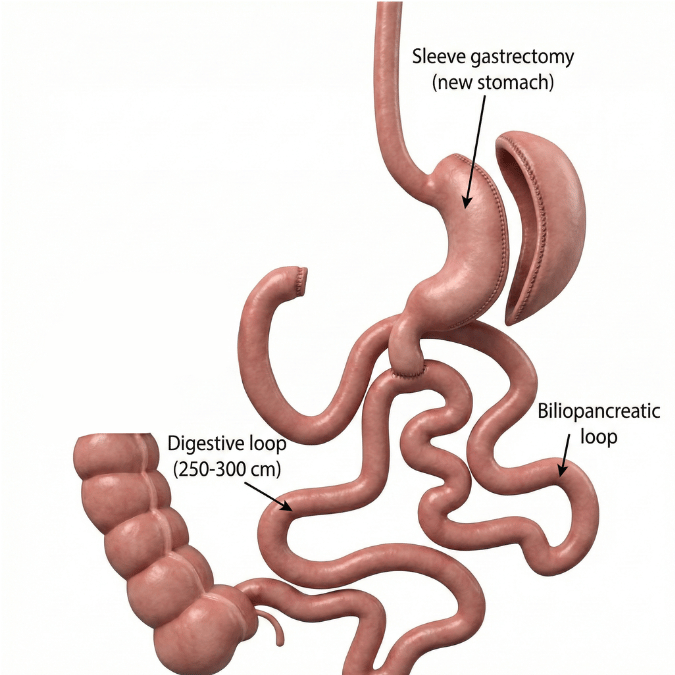
Converting a sleeve to a SADI-S means leaving the existing sleeve in place (sometimes re-sizing it) and adding a malabsorptive intestinal bypass: the duodenum is divided just past the stomach and connected to a loop of ileum, routing food past most of the small intestine. SADI-S is a modern, simplified evolution of the classic biliopancreatic diversion with duodenal switch (BPD/DS), using a single anastomosis instead of two (Ponce de Leon-Ballesteros et al., IFSO Position Statement, 2024; Lee et al., Obesity Surgery, 2025). Because a sleeve already exists, the conversion is technically well suited to this role — the dissection occurs away from the scarred sleeve staple line, and the single duodeno-ileal anastomosis carries a low ulcer risk (Barajas-Gamboa et al., Surgical Endoscopy, 2023). As with all bariatric care, durable results and safe nutritional outcomes depend on being embedded in a multidisciplinary program with lifelong follow-up (Ponce de Leon-Ballesteros et al., 2024).
How the Procedure Works
SADI-S produces weight loss through two combined mechanisms. The sleeve component restricts intake and lowers the hunger hormone ghrelin, and the duodeno-ileal bypass adds significant malabsorption and favorable gut-hormone changes by routing food past most of the small intestine so fewer calories and nutrients are absorbed (Ponce de Leon-Ballesteros et al., 2024). Because a sleeve is purely restrictive, converting to a SADI-S adds a genuinely new, powerful malabsorptive mechanism rather than simply re-restricting the stomach — which is why it produces more additional weight loss than re-sleeving or converting to a gastric bypass (Małczak et al., 2025). The common channel (the final shared segment of intestine) is typically kept at 250–350 cm, a length chosen to balance strong weight loss against the risk of malnutrition (Lee et al., 2025; Noel et al., J Laparoendosc Adv Surg Tech, 2026).
Benefits
- The greatest additional weight loss of any sleeve conversion — network meta-analyses rank SADI-S first for both %EWL and %TWL after a failed sleeve, ahead of OAGB, gastric bypass, and re-sleeve (Małczak et al., 2025; Salman et al., 2024).
- Superior, durable long-term results — in head-to-head data, SADI-S achieves significantly greater excess weight loss, total weight loss, and BMI reduction than gastric bypass at 1, 5, and 7 years (Salama et al., Surgical Endoscopy, 2026).
- High metabolic/diabetes remission — revisional SADI-S is associated with roughly 69% diabetes remission, plus meaningful remission of hypertension, hyperlipidemia, and sleep apnea (Esparham et al., SOARD, 2026).
- A favorable safety profile for a revision — conversion from sleeve to SADI carries 30-day serious-complication rates similar to a primary SADI-S and comparable to other conversions (Barajas-Gamboa et al., 2023; Małczak et al., 2025).
- Low ulcer and favorable reflux profile — the single duodeno-ileal anastomosis has a lower marginal-ulcer risk than a gastric-bypass anastomosis, and network data show lower rates of reflux worsening/de novo reflux than OAGB or re-sleeve (Barajas-Gamboa et al., 2023; Salman et al., 2024).
- Preserves the pylorus — keeping the natural stomach outlet reduces dumping syndrome and marginal ulceration compared with a gastric bypass.
Who Is a Candidate
Sleeve-to-SADI-S conversion is particularly well suited to patients with a prior sleeve gastrectomy who have:
- Significant weight regain or inadequate weight loss — by far the most common indication; in MBSAQIP data, roughly 90% of sleeve-to-SADI conversions were performed for weight recurrence or inadequate weight loss (Barajas-Gamboa et al., 2023; Salas-Parra et al., Surgical Endoscopy, 2026).
- A higher pre-revision BMI — the strong malabsorptive effect is especially advantageous for patients with a higher BMI at conversion, who tend to be routed to SADI-S or BPD/DS rather than a bypass (Salas-Parra et al., 2026; Salama et al., 2026).
- Metabolic disease, particularly type 2 diabetes — where SADI-S delivers among the highest remission rates of any revision (Esparham et al., 2026).
- No significant gastroesophageal reflux — this is the key exclusion. SADI-S does not reliably correct reflux, and many surgeons consider significant GERD a contraindication to this conversion, favoring a Roux-en-Y gastric bypass instead (Barajas-Gamboa et al., 2023; Esparham et al., Obesity Surgery, 2023).
- Willingness and ability to commit to strict lifelong supplementation and monitoring — because the malabsorptive component carries a meaningful nutritional risk (Ponce de Leon-Ballesteros et al., 2024).
A pre-conversion upper GI evaluation and endoscopy are essential to assess the sleeve anatomy and rule out significant reflux or esophagitis before choosing this pathway (Kermansaravi et al., Surgical Endoscopy, 2023).
How the Procedure Is Performed
The operation is performed under general anesthesia using a minimally invasive (laparoscopic or robotic) approach. The existing sleeve is inspected and, if dilated, may be re-sized; the duodenum is then divided just beyond the pylorus, and a loop of ileum is brought up and connected to the duodenum (duodeno-ileostomy) as a single anastomosis, leaving a common channel of roughly 250–350 cm (Lee et al., 2025). Because the areas of dissection lie away from the scarred sleeve staple line, and only one anastomosis is created, the conversion is technically favorable compared with sleeve-to-bypass or sleeve-to-OAGB, which require retro-gastric mobilization and carry higher anastomotic-ulcer risk (Barajas-Gamboa et al., 2023). Operative times are modestly longer than a primary SADI-S (about 157 vs 142 minutes) but serious-complication rates are similar (Barajas-Gamboa et al., Surgical Endoscopy, 2023). Because of the malabsorptive anatomy and reoperative dissection, these cases are best performed at experienced, high-volume centers (Ponce de Leon-Ballesteros et al., 2024).
Risks and Considerations
Sleeve-to-SADI-S conversion is safe but carries the risks of both reoperative surgery and a malabsorptive operation, and these should be discussed candidly. In MBSAQIP data, the 30-day serious-complication rate was about 5.7% for sleeve-to-SADI — not significantly different from primary SADI-S (6.9%) and not an independent predictor of complications on multivariable analysis, with no deaths in the conversion group (Barajas-Gamboa et al., 2023). In a dedicated meta-analysis of revisional SADI-S, the most commonly reported complications were steatorrhea (~11.2%), diarrhea (~8.7%), anemia (~5.7%), GERD (~5.1%), nutritional deficiency (~4.2%), and anastomotic leak (~2.9%) (Esparham et al., SOARD, 2026).
The most important long-term risk is nutritional, because the operation bypasses the duodenum and proximal jejunum where iron, calcium, and fat-soluble vitamins are chiefly absorbed. Reported deficiencies include fat-soluble vitamins (A, D, E), iron, zinc, folate, and vitamin B12, along with anemia and hypoalbuminemia (Ponce de Leon-Ballesteros et al., 2024; Salama et al., 2026). The most serious concern is protein-calorie malnutrition, with a reported risk of roughly 3–10% depending on common-channel length — which is why both the 2020 and 2023 IFSO/ASMBS position statements recommend a minimum common channel of 250 cm, and why strict lifelong supplementation and monitoring are mandatory (Noel et al., 2026; Ponce de Leon-Ballesteros et al., 2024). In rare severe cases, a further operation to lengthen the common channel is required (Lee et al., Obesity Surgery, 2025).
Recovery Timeline
Recovery mirrors a primary SADI-S but with the added considerations of reoperative surgery. Most patients have a short hospital stay followed by a staged diet progression. Early, progressive walking reduces clot risk, and most weight loss occurs over the first 12–18 months. Patients follow the staged bariatric diet and begin a strict lifelong supplementation and follow-up routine immediately — more intensive than after a purely restrictive operation because of the malabsorptive anatomy.
Long-Term Expectations
Sleeve-to-SADI-S conversion produces strong, durable weight loss. In a dedicated meta-analysis of revisional SADI-S after a failed sleeve or band, BMI fell by about 11 kg/m² at 12 months and was sustained at roughly 11 kg/m² at 60 months, with total weight loss of about 23.8% at 1 year, 21.0% at 3 years, and 22.1% at 5 years (Esparham et al., 2026). A five-year cohort of SADI-S conversions reported %TWL maintained above 34% and %EWL consistently above 90% through five years, with every patient reaching five-year follow-up still exceeding the clinically meaningful 20% total weight loss threshold (El-On et al., Obesity Surgery, 2026). Head-to-head against gastric bypass, SADI-S maintains significantly greater excess weight loss, total weight loss, and BMI reduction out to seven years, an advantage attributed to its stronger malabsorptive component (Salama et al., 2026). Longer-term 10-year data suggest the weight-loss advantage of SADI-S over OAGB may narrow over time, so individualized counseling is appropriate (Yahmadi et al., International Journal of Obesity, 2026).
Why Choose Dr. de la Cruz-Muñoz
Revisional SADI-S after a sleeve is a technically demanding, malabsorptive operation; the duodenal division, precise common-channel measurement, and the judgment required to select the right conversion and avoid malnutrition all affect safety and outcomes, and results are strongly tied to surgeon experience and center volume (Ponce de Leon-Ballesteros et al., 2024). Dr. de la Cruz-Muñoz is a board-certified metabolic and bariatric surgeon who performs the full spectrum of revision and conversion procedures, including the advanced malabsorptive conversions (SADI-S and BPD/DS) that relatively few surgeons offer, using minimally invasive and robotic techniques. Every sleeve conversion begins with a complete anatomical and multidisciplinary evaluation, including upper GI study and endoscopy, so the operation is matched precisely to each patient's anatomy, reflux status, BMI, and metabolic needs; and SADI-S is reserved for the weight/metabolic-dominant patients who stand to benefit most while reflux patients are directed to a gastric bypass.
Total Body Weight Loss (TBWL) Expectations
Expect substantial, durable weight loss — the most of any mainstream sleeve conversion. Revisional SADI-S series report roughly 22–24% total weight loss maintained through 5 years (Esparham et al., 2026), and conversion cohorts show %TWL above 34% and %EWL above 90% sustained at 5 years (El-On et al., 2026). Network meta-analysis confirms SADI-S ranks first for both %EWL (mean difference ~14.8%) and %TWL (mean difference ~9.3%) versus other sleeve revisions (Małczak et al., 2025). Individual results depend on starting BMI, common-channel length, the reason for conversion, and adherence to nutrition and supplementation.
Expected Metabolic Improvements
SADI-S produces among the strongest metabolic effects of any bariatric operation. Revisional SADI-S is associated with roughly 69% remission of type 2 diabetes, along with about 41% remission of hypertension, 47% of hyperlipidemia, and 69% of obstructive sleep apnea (Esparham et al., 2026). In primary-SADI-S long-term data, diabetes remission approaches 81% — comparable to BPD/DS and higher than sleeve or gastric bypass (Esparham et al., Obesity Surgery, 2023). SADI-S also produces greater reductions in total cholesterol and triglycerides than gastric bypass over long-term follow-up (Salama et al., 2026). This makes SADI-S an especially attractive conversion when metabolic disease — particularly diabetes — is a major concern.
Weight Regain Prevention Strategy
Durable results require a lifelong plan: protein-prioritized nutrition, strict daily supplementation, regular physical activity, and multidisciplinary behavioral follow-up. SADI-S's strong malabsorptive component gives it an inherent durability advantage over restrictive conversions (Salama et al., 2026), but that advantage is only realized with consistent follow-up and supplementation. If weight regain occurs despite an intact SADI-S, options are limited and specialized (further lengthening or revision), so prevention through adherence is paramount; anti-obesity medications (including GLP-1 therapy) can be layered on when appropriate to protect results.
GERD / Reflux Considerations
This is the single most important factor in choosing SADI-S versus a gastric bypass. SADI-S does not reliably correct reflux, and significant pre-existing GERD is considered a contraindication by many surgeons, who route reflux patients to a Roux-en-Y gastric bypass instead — in one series, GERD accounted for only 2.7% of sleeve-to-SADI indications and is treated as a contraindication in that practice (Barajas-Gamboa et al., 2023). That said, network meta-analysis data show SADI-S has significantly lower rates of reflux worsening or de novo reflux than OAGB or re-sleeve, because it preserves the pylorus and does not create a bile-exposed anastomosis near the esophagus (Salman et al., 2024). A pre-conversion endoscopy and reflux assessment are essential; patients whose dominant problem is reflux should be converted to a gastric bypass rather than SADI-S (Kermansaravi et al., 2023).
Revision Options
Sleeve-to-SADI-S is one of several conversion pathways after a failed sleeve; the correct choice depends on whether the problem is weight, reflux, or both, and on BMI and metabolic disease:
- Sleeve → SADI-S (this page) — ranked highest for additional weight loss and among the highest for diabetes remission; best when weight/metabolic disease is the issue and there is no significant reflux (Małczak et al., 2025; Salman et al., 2024).
- Sleeve → Roux-en-Y gastric bypass — the gold standard when reflux is the dominant problem; more modest additional weight loss than SADI-S (Salama et al., 2026).
- Sleeve → one-anastomosis gastric bypass (OAGB) — strong weight loss but more associated reflux/bile reflux than SADI-S (Salman et al., 2024).
- Sleeve → BPD/DS — the classic two-anastomosis duodenal switch; powerful for higher-BMI patients but technically more complex than SADI-S.
- Re-sleeve (repeat sleeve gastrectomy) — the lowest-morbidity option but the least durable weight loss and highest reflux rate (Salman et al., 2024).
See the Revision Bariatric Surgery hub and the dedicated sub-pages for each pathway.
Body Composition & Muscle Preservation
As with any weight-loss operation — and especially a malabsorptive one — a portion of the weight lost is lean mass, so protecting muscle is critical. A high daily protein intake (generally ≥60–80 g/day, and often higher after a malabsorptive procedure), resistance training, and body-composition monitoring help ensure the weight lost is predominantly fat, preserving metabolic rate and supporting durable results. Because SADI-S malabsorbs protein and fat, meeting protein targets and monitoring albumin are especially important to avoid protein-calorie malnutrition (Ponce de Leon-Ballesteros et al., 2024).
Insurance & Qualification Requirements
Coverage for revision surgery is more restrictive and variable than for primary procedures, and some payers consider SADI-S investigational, which can add an additional authorization hurdle. Many plans require documentation of the original sleeve, objective evidence of weight regain or inadequate weight loss (and the absence of untreated reflux), and a repeat preoperative work-up; some policies will not cover a second weight-loss procedure performed solely for weight-loss failure. Our team handles the documentation needed to establish medical necessity.
Preparing for Surgery (Pre-Op Requirements)
Sleeve-to-SADI-S conversion requires a more detailed work-up than a first operation. This includes an upper GI contrast study and endoscopy to assess sleeve anatomy, rule out significant reflux or esophagitis (which would redirect the patient to a gastric bypass), and confirm the indication (Kermansaravi et al., 2023). A complete multidisciplinary evaluation (nutritional, behavioral/psychosocial, and medical optimization), thorough baseline nutritional labs including fat-soluble vitamins, iron studies, B12, folate, zinc, and albumin, correction of any pre-existing deficiencies, smoking cessation, and cardiac, pulmonary, and sleep-apnea evaluations are arranged as indicated. Counseling on the lifelong, strict supplementation regimen required after a malabsorptive operation is an essential part of preparation (Ponce de Leon-Ballesteros et al., 2024).
Post-Op Nutrition Overview
Patients follow the staged bariatric diet (clear liquids → full liquids → pureed → soft → regular textures) over several weeks, with emphasis on high protein intake, hydration, and small portions. Because SADI-S is a strongly malabsorptive operation that bypasses the duodenum and proximal jejunum, lifelong, high-dose supplementation and routine lab monitoring are mandatory — including fat-soluble vitamins (A, D, E, K), iron, calcium, vitamin B12, folate, and zinc — with vigilance for anemia, hypoalbuminemia, and protein-calorie malnutrition (Ponce de Leon-Ballesteros et al., 2024; Rao et al., Obesity Surgery, 2023). Structured supplementation programs and regular dietitian follow-up have been shown to keep fat-soluble vitamin levels within range through four years (Rao et al., 2023).
Post-Op Activity & Exercise Guidance
Early, progressive walking reduces clot risk and speeds recovery. Patients gradually resume normal activity over the first few weeks, avoid heavy lifting during initial healing, and transition into a combined aerobic and resistance-training program to preserve lean muscle mass and support durable weight loss — particularly important given the malabsorptive nature of this procedure.
Special Considerations for International Patients
Traveling to Miami for a sleeve‑to‑SADI conversion requires a bit of extra planning, but our program is built to make the process smooth and safe.
Pre‑Arrival Evaluation Most of the decision‑making happens before you travel. We review your sleeve history, weight‑regain pattern, reflux symptoms, labs, and any prior imaging through a virtual consult.
Consolidated Testing in Miami All pre‑operative testing is scheduled within 1–2 days after you arrive. Most patients come 2–3 days before surgery.
Recommended Length of Stay Plan for 7–10 days in Miami total. This allows for surgery, early recovery, and a postoperative check before flying home.
Postoperative Monitoring You’ll receive daily virtual follow‑ups, hydration and nutrition guidance, and a direct contact line for urgent concerns once you return home.
Long‑Term Care Abroad SADI‑S requires lifelong vitamin supplementation and periodic labs. We coordinate testing with your local physician and review results virtually.
Travel Support We assist with lodging recommendations, medical travel documentation, and—if needed—letters for visa or work‑leave purposes.
Quick Procedure Details
Pre-authorization requirements differ widely by plan and are generally stricter than for first-time surgery; some payers additionally classify SADI-S as investigational. Expect documentation of the original sleeve, objective proof of weight regain or inadequate weight loss, and often a repeat supervised evaluation; some policies exclude a second weight-loss procedure entirely. Our office verifies benefits and builds the medical-necessity case for each patient.
Featured Procedures


Conditions



FAQ
When the problem is weight regain or inadequate weight loss (not reflux), especially if the intitial BMI was greater than 50, SADI-S produces more additional weight loss than a gastric bypass. Network meta-analyses rank SADI-S highest for both excess and total weight loss among all sleeve revisions, and head-to-head data show SADI-S maintains significantly greater weight loss and BMI reduction than gastric bypass out to seven years, thanks to its stronger malabsorptive component (Małczak et al., Obesity Reviews, 2025; Salama et al., Surgical Endoscopy, 2026). Gastric bypass remains the better choice when reflux is the dominant problem.
Yes. In national MBSAQIP data, sleeve-to-SADI conversion had a 30-day serious-complication rate of about 5.7% — not significantly different from a primary SADI-S and not an independent predictor of complications, with no deaths in the conversion group (Barajas-Gamboa et al., Surgical Endoscopy, 2023). Because the dissection occurs away from the scarred sleeve staple line and only one anastomosis is created, it has a favorable technical profile among conversions. The main long-term risk is nutritional, requiring strict lifelong supplementation (Ponce de Leon-Ballesteros et al., Obesity Surgery, 2024).
Sleeve-to-SADI-S produces the greatest additional weight loss of any mainstream sleeve revision. Revisional SADI-S series report about 22–24% total weight loss maintained through five years, and conversion cohorts show excess weight loss consistently above 90% at five years, with every patient still exceeding 20% total weight loss at that point (Esparham et al., SOARD, 2026; El-On et al., Obesity Surgery, 2026). Individual results depend on starting BMI, common-channel length, and adherence.
SADI-S bypasses the duodenum and upper small intestine, so lifelong deficiencies of fat-soluble vitamins (A, D, E, K), iron, calcium, B12, folate, and zinc are possible, along with a 3–10% risk of protein-calorie malnutrition depending on common-channel length — which is why strict supplementation and monitoring are mandatory (Ponce de Leon-Ballesteros et al., Obesity Surgery, 2024; Noel et al., J Laparoendosc Adv Surg Tech, 2026). SADI-S does not reliably fix reflux, so patients with significant GERD are generally better served by a gastric bypass instead (Barajas-Gamboa et al., Surgical Endoscopy, 2023).