When Does Acid Reflux Need Surgery? A Guide to Your Options (Nissen, Toupet, LINX, and TIF)

Quick Answer
Watch Related Video
Article
If you've been on a proton pump inhibitor (PPI) for years and still feel the burn, still taste acid in your throat at night, or still clear your throat a hundred times a day — you are not imagining it, and you are not alone. Roughly a third of people with reflux never get full relief from medication, and for many of them, the problem was never the acid itself. It was the valve.
This post walks through exactly when acid reflux crosses the line from "manage with pills" to "fix with a procedure," who qualifies, what testing comes first, and how the four main surgical options actually differ. The goal is simple: by the end, you should be able to have a real, informed conversation with a foregut surgeon about which path fits you.
Understanding the Biology Behind the Condition
To understand why surgery works when medication fails, you have to understand what reflux actually is. At the junction between your esophagus and your stomach sits the lower esophageal sphincter (LES) — a ring of muscle that is supposed to stay closed and only open when you swallow. Working alongside it is the diaphragm, which wraps around the esophagus at the same spot and acts as a second, external valve.
In GERD, that antireflux barrier fails mechanically. The LES weakens or relaxes at the wrong times, and very often a hiatal hernia develops — a condition where the top of the stomach slides up through the diaphragm into the chest, pulling the two valves apart so they no longer reinforce each other. Once that barrier is broken, stomach contents wash back up into the esophagus, throat, and airway.
Here is the key insight: a PPI does not repair any of this. It simply makes the refluxing fluid less acidic. The fluid still refluxes — which is why patients on maximal medication can still have regurgitation, cough, hoarseness, and a sensation of things coming back up. Medication treats the acid; it does not treat the valve. Surgery is the only category of treatment that actually restores the mechanical barrier (Fass, New England Journal of Medicine, 2022).
When Reflux Has Crossed Into Surgical Territory
The American College of Gastroenterology's GERD guideline recommends antireflux surgery, performed by an experienced surgeon, as an option for long-term treatment of patients with objective evidence of GERD — and it specifically highlights those with severe reflux esophagitis (LA grade C or D), large hiatal hernias, and/or persistent, troublesome symptoms (Katz et al., American College of Gastroenterology, 2022). In practice, the following profiles are the ones most likely to benefit:
- Incomplete control despite optimized therapy. You're taking a PPI correctly — once or twice daily, 30 to 60 minutes before meals — and still have breakthrough symptoms, especially regurgitation, which responds to acid suppression far less well than heartburn does.
- Effective medication you want to stop. The pills work, but you don't want to take them for the next 40 years — whether because of cost, side-effect concerns, or simply preference. Surgery is a legitimate, guideline-endorsed alternative to lifelong medication, not merely a last resort.
- Regurgitation as a dominant symptom. Because regurgitation is a mechanical problem, it is one of the strongest signals that a mechanical fix is warranted. The ACG specifically recommends considering magnetic sphincter augmentation as an alternative to fundoplication for patients with regurgitation who fail medical management (Katz et al., American College of Gastroenterology, 2022).
- A sizable hiatal hernia. Once a hernia is present, no amount of medication puts the stomach back below the diaphragm. Repairing the hernia and reconstructing the valve is a surgical task.
- Severe esophagitis or complications. LA grade C/D esophagitis, peptic stricture, or Barrett's esophagus all signal aggressive, uncontrolled reflux where durable barrier restoration matters most.
- Atypical and airway symptoms (with proof). Chronic cough, hoarseness, laryngopharyngeal symptoms, or aspiration — but only when reflux has been objectively confirmed as the cause, because these symptoms respond less predictably to surgery than classic heartburn and regurgitation do.
Testing Comes First — Always
No one should go to the operating room on symptoms alone. The single most important principle in antireflux surgery is objective confirmation of GERD before committing to a procedure. Standard preoperative workup typically includes upper endoscopy (to assess esophagitis, hernia size, and Barrett's), ambulatory pH or pH-impedance monitoring off medication (to prove abnormal acid exposure and correlate symptoms with reflux events), and esophageal high-resolution manometry (to measure how well the esophagus squeezes). That motility study is not optional box-checking — it is what determines whether a full wrap is safe or whether a partial wrap is the smarter choice.
Relative contraindications flagged in the 2026 JAMA review include prior upper abdominal surgery, a BMI above 35, esophageal dysmotility, a normal esophageal pH study, atypical symptoms such as bloating or epigastric pain, and symptoms that never responded to PPIs at all — because a patient whose symptoms didn't improve on medication is less likely to improve after surgery (Thrumurthy et al., JAMA, 2026). Notably, in patients with obesity, the ACG suggests Roux-en-Y gastric bypass as a reflux-directed option, since it addresses both weight and reflux in one operation (Katz et al., American College of Gastroenterology, 2022).
The Four Main Options
1. Nissen (360°) fundoplication — the gold standard. The surgeon repairs the hiatal hernia and wraps the upper stomach a full 360 degrees around the lower esophagus, rebuilding a one-way valve. It is the most thoroughly studied antireflux operation in existence. A 2026 systematic review and meta-analysis of 1,334 patients followed for an average of 13 years found heartburn dropped from 94% to 34%, regurgitation from 69% to 13%, and esophagitis from 62% to 7%, with 87% of patients satisfied and 87% willing to undergo the operation again (Principe et al., Annals of Surgery, 2026). The trade-off is mechanical side effects: in that long-term data, gas-bloat occurred in roughly half and some dysphagia in about a quarter, though reoperation was needed in only about 6% (Principe et al., Annals of Surgery, 2026).
2. Toupet (270°) partial fundoplication — the motility-friendly wrap. Here the stomach is wrapped only partially (about 270 degrees), which provides strong reflux control while leaving a "release valve" that reduces postoperative swallowing difficulty and gas-bloat. This is typically the wrap of choice when manometry shows weak or impaired esophageal motility. A randomized-trials network meta-analysis found the Toupet had a higher probability of the lowest postoperative dysphagia rates compared with Nissen and anterior wraps, while delivering similar control of heartburn and regurgitation (Rausa et al., Langenbeck's Archives of Surgery, 2023).
3. Magnetic sphincter augmentation (LINX) — the "valve bracelet." A flexible ring of titanium-encased magnetic beads is placed laparoscopically around the gastroesophageal junction. The magnets keep the valve closed at rest but separate to let food pass when you swallow. It is less anatomically disruptive than a wrap and is specifically endorsed by the ACG as an alternative to fundoplication for regurgitation-predominant patients who fail medical therapy (Katz et al., American College of Gastroenterology, 2022). It is generally best suited to smaller hernias and preserved motility.
4. Transoral incisionless fundoplication (TIF) — the no-incision option. Performed entirely through the mouth with an endoscopic device, TIF rebuilds a partial valve without any abdominal incisions. The ACG suggests it for patients with troublesome regurgitation or heartburn who do not want surgery and who do not have severe esophagitis (LA grade C/D) or a hiatal hernia larger than 2 cm (Katz et al., American College of Gastroenterology, 2022). In a network meta-analysis, TIF showed the highest probability of symptom-based quality-of-life improvement, while laparoscopic Nissen was the strongest at correcting the underlying physiology — higher LES pressure and lower acid exposure — reflecting TIF's role as a less invasive, anatomy-limited option (Richter et al., Gastroenterology, 2018).
What Surgery Can and Can't Promise
Antireflux surgery is highly effective and durable, but it is not magic. Across randomized trials, 10-year patient satisfaction exceeds 90% and symptom relief reaches up to 92%, yet up to 20% of patients experience some symptom recurrence within a decade, and a small percentage return to medication or require revision (Thrumurthy et al., JAMA, 2026). The honest framing is this: surgery offers the best chance of getting off medication and controlling regurgitation, in exchange for accepting a well-defined set of mechanical side effects and a small recurrence risk. Choosing the right procedure for the right anatomy — which is exactly what preoperative testing determines — is what tilts the odds in your favor.
Further Information
Medical Topics Covered
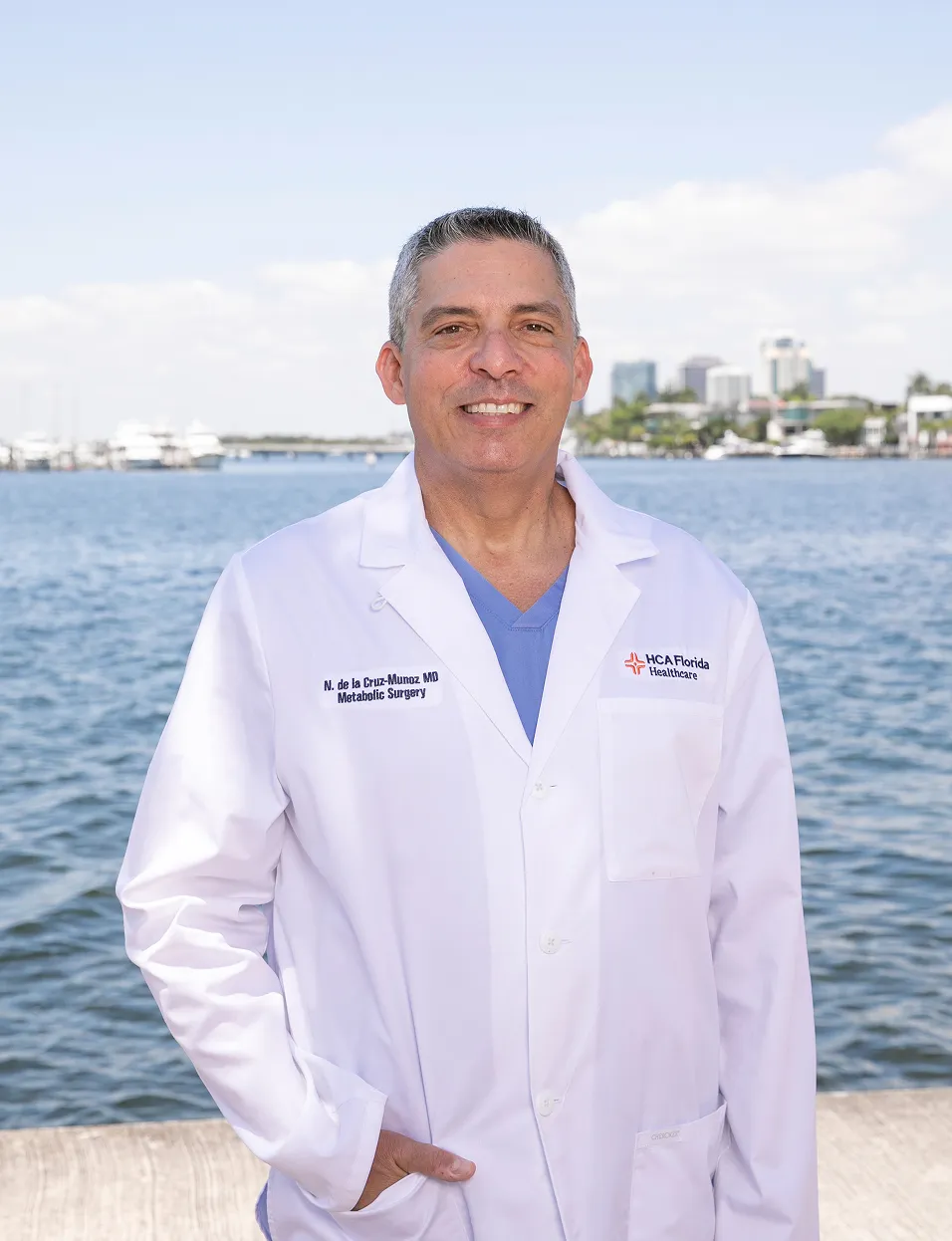

Dr. de la Cruz‑Muñoz specializes in advanced minimally invasive and robotic surgery, metabolic disease management, and comprehensive long‑term patient care. His work integrates clinical expertise, academic leadership, and a commitment to evidence‑based medicine. He has trained surgeons across the country, contributed to national guidelines, and is widely regarded for his outcomes, innovation, and patient‑centered approach.
Patients choose Dr. de la Cruz‑Muñoz for his combination of surgical excellence, metabolic expertise, and lifelong dedication to improving patient health through compassionate, high‑quality care.
Procedures We Offer


Conditions


FAQ
Most patients can. In long-term data following Nissen fundoplication for more than a decade, the majority remained off acid-suppressing medication, though roughly a quarter resumed PPI use at some point (Principe et al., Annals of Surgery, 2026). Getting off lifelong medication is one of the most common reasons patients choose surgery in the first place.Most patients can. In long-term data following Nissen fundoplication for more than a decade, the majority remained off acid-suppressing medication, though roughly a quarter resumed PPI use at some point (Principe et al., Annals of Surgery, 2026). Getting off lifelong medication is one of the most common reasons patients choose surgery in the first place.
Neither is universally "better" — it depends on your esophageal motility. The Nissen (360°) gives the strongest reflux control but more gas-bloat and swallowing side effects, while the Toupet (270°) lowers those side effects and is favored when manometry shows weak esophageal squeeze, with comparable control of heartburn and regurgitation (Rausa et al., Langenbeck's Archives of Surgery, 2023). This is precisely why preoperative manometry is essential.
For the right patient, yes. LINX (magnetic sphincter augmentation) is endorsed as an alternative to fundoplication for regurgitation that fails medication, and TIF is an incisionless option for milder disease — but TIF is not appropriate for severe esophagitis (LA grade C/D) or hiatal hernias larger than 2 cm (Katz et al., American College of Gastroenterology, 2022). Both require objective testing first.
People Also Ask
Obesity is recognized as a chronic metabolic disease influenced by genetics, hormones, environment, and biological factors — not simply lifestyle choices.
The body has built-in mechanisms that defend weight, including hunger hormones and metabolic adaptations that make long-term weight loss challenging.
Yes. Genetics can significantly influence body weight regulation, appetite, metabolism, and an individual's susceptibility to obesity.
GLP-1 medications help regulate appetite, slow stomach emptying, improve satiety, and support sustainable weight management.
Yes. Obesity is associated with conditions such as Type 2 diabetes, hypertension, sleep apnea, fatty liver disease, and cardiovascular disease.
Dieting alone often cannot overcome the biological adaptations that increase hunger and decrease energy expenditure after weight loss.
Medical evaluation may be appropriate when excess weight affects health, quality of life, or contributes to obesity-related medical conditions.
Yes. Bariatric surgery addresses biological and metabolic factors involved in obesity and can lead to significant long-term health improvements.