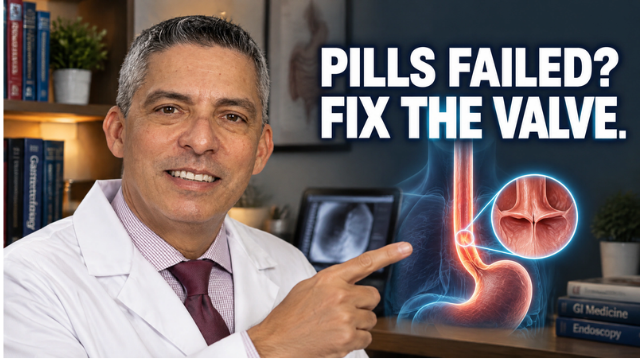
Transoral Incisionless Fundoplication (TIF) for Acid Reflux — Scarless GERD Surgery


Overview
Transoral incisionless fundoplication (TIF) is an endoscopic antireflux procedure in which a proprietary device affixed to a gastroscope is used to internally wrap and fasten the gastric fundus around the lower esophagus, recreating an antireflux valve at the gastroesophageal junction (GEJ) — all through the mouth, with no abdominal incisions (Thrumurthy et al., JAMA, 2026). The modern TIF 2.0 technique plicates the fundus with multiple nonabsorbable fasteners to construct a 3-to-5-cm valve taking in 180°–270° of the esophageal circumference (Maret-Ouda et al., JAMA, 2020).
TIF occupies a distinct niche within the antireflux spectrum. Because it is purely endoscopic, it leaves no scars, does not divide any tissue, and does not permanently alter the stomach — preserving every future option, including LINX or a laparoscopic fundoplication if needed later. In randomized data, TIF reliably controls troublesome regurgitation and improves GERD-related quality of life compared with sham or continued PPI therapy (Thrumurthy et al., JAMA, 2026; Lee and Chang, Digestive Diseases and Sciences, 2022). A sham-controlled trial of 129 patients with refractory GERD found that TIF eliminated troublesome regurgitation in 67% of patients versus 45% with sham-plus-PPI (P = .02), with a low adverse-event profile (Thrumurthy et al., JAMA, 2026).
Patient selection is the key to success, and TIF has clear anatomic limits. The American College of Gastroenterology recommends TIF for patients with confirmed GERD who do not have a significant hiatal hernia (length >2 cm or Hill grade III/IV) or severe reflux esophagitis (LA grade C or D), who have had GERD symptoms and PPI use for 6 months or longer, who are regurgitation-predominant, and who prefer to avoid long-term PPIs or conventional antireflux surgery (Thrumurthy et al., JAMA, 2026). For patients who do have a larger hiatal hernia, the hernia can be repaired laparoscopically and the TIF performed in the same session — a hybrid called concomitant TIF (cTIF) — which extends the benefits of an incision-sparing valve to a broader group (Jaber et al., Surgical Endoscopy, 2024).
How the Procedure Works
Reflux occurs when the antireflux barrier at the GEJ fails. TIF rebuilds that barrier from the inside, without external incisions or tissue division (Maret-Ouda et al., JAMA, 2020):
- Reconstructing the valve: The device draws the gastric fundus up alongside the distal esophagus and fastens serosa-to-serosa plications (including the muscle layers), constructing a partial fundoplication valve 3–5 cm long and 180°–270° around the GEJ (Maret-Ouda et al., JAMA, 2020).
- Restoring the flap valve: By tightening and lengthening the intra-abdominal esophagus and recreating the acute angle of His, TIF restores a competent one-way flap valve and augments lower esophageal sphincter function (Richter et al., Gastroenterology, 2018).
- Reducing reflux episodes: The reconstructed valve reduces both acid and non-acid reflux episodes — addressing the mechanical cause of reflux rather than merely suppressing acid, which is why it is especially effective against regurgitation (Thrumurthy et al., JAMA, 2026).
- Addressing the hernia when needed (cTIF): Because TIF itself does not fix a hiatal hernia, patients with a hernia larger than 2 cm first undergo a laparoscopic hiatal hernia and crural repair, after which the TIF valve is constructed in the same session (Jaber et al., Surgical Endoscopy, 2024).
Benefits
- No incisions and no scars — the entire procedure is performed through the mouth, avoiding abdominal wounds (Thrumurthy et al., JAMA, 2026).
- Superior control of regurgitation — TIF eliminated troublesome regurgitation in 67% of patients versus 45% with sham-plus-PPI, and is particularly effective for regurgitation and extra-esophageal symptoms (Thrumurthy et al., JAMA, 2026; Vaezi et al., Gastroenterology, 2020).
- Freedom from or reduction of daily PPIs in a large proportion of carefully selected patients, with durable quality-of-life improvement (Lee and Chang, Digestive Diseases and Sciences, 2022; Vaezi et al., Gastroenterology, 2020).
- No permanent alteration of the stomach and no tissue division — preserving native anatomy and leaving future antireflux options (LINX, laparoscopic fundoplication) open (Rabach et al., Current Opinion in Gastroenterology, 2019).
- Low rate of side effects — unlike fundoplication, TIF is associated with low rates of long-term dysphagia and gas-bloat because it is a partial, internally constructed valve (Thrumurthy et al., JAMA, 2026).
- Very high procedural success and favorable safety — the largest meta-analysis of TIF 2.0 reported a 99% immediate procedural success rate with adverse events in about 2% of cases (Vaezi et al., Gastroenterology, 2020).
- A single-session hybrid option (cTIF) for patients with a hiatal hernia, combining laparoscopic hernia repair with an incisionless valve (Jaber et al., Surgical Endoscopy, 2024).
Who Is a Candidate
TIF is appropriate for a carefully selected subset of patients with objectively confirmed GERD (Thrumurthy et al., JAMA, 2026; Katz et al., American College of Gastroenterology, 2022):
- Confirmed GERD with symptoms and PPI use for 6 months or longer.
- Regurgitation-predominant GERD — the symptom profile that responds best to TIF (Thrumurthy et al., JAMA, 2026).
- A preference to avoid lifelong PPIs or conventional antireflux surgery, including patients with a partial but incomplete response to PPIs (Vaezi et al., Gastroenterology, 2020).
- Favorable anatomy — no significant hiatal hernia (standalone TIF requires a hernia ≤2 cm and Hill grade I/II) and no severe esophagitis (Katz et al., American College of Gastroenterology, 2022).
Standalone TIF is not appropriate when there is a hiatal hernia larger than 2 cm (Hill grade III/IV), severe erosive esophagitis (LA grade C or D), long-segment Barrett's esophagus, an esophageal stricture, or a BMI over 35 (Vaezi et al., Gastroenterology, 2020). Esophageal motility disorders — including achalasia and absent peristalsis (scleroderma esophagus) — must be excluded, and most experienced practitioners do not offer TIF/cTIF to patients with absent peristalsis (Gioe et al., Surgical Endoscopy, 2026; Yadlapati et al., American Gastroenterological Association, 2022). Patients who fall outside the standalone criteria because of a larger hernia may instead be candidates for cTIF, which combines a laparoscopic hernia repair with the TIF valve (Jaber et al., Surgical Endoscopy, 2024). Notably, TIF/cTIF can also be an option for selected patients with a prior lower-esophageal-sphincter intervention or a failed fundoplication (Gioe et al., Surgical Endoscopy, 2026).
How the Procedure Is Performed
TIF is performed under general anesthesia, entirely endoscopically through the mouth; cTIF adds a laparoscopic hernia-repair phase first (Jaber et al., Surgical Endoscopy, 2024; Maret-Ouda et al., JAMA, 2020):
- Hiatal hernia repair (cTIF only): For patients with a hernia larger than 2 cm, a laparoscopic hiatal hernia reduction and crural repair is performed first to restore normal GEJ anatomy (Jaber et al., Surgical Endoscopy, 2024).
- Endoscopic access: The TIF device, mounted on a gastroscope, is passed through the mouth into the stomach — no incisions are made for the TIF itself.
- Retroflexion and tissue capture: Under direct endoscopic vision, the device is retroflexed to engage the fundus and the distal esophagus at the GEJ.
- Valve construction: The fundus is drawn up and plicated against the esophagus, and multiple nonabsorbable fasteners are deployed in a circumferential pattern to create a partial valve 3–5 cm long, taking in roughly 180°–270° of the circumference (Maret-Ouda et al., JAMA, 2020).
- Confirmation and completion: Valve geometry and integrity are confirmed endoscopically; the device is withdrawn. There is nothing to close, as no incisions were made for the TIF portion.
The TIF portion is typically completed within about an hour; cTIF adds the time required for the laparoscopic hernia repair.
Risks and Considerations
TIF has a favorable safety profile, with most adverse events mild and transient, but risks exist (Thrumurthy et al., JAMA, 2026):
- Temporary dysphagia, nausea, and post-procedure chest or abdominal pain — generally mild and short-lived (dysphagia ~2.3%, nausea ~1.1%, temporary abdominal pain ~2.3% in the randomized TIF arm) (Thrumurthy et al., JAMA, 2026).
- Serious adverse events (perforation, bleeding) are uncommon — about 2.4% in a systematic review, and roughly 2% in the largest TIF 2.0 meta-analysis (Katz et al., American College of Gastroenterology, 2022; Vaezi et al., Gastroenterology, 2020).
- Attenuation of efficacy over time — reflux control tends to wane over the years, and many patients resume some PPI use (often at a lower dose) during long-term follow-up; in one RCT, esophageal pH normalized in only 29% at 12 months and 61% resumed PPIs (Maret-Ouda et al., JAMA, 2020; Vaezi et al., Gastroenterology, 2020).
- Weaker objective acid control than laparoscopic Nissen fundoplication — network meta-analysis found TIF produced the largest quality-of-life improvement but ranked below Nissen (and PPIs) for normalizing esophageal acid exposure and LES pressure (Richter et al., Gastroenterology, 2018).
- Need for a subsequent antireflux operation — a minority of patients remain unresponsive and proceed to fundoplication (Maret-Ouda et al., JAMA, 2020).
- cTIF-specific risks — those of the added laparoscopic hernia repair, with a median early-complication rate of 4.4% and 30-day readmission rate of 3.3% in systematic review (Jaber et al., Surgical Endoscopy, 2024).
Recovery Timeline
Recovery is typically fast, reflecting the incisionless nature of the procedure:
- Discharge: Many patients go home the same day or after a short stay; in a large multicenter cTIF cohort, the median length of stay was about 23 hours (Kolb et al., Journal of the American College of Surgeons, 2026).
- Diet: A staged diet (liquids advancing to soft foods and then regular food over several weeks) protects the healing valve.
- Activity: Because there are no abdominal incisions for standalone TIF, patients generally return to light activity quickly; cTIF patients follow the lifting and activity restrictions of a laparoscopic hernia repair.
- Return to work: Many patients return to desk work within several days to about a week.
Long-Term Expectations
Most appropriately selected patients achieve durable improvement in heartburn and regurgitation and reduce or stop daily PPIs, with sustained quality-of-life gains reported at 3 and 5 years and in some patients out to 8–10 years (Vaezi et al., Gastroenterology, 2020; Lee and Chang, Digestive Diseases and Sciences, 2022). However, GERD is a chronic disease and TIF's effect attenuates over time: the majority of patients resume some PPI use during long-term follow-up, usually at lower doses than before, and objective acid-exposure normalization is less consistent than with a laparoscopic Nissen (Vaezi et al., Gastroenterology, 2020; Richter et al., Gastroenterology, 2018). The consistent theme is that TIF trades some durability and objective acid control for the advantages of no incisions, preserved anatomy, and fewer long-term side effects — a worthwhile trade for the right patient, and a decision best made after a complete objective workup (Katz et al., American College of Gastroenterology, 2022).
Why Choose Dr. de la Cruz-Muñoz
Offering the full antireflux spectrum — and knowing precisely when each option is the right one — is where experience matters most. Dr. Nestor de la Cruz-Muñoz, MD, FACS, DABOM, individualizes every antireflux decision based on objective esophageal physiologic testing (high-resolution manometry and ambulatory pH-impedance monitoring) and offers endoscopic TIF, the concomitant cTIF hybrid with laparoscopic hiatal hernia repair, LINX magnetic sphincter augmentation, and Nissen and partial fundoplication. For patients with regurgitation-predominant GERD and favorable anatomy who want an incisionless, anatomy-preserving option, TIF is often ideal — and for those with a larger hiatal hernia, the single-session cTIF approach extends that benefit while fixing the underlying defect. This physiology-first, full-toolbox philosophy matches each patient to the operation most likely to deliver durable relief with the fewest side effects.
Total Body Weight Loss (TBWL) Expectations
Expected Metabolic Improvements
Weight Regain Prevention Strategy
GERD / Reflux Considerations
TIF sits between medical therapy and conventional antireflux surgery on the treatment spectrum (Yadlapati et al., American Gastroenterological Association, 2022). The guiding principles are:
- Best for regurgitation-predominant, PPI-refractory or PPI-averse GERD with favorable anatomy — this is where randomized data most strongly support TIF (Thrumurthy et al., JAMA, 2026).
- Anatomy dictates eligibility — a hiatal hernia larger than 2 cm, severe esophagitis (LA C/D), or long-segment Barrett's esophagus moves a patient toward fundoplication (or cTIF, for the hernia) rather than standalone TIF (Rabach et al., Current Opinion in Gastroenterology, 2019; Katz et al., American College of Gastroenterology, 2022).
- cTIF closes the anatomy gap — combining laparoscopic hernia repair with TIF reproduces TIF's known efficacy in patients with hernias larger than 2 cm, with high PPI-discontinuation rates and low rates of new dysphagia (~5.3%) and bloating (~6.9%) in systematic review (Jaber et al., Surgical Endoscopy, 2024).
- Objective confirmation first — candidacy requires proven pathologic GERD, exclusion of achalasia, and assessment of esophageal peristalsis; in practice, 90% of TIF practitioners obtain preoperative pH testing when GERD is not already conclusively established (Yadlapati et al., American Gastroenterological Association, 2022; Gioe et al., Surgical Endoscopy, 2026).
- TIF preserves future options — because nothing is divided and the stomach is not permanently altered, LINX or laparoscopic fundoplication remains available if reflux recurs (Rabach et al., Current Opinion in Gastroenterology, 2019).
Revision Options
If reflux persists or recurs after TIF, options are matched to repeat objective testing and include optimized medical therapy, a repeat/revision TIF in selected cases, conversion to a laparoscopic fundoplication, or LINX magnetic sphincter augmentation — all preserved by the fact that TIF divides no tissue and leaves native anatomy intact (Maret-Ouda et al., JAMA, 2020; Rabach et al., Current Opinion in Gastroenterology, 2019). If an unrepaired or recurrent hiatal hernia is driving failure, laparoscopic hernia repair (as part of a cTIF or a conventional fundoplication) is the logical next step (Jaber et al., Surgical Endoscopy, 2024). All revisional decisions are best made at an experienced foregut center.
Body Composition & Muscle Preservation
Insurance & Qualification Requirements
TIF is generally covered when medical necessity is documented. Typical requirements include objective confirmation of GERD (abnormal pH study, or erosive esophagitis), documented GERD symptoms and PPI use for 6 months or longer, documentation of hiatal hernia size and esophagitis grade (to establish standalone-TIF eligibility versus cTIF), and exclusion of a motility disorder (Katz et al., American College of Gastroenterology, 2022; Gioe et al., Surgical Endoscopy, 2026).
Preparing for Surgery (Pre-Op Requirements)
- Upper endoscopy to grade esophagitis, measure the hiatal hernia and Hill grade, and exclude Barrett's esophagus and stricture (Katz et al., American College of Gastroenterology, 2022).
- Ambulatory pH or pH-impedance monitoring to confirm pathologic reflux when GERD is not already objectively established — obtained by 90% of TIF practitioners in this situation (Gioe et al., Surgical Endoscopy, 2026).
- High-resolution esophageal manometry (and/or esophagram or FLIP panometry) to exclude achalasia and assess peristalsis, particularly if dysphagia is present (Gioe et al., Surgical Endoscopy, 2026; Yadlapati et al., American Gastroenterological Association, 2022).
- Gastric emptying study when dyspeptic symptoms are present (Gioe et al., Surgical Endoscopy, 2026).
- Medication review and dietary counseling for the staged postoperative diet.
Post-Op Nutrition Overview
- Diet: Advance through a staged diet — liquids, then soft foods, then regular food over several weeks — eating small, well-chewed meals to protect the newly constructed valve.
- Activity: Standalone TIF patients generally resume light activity quickly given the absence of incisions; cTIF patients observe the heavy-lifting and strenuous-exertion restrictions of a laparoscopic hernia repair for several weeks.
- Follow-up: Scheduled visits to monitor symptom control and PPI use, with early reporting of persistent dysphagia or recurrent reflux.
Post-Op Activity & Exercise Guidance
Special Considerations for International Patients
Quick Procedure Details
Featured Procedures

Conditions


FAQ
TIF (transoral incisionless fundoplication) rebuilds the antireflux valve entirely through the mouth using a device on an endoscope — there are no abdominal incisions and no scars, and the stomach is not permanently altered (Thrumurthy et al., JAMA, 2026). A traditional fundoplication, by contrast, is performed laparoscopically through several small abdominal incisions and wraps the stomach around the esophagus from the outside (Maret-Ouda et al., JAMA, 2020). The trade-off is durability and objective acid control: TIF produces excellent symptom and quality-of-life improvement — the largest of any option in one network meta-analysis — but a laparoscopic Nissen fundoplication is more effective at normalizing esophageal acid exposure and raising lower esophageal sphincter pressure over the long term (Richter et al., Gastroenterology, 2018). TIF's major advantages are no scars, fewer long-term side effects, and preserved future options (Rabach et al., Current Opinion in Gastroenterology, 2019).
TIF works best for patients with objectively confirmed, regurgitation-predominant GERD who have had symptoms and PPI use for at least 6 months, who want to avoid lifelong medication or conventional surgery, and who have favorable anatomy (Thrumurthy et al., JAMA, 2026). Standalone TIF requires a small or absent hiatal hernia (≤2 cm, Hill grade I/II) and no severe esophagitis (LA grade C or D) (Katz et al., American College of Gastroenterology, 2022). It is not appropriate for patients with a large hiatal hernia, severe erosive esophagitis, long-segment Barrett's esophagus, a BMI over 35, or an esophageal motility disorder such as achalasia (Vaezi et al., Gastroenterology, 2020). If you have a hernia larger than 2 cm, you may still be a candidate for cTIF, which repairs the hernia laparoscopically and performs the TIF in the same session (Jaber et al., Surgical Endoscopy, 2024). A complete workup — endoscopy, pH testing, and often manometry — determines candidacy.
cTIF combines a laparoscopic hiatal hernia repair with a transoral incisionless fundoplication performed in the same session (Jaber et al., Surgical Endoscopy, 2024). It exists because standard TIF does not fix a hiatal hernia, so patients with a hernia larger than 2 cm — who would otherwise be excluded from TIF — can have the hernia repaired first and then receive the incisionless valve (Choi et al., Journal of the American College of Surgeons, 2021). The results are strong: a prospective multicenter study of 188 patients reported clinical success in 92%, discontinuation of daily PPIs in 84%, and normalization of esophageal acid exposure in 84%, with a median stay of about 23 hours and serious adverse events in only 1.6% (Kolb et al., Journal of the American College of Surgeons, 2026). Systematic review confirms high PPI-discontinuation rates with low rates of new dysphagia (~5.3%) and bloating (~6.9%) (Jaber et al., Surgical Endoscopy, 2024).
Many carefully selected patients come off daily PPIs after TIF and maintain good symptom and quality-of-life control for years, with durable results reported at 3 and 5 years and in some patients out to 8–10 years (Vaezi et al., Gastroenterology, 2020; Lee and Chang, Digestive Diseases and Sciences, 2022). However, GERD is a chronic disease and TIF's effect attenuates over time — the majority of patients resume some PPI use during long-term follow-up, usually at a lower dose than before, and TIF normalizes esophageal acid exposure less consistently than a laparoscopic Nissen fundoplication (Vaezi et al., Gastroenterology, 2020; Richter et al., Gastroenterology, 2018). TIF is especially effective at eliminating troublesome regurgitation, where it outperforms PPI therapy (Thrumurthy et al., JAMA, 2026). If reflux recurs, TIF preserves the option of later LINX or fundoplication because no tissue was divided (Rabach et al., Current Opinion in Gastroenterology, 2019).