
Should I Stay on PPIs or Have Reflux Surgery? A Reflux Surgeon's Evidence-Based Answer

Quick Answer
Watch Related Video
The Patients Who Do Best After Reflux Surgery
Most people assume reflux surgery is for the patients whose pills have failed. In practice it's often the opposite. The people who do best after an antireflux operation are usually the ones whose acid pill clearly works. A good response to a proton pump inhibitor (PPI) is strong evidence that the symptoms really come from reflux, and reflux is exactly what surgery is built to stop.
When the pill does nothing at all, that's usually a sign the problem isn't reflux. An operation that tightens the valve between the esophagus and stomach can't fix a problem that isn't reflux, and it can leave you with new ones.
This article is for anyone taking omeprazole (Prilosec), esomeprazole (Nexium), pantoprazole (Protonix), lansoprazole or rabeprazole every day and wondering whether to stay on it, come off it, or have the operation. It's a companion to my video on the same question, which walks through each trial in more detail.
Reflux Comes in Four Types
When people with heartburn get a full workup, meaning an upper endoscopy plus a test that measures acid in the esophagus, they sort into four groups. The current international criteria for this, the Lyon Consensus 2.0, use the same building blocks.
- Erosive reflux. The camera shows damage to the lining. Roughly 30 percent of people with symptoms fall here, and they respond best to PPIs, with about 70 to 80 percent getting complete relief.
- Non-erosive reflux (NERD). The lining looks normal, but acid exposure is measurably high. This is the largest group, and PPIs give full relief to only about half to 60 percent.
- Reflux hypersensitivity. Acid levels are normal, but a sensitive esophagus feels ordinary reflux as burning.
- Functional heartburn. Normal lining, normal acid, and symptoms that don't line up with reflux events. The burning is real, but it comes from how the esophageal nerves process signals.
Symptoms alone can't tell these groups apart. Two patients can describe identical burning and turn out to be in different groups, one an excellent surgical candidate and the other someone surgery would harm. Testing is the only way to know which you are.
Is Your PPI Failing, or Is It the Timing?
A PPI is absorbed in the small intestine and carried in the blood to the acid-producing cells of the stomach. It can only switch off acid pumps that are active at that moment, and food is what activates them. That's why the drug works best taken 30 to 60 minutes before breakfast, and a second dose, when needed, 30 to 60 minutes before dinner. A bedtime dose catches very few active pumps. Because the drug clears the blood in about an hour, a mistimed dose is simply lost.
Timing alone changes outcomes. In the Veterans Affairs refractory heartburn trial published in the New England Journal of Medicine, 366 patients were referred because their heartburn wasn't responding to a PPI. Before any testing, they were given omeprazole twice daily with clear instructions on when to take it. Forty-two of them, about one in nine, improved enough that they needed nothing else.
One of my composite patients (details changed) had been told his omeprazole "stopped working" after six years. He was taking it at night with a snack. We moved the dose to half an hour before breakfast, and within two weeks his heartburn was controlled.
Before concluding that a PPI has failed, check three things: are you taking it every day, are you taking it before a meal, and is the dose right for your type of reflux? Switching to a different PPI helps some people, and splitting the dose into two daily doses controls acid better than one double dose. If you're still burning after all of that, my article on refractory reflux covers the next steps.
Was the Pill Ever Meant to Be Permanent?
Usually not. The American College of Gastroenterology (ACG) 2022 guideline recommends an initial eight-week trial of a once-daily PPI before a meal. If it works, the next step is to try stopping it. If it doesn't work, or symptoms return quickly after stopping, that's the point for an upper endoscopy. Many patients I see started that eight-week trial a decade ago, and nobody ever told them it was supposed to end.
Lifestyle changes make the pill work better. Weight loss is the only lifestyle measure the ACG strongly recommends. In Norway's HUNT study, which followed nearly 30,000 adults for about a decade, people who lowered their BMI by 3.5 points or more were about twice as likely to lose their reflux symptoms entirely, and those already using reflux medication weekly were about four times as likely.
Meal timing matters too. In one study, people who lay down within three hours of dinner had about seven times the odds of reflux compared with people who waited four hours or more. For nighttime symptoms, raise the head of the bed with a wedge under the whole upper body rather than stacked pillows, and sleep on your left side. Blanket bans on coffee, chocolate, tomatoes and spicy food aren't well supported by evidence. Avoid only the foods that clearly trigger your own symptoms.
The Four Kinds of Acid Medicine
- Antacids and alginates work within minutes and wear off just as fast. Plain antacids beat placebo only modestly. Alginates form a foam raft over the stomach contents and do clearly better, especially after meals or for breakthrough symptoms on top of a daily PPI. Alginate content varies between brands, so read the label.
- H2 blockers such as famotidine act faster than PPIs and are useful before a meal you know will cause trouble, but the body adapts to daily use within about two weeks. In a large meta-analysis of 7,635 patients, H2 blockers healed erosive esophagitis in about 52 percent of patients, compared with about 84 percent for PPIs.
- PPIs are the daily controllers for proven reflux.
- P-CABs, led by vonoprazan, block the acid pump directly without needing a meal to switch it on first. In a randomized trial of more than 1,000 patients, about 70 percent of those with severe erosive esophagitis healed at two weeks on vonoprazan, versus about 53 percent on lansoprazole. That's a real advance for severe esophagitis. Like every acid medicine, though, it lowers acid without stopping anything from coming back up.
Are Long-Term PPIs Dangerous?
The alarming headlines linking PPIs to kidney disease, dementia, fractures, pneumonia and heart attacks came almost entirely from observational studies. People who take PPIs tend to be older and sicker than people who don't, so those studies can't separate the drug from everything else going on. In 2017 the American Gastroenterological Association (AGA) graded nearly all of these associations as low or very low quality evidence.
The COMPASS trial then tested the question properly. It randomized 17,598 people to pantoprazole or placebo and followed them for about three years. The only clear difference was in enteric (bowel) infections, 1.4 percent versus 1.0 percent, roughly one extra infection for every 250 people treated for three years. There was no significant difference in pneumonia, fractures, dementia, chronic kidney disease, cancer, heart attacks or death.
Three years isn't thirty, and very rare harms are hard to measure, but this is the best evidence available and it's reassuring. A few real but uncommon problems are worth knowing about:
- Low magnesium, especially if you also take a diuretic (water pill). Muscle cramps, weakness or palpitations are worth reporting.
- Acute interstitial nephritis, a rare kidney inflammation. Anyone who has had it should not take a PPI again.
- New, persistent watery diarrhea should be evaluated.
- Clopidogrel users should ask whether pantoprazole is a better choice than omeprazole.
Routine bone scans or vitamin testing aren't needed just because you take a PPI. The AGA's advice is to avoid PPIs you don't need and use the lowest effective dose when you do.
The Pill Works. Should You Stay On It or Come Off?
For most people with well-controlled symptoms, staying on a PPI is a reasonable and safe choice. Two groups should stay on it:
- Severe esophagitis (Los Angeles grade C or D), where relapse after stopping is almost universal, often within weeks.
- Barrett's esophagus, where a daily PPI is recommended to protect the lining whether or not you have symptoms.
Everyone else should aim for the lowest dose that works. The AGA's de-prescribing guidance supports stepping down from twice daily to once daily, and from there to on-demand use, an H2 blocker, or nothing at all when symptoms allow. Some heartburn after stopping is common and doesn't automatically mean you need a daily pill again.
Experts disagree about rebound acid production after stopping. It has been shown in healthy volunteers, but the ACG finds little evidence that it worsens symptoms in patients. I suggest a taper over two weeks or so: half the dose, then every other day, then stop. It costs nothing. If significant symptoms persist for more than a couple of months off the drug, you probably still need treatment, or something else is going on.
Long-term PPI users should also consider whether they've ever had an endoscopy. The ACG Barrett's guideline recommends a one-time screening endoscopy for people with chronic reflux symptoms plus three or more risk factors: male sex, age over 50, white race, current or past smoking, abdominal obesity, or a first-degree relative with Barrett's or esophageal cancer. Barrett's usually causes no symptoms of its own, and a pill can quiet the burning while the lining keeps changing. My article on how chronic reflux progresses explains why that matters.
Don't Adjust Pills at Home If You Have These
Get an endoscopy soon, not a stronger prescription, if you have any of these:
- Food sticking on the way down (dysphagia) or pain with swallowing
- Unintentional weight loss
- Vomiting, especially blood or material that looks like coffee grounds
- Black, tarry stools or a new diagnosis of anemia
- Reflux symptoms that start for the first time after age 60
Most causes turn out to be benign, such as a stricture, an ulcer or a large paraesophageal hernia, but these are exactly the problems a pill can mask.
What No Pill Can Fix
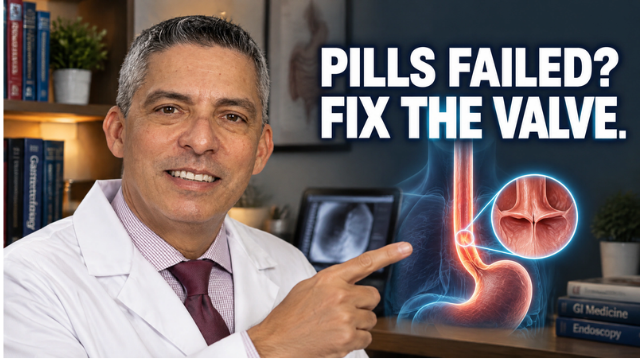
A PPI lowers acid. It doesn't stop stomach contents from coming back up. Think of the lower esophageal valve as a door. Acid medicine makes what passes through the door less acidic, but it does nothing to close a weak door or repair a broken frame.
That's why PPIs work far better for heartburn than for regurgitation, the return of food or sour fluid into the throat or mouth. In a review of placebo-controlled PPI trials, the gain over placebo for regurgitation averaged only about 17 percent, more than 20 percentage points less than the gain for heartburn.
Doubling the dose doesn't solve it. In the CALIBER randomized trial, patients with moderate to severe regurgitation despite a daily PPI received either a double dose or magnetic sphincter augmentation (LINX). At six months, regurgitation was relieved in 89 percent of the LINX group and 10 percent of the double-dose group.
A pill also can't repair a hiatal hernia. Normally the diaphragm wraps around the valve and helps hold it closed. When the opening in the diaphragm stretches and the top of the stomach slides into the chest, that support is lost, and no medication restores it.
Surgery Versus Medication: The LOTUS Trial
The longest high-quality comparison is the LOTUS trial, published in JAMA. It randomized 554 patients whose reflux was controlled on a PPI to continue esomeprazole with dose adjustment or to have laparoscopic antireflux surgery, then followed them for five years.
- Overall remission: 92 percent on medication, 85 percent after surgery. Well-managed medication was slightly better on the main measure.
- Acid regurgitation: 13 percent on medication, 2 percent after surgery.
- Heartburn: 16 percent on medication, 8 percent after surgery.
- Trouble swallowing: 11 percent after surgery, 5 percent on medication.
- Bloating: 40 percent after surgery, 28 percent on medication. Flatulence: 57 percent versus 40 percent.
Surgery doesn't make anyone symptom-free. It trades one set of symptoms for a different, usually smaller one. That trade often makes sense for nighttime regurgitation and rarely makes sense for mild heartburn a pill already controls.
Who Is a Good Candidate for Reflux Surgery?
The factors that predict a good result are consistent across studies and are reflected in the SAGES guidelines:
- Abnormal acid exposure on pH testing
- Esophagitis on endoscopy
- Typical symptoms (heartburn and regurgitation) rather than cough or hoarseness alone
- A good symptomatic response to PPIs
- A hiatal hernia
- A high-volume surgeon and team
The patients I seriously consider for antireflux surgery have proven reflux and fall into at least one of these groups: they don't want medication for decades, they respond to PPIs but can't tolerate them, their main problem is regurgitation, or they have a large hiatal hernia. One composite patient, a teacher in her forties, had taken omeprazole for twelve years. Her heartburn was mostly controlled, but she woke several nights a week coughing with sour fluid in her throat. Testing showed true reflux and a 3-centimeter hiatal hernia. After hiatal hernia repair and a fundoplication, she sleeps through the night off medication.
The Test That Predicts Who Can Stop the Pill
Wireless pH monitoring uses a small capsule attached to the esophageal lining during endoscopy to record acid for up to four days. In a clinical trial of patients with incomplete response to PPIs, everyone stopped the drug and underwent 96-hour monitoring. Those with normal acid exposure on all four days had about ten times the odds of successfully staying off PPIs compared with those whose acid was abnormal every day. Many people on PPIs for a decade have never had this test.
When the Pill Does Nothing
Complete lack of response is a warning that the symptoms may not be reflux. In the VA trial, after the 42 timing responders, the remaining patients underwent full testing. About a quarter had functional heartburn, and others had different esophageal disorders. Only 78 of the original 366, about one in five, had confirmed reflux that truly didn't respond to medication. In that group, surgery succeeded in 67 percent, the best active medical regimen in 28 percent, and the control medical regimen in 12 percent.
Surgery works well in the right patient, but most people who believe they need it don't. If the pill does nothing, the next step is testing, in this order:
- Endoscopy, ideally after two to four weeks off the PPI so healing doesn't hide the evidence. I perform much of my own endoscopy because I want to see the valve and hernia myself before planning an operation.
- pH monitoring. Acid exposure time below 4 percent is normal, and above 6 percent is conclusive for reflux. Values in between are borderline and need supporting findings.
- Esophageal manometry before any operation, to measure how the esophagus contracts and whether the valve relaxes. I work alongside a gastroenterologist who specializes in motility testing.
Manometry's most important job is catching achalasia, in which the valve fails to open. In a multicenter study of more than 500 patients with achalasia, 29 percent had first been treated with acid-reducing medication for what was assumed to be reflux. Patients like these are often sent for antireflux surgery without further testing. Tightening a valve that already won't open makes things worse.
Throat-only symptoms deserve the same caution. Chronic cough, hoarseness, throat clearing and a lump sensation are often called silent reflux or laryngopharyngeal reflux, but they have many other causes. In a randomized trial, four months of twice-daily esomeprazole did no better than placebo for chronic throat symptoms. My article on chronic cough, hoarseness and silent reflux covers how these patients should be evaluated. When all testing is normal off medication, guidelines advise stopping the PPI. Functional heartburn is treated with low-dose neuromodulating medications and, for some patients, gut-directed hypnotherapy or cognitive behavioral therapy. Surgery doesn't help it and can make it worse.
How Long Does Reflux Surgery Last?
Some of the most realistic numbers come from a Swedish nationwide cohort of 2,655 patients who had laparoscopic antireflux surgery and were followed for a median of about 5.6 years. About 18 percent had reflux recurrence, defined as returning to long-term reflux medication or having a second operation. Most of them went back on medication, and fewer than one in six needed reoperation. Put another way, more than eight in ten patients remained off long-term reflux medication.
Restarting a PPI doesn't always mean the operation failed. Some patients take one for symptoms that were never reflux, which is one more reason to test first. Recurrence risk rises with older age, female sex, other medical conditions and obesity. With a BMI around 35 or higher, a standard wrap is more likely to fail, and gastric bypass for GERD often makes more sense because it treats both reflux and weight. When a prior operation hasn't held up, revision is possible, as I explain in my article on redo fundoplication.
Choosing among a Nissen, Toupet, LINX, TIF or bypass depends on testing, anatomy and symptoms. My guide to reflux surgery options compares them.
Frequently Asked Questions
Is it safe to take a PPI for the rest of my life?
For most people who need one, yes. In the 17,598-person COMPASS trial, the only clear difference from placebo over three years was a small increase in bowel infections. Use the lowest dose that works and confirm with testing that you actually need it.
Do PPIs cause stomach or esophageal cancer?
COMPASS found no significant difference in cancer between pantoprazole and placebo. For people with Barrett's esophagus, a daily PPI is recommended to help protect the lining.
Will reflux surgery mean no more pills?
For most patients it means no daily medication or much less of it. Long-term data show more than eight in ten patients remain off long-term reflux medication, but it isn't guaranteed.
What are the risks of antireflux surgery?
Done laparoscopically by an experienced team, most patients go home the same day or the next. Temporary swallowing difficulty, gas and bloating are the common side effects. Serious complications are uncommon, but they do occur.
Should I stop my PPI before reflux testing?
For endoscopy and pH monitoring done to prove reflux, stopping the PPI for one to four weeks beforehand is usually advised, depending on the test. Follow your physician's specific instructions.
Who Should Consider Surgery, and Who Shouldn't
If your PPI works and you're comfortable taking it, take it before a meal, every day, at the lowest dose that works. Stay on it if you have severe esophagitis or Barrett's. If you want to stop, taper gradually and keep famotidine or an alginate for the occasional bad day.
If the pill works but you don't want it for decades, or you still have regurgitation, or you have a hiatal hernia, get tested and talk with a reflux surgeon. If the pill does nothing, test before considering any operation. Surgery isn't for people whose tests are normal, people with functional heartburn, or anyone who hasn't been tested yet.
Patients come to my Miami practice from across Florida, other states, the Caribbean and Latin America. Out-of-town patients start with a video visit to review records and test results, and travel only once there's a plan. To have your case reviewed, call or text 305-692-0392 or contact the office. Se habla español.
This article is for education and isn't medical advice. Don't stop or change a prescribed medication without talking to your doctor.
Further Information
Medical Topics Covered

Dr. de la Cruz‑Muñoz specializes in advanced minimally invasive and robotic surgery, metabolic disease management, and comprehensive long‑term patient care. His work integrates clinical expertise, academic leadership, and a commitment to evidence‑based medicine. He has trained surgeons across the country, contributed to national guidelines, and is widely regarded for his outcomes, innovation, and patient‑centered approach.
Patients choose Dr. de la Cruz‑Muñoz for his combination of surgical excellence, metabolic expertise, and lifelong dedication to improving patient health through compassionate, high‑quality care.
Procedures We Offer


Conditions


FAQ
People Also Ask
Obesity is recognized as a chronic disease by major medical organizations, including the American Medical Association. It is influenced by genetics, hormones, brain signaling, environment, sleep, stress and medications, not simply willpower. Like other chronic diseases, it often requires long-term treatment, which may include nutrition, activity, behavioral support, medications and surgery. Lifestyle matters, but biology largely determines how the body responds.
The body has powerful systems that defend its weight. When you lose weight, hunger hormones rise, fullness hormones drop, the brain becomes more focused on food and metabolism slows, a process called metabolic adaptation. Genetics, sleep, stress, medications and the modern food environment add to the challenge. These are biological forces, not character flaws, which is why medical treatment is often needed.
Genetics play a major role. Studies of twins and adopted children suggest that roughly 40–70% of the variation in body weight is inherited, influencing appetite, fullness, metabolism and where fat is stored. Many genes each contribute a small effect, and a few rare single-gene forms cause severe early obesity. Genes interact with environment, sleep, stress and medications, so a family history raises risk but does not determine destiny.
GLP-1 medications mimic a natural gut hormone released after eating. They act on the brain to reduce hunger and increase fullness, slow stomach emptying so meals last longer, quiet "food noise," and improve insulin release and blood sugar. Tirzepatide also acts on a second hormone, GIP. In clinical trials, these medications produced average weight loss of about 15–20% (Wilding et al., New England Journal of Medicine, 2021; Jastreboff et al., New England Journal of Medicine, 2022).
Yes. Obesity is associated with more than 200 health conditions, including type 2 diabetes, high blood pressure, high cholesterol, heart disease, stroke, sleep apnea, fatty liver disease, reflux, osteoarthritis, infertility and PCOS, depression and at least 13 types of cancer. Losing weight, through medical treatment or bariatric surgery, improves or resolves many of these conditions.
Dieting alone usually cannot overcome the body's biological defenses against weight loss. As weight falls, hunger hormones rise, fullness hormones fall and metabolism slows, changes that can last for years. Most people regain the majority of diet-related weight loss within several years. That is not a failure of willpower, and it is why treatments that address appetite biology, such as GLP-1 medications and bariatric surgery, are more effective for many people with obesity.
Consider medical evaluation when excess weight affects your health, mobility or quality of life, or when you have related conditions such as prediabetes, diabetes, high blood pressure, sleep apnea, fatty liver or joint pain. Guidelines support medications for adults with a BMI of 30 or higher, or 27 or higher with a weight-related condition, and surgery for a BMI of 35 or higher, or 30 or higher with metabolic disease. Early treatment can help prevent complications.
Yes. Bariatric surgery treats the biological drivers of obesity, changing hunger and fullness hormones, insulin sensitivity and the weight the body defends. It is the most effective and durable treatment for severe obesity, producing large, sustained weight loss and improving or resolving diabetes, high blood pressure, sleep apnea and fatty liver. Long-term studies show it also reduces the risk of heart disease, cancer and early death.