Still Have Heartburn on PPIs? What Refractory Reflux Means and What to Do Next

Quick Answer
Watch Related Video
"I take my reflux pill every single day, and I still have heartburn." I hear some version of that sentence in my office almost every week. Proton pump inhibitors (PPIs) such as omeprazole, esomeprazole and pantoprazole are among the most effective medications in gastroenterology, so when they do not work, patients understandably feel stuck. Some are told to double the dose. Some are told to simply live with it. Others are sent straight to a surgeon.
The truth is more useful than any of those answers. Persistent symptoms on a PPI are not a diagnosis; they are a question. The answer can be anything from taking the pill at the wrong time, to reflux that is not acidic, to a hiatal hernia that no pill can fix, to a sensitive esophagus that is not actually being damaged by reflux at all. Each of those has a different treatment, and only some of them are helped by surgery. Here is how I sort it out, and what the next steps usually look like.
What "Refractory Reflux" Actually Means
Doctors use the term PPI-refractory GERD (or refractory reflux) when troublesome heartburn, regurgitation or reflux-type chest discomfort continues despite an adequate trial of acid-suppressing medication. Current expert guidance suggests starting with a 4- to 8-week trial of a once-daily PPI and, if the response is incomplete, increasing to twice daily or switching to a stronger acid-suppressing drug before moving on to testing (Yadlapati et al., Clinical Gastroenterology and Hepatology, 2022).
The important word is "symptoms." Refractory heartburn tells us the burning has not gone away. It does not yet tell us whether that burning is caused by gastroesophageal reflux disease (GERD). That distinction drives everything that follows.
Understanding the Biology Behind the Condition
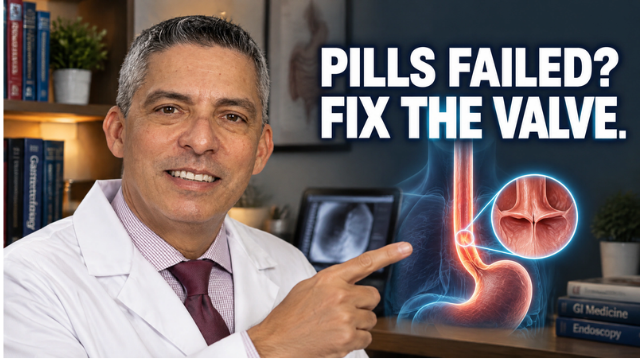
At the bottom of the esophagus sits the lower esophageal sphincter, a ring of muscle that works together with the diaphragm to act as a one-way valve. Food goes down; stomach contents are supposed to stay down. In GERD, that barrier is weakened. The sphincter may relax at the wrong times, the diaphragm opening may be stretched by a hiatal hernia, or the valve may simply be too loose, so stomach contents flow back up.
PPIs work by shutting down the acid pumps in the stomach lining. That makes the refluxed material far less acidic, which lets an inflamed esophagus heal and usually relieves heartburn. But a PPI does nothing to the valve itself. The reflux still happens; it is just less acidic. That is why a PPI can be excellent for burning and much less effective for regurgitation, the sensation of food or liquid coming back up into the chest or throat.
There is also a nerve side to the story. The esophagus has its own sensory nerves, and in some people those nerves become hypersensitive, so that normal amounts of reflux, or even no reflux at all, are felt as pain or burning. Acid suppression cannot fix a sensitivity problem, which is one of the most common reasons PPIs seem to "fail."
Why PPIs Fall Short: The Five Most Common Reasons
1. The medication is not being taken in the way that works best
PPIs block acid pumps that are switched on by eating, so they work best when taken 30 to 60 minutes before a meal, typically breakfast (Katz et al., American Journal of Gastroenterology, 2022). Taking a PPI at bedtime, with food, or only when symptoms flare is a very common reason for a poor response. Before anything else, I review timing, dose and how consistently the medication is actually being taken.
2. The reflux is real, but it is not acid that causes the symptoms
Even on a PPI, the stomach still pushes contents back into the esophagus. When that refluxed material is weakly acidic, it may still cause regurgitation, cough, throat symptoms or a sour taste. In these patients the problem is mechanical: a valve that leaks. Medications reduce the acid in the leak; they do not stop the leak.
3. A hiatal hernia is holding the valve open
When part of the stomach slides up through the diaphragm into the chest, the natural barrier against reflux is disrupted. Larger hernias often cause regurgitation, reflux at night or when bending over, and symptoms that medications only partly control.
4. The esophagus is hypersensitive
Some patients have a normal or near-normal amount of reflux, but they feel each reflux event intensely. This is called reflux hypersensitivity. It often overlaps with non-erosive reflux disease (NERD), in which reflux symptoms occur without visible damage to the esophageal lining on endoscopy.
5. It is not reflux at all
In functional heartburn, the burning feels identical to reflux, but testing shows normal acid exposure and no link between reflux events and symptoms. The American Gastroenterological Association's update on this condition is clear that antireflux surgery and endoscopic reflux procedures do not help functional heartburn and should not be recommended for it (Fass et al., Gastroenterology, 2020). Other conditions can also masquerade as refractory reflux, including eosinophilic esophagitis, esophageal motility disorders such as achalasia, and, importantly, heart disease. Chest pain should always be evaluated for a cardiac cause first.
How We Find the Real Cause
Guessing is the enemy here. The modern approach is to stop escalating medication blindly and instead measure what is happening. Both the American College of Gastroenterology guideline and the AGA clinical practice update recommend objective testing when symptoms do not respond to a PPI trial (Katz et al., American Journal of Gastroenterology, 2022; Yadlapati et al., Clinical Gastroenterology and Hepatology, 2022). The usual work-up includes:
- Upper endoscopy (EGD). A camera examination of the esophagus, stomach and duodenum looks for erosive esophagitis, Barrett's esophagus, strictures, a hiatal hernia and other conditions, with biopsies as needed.
- Prolonged wireless pH monitoring off PPI. If endoscopy does not already prove GERD, a small capsule attached to the esophageal wall measures acid exposure over several days while you are off medication. The AGA update prefers a 96-hour study for this purpose (Yadlapati et al., Clinical Gastroenterology and Hepatology, 2022).
- pH-impedance monitoring on PPI. In patients whose GERD is already proven, a 24-hour catheter study while taking medication can show whether symptoms are being driven by ongoing reflux, including weakly acidic reflux, despite treatment.
- High-resolution esophageal manometry. This measures the pressure and coordination of the esophageal muscle. It is essential before any antireflux procedure, because a weak or uncoordinated esophagus, or achalasia, changes the plan completely.
- Barium swallow or other imaging when a hiatal hernia or anatomic problem is suspected.
The Lyon Consensus 2.0, an international expert framework for interpreting these tests, helps classify each patient as having conclusive GERD, no GERD, or a borderline result that needs more information (Gyawali et al., Gut, 2024). That classification is what tells us who may benefit from a procedure and who will not.
What the Best Evidence Shows About Surgery for Refractory Heartburn
The most important study on this question is a randomized trial from the Veterans Affairs health system. Researchers enrolled 366 patients with heartburn that had not responded to PPIs and then put them through a structured evaluation. Only about one in five turned out to have truly PPI-refractory heartburn caused by reflux and were eligible for randomization. Many of the rest either improved once their medication was optimized or had a cause other than GERD (Spechler et al., New England Journal of Medicine, 2019).
Among the patients who did have proven reflux-related heartburn, laparoscopic Nissen fundoplication succeeded in 67%, compared with 28% for an active combination of medications and 12% for a control medication strategy at one year (Spechler et al., New England Journal of Medicine, 2019). In other words, surgery can be very effective, but only for the right patients, and the only way to find those patients is careful testing. I find that message reassuring rather than discouraging: it means we can offer surgery with confidence when the testing supports it, and spare patients an operation when it will not help.
Treatment Options Once We Know the Cause
If testing proves GERD
For patients with confirmed GERD who remain symptomatic, or who do not want lifelong medication, an antireflux procedure is often the right next step. The SAGES guideline conditionally recommends surgical treatment over continued medical management for adults with chronic or chronic refractory GERD (Slater et al., Surgical Endoscopy, 2021). The AGA update lists laparoscopic fundoplication and magnetic sphincter augmentation as effective options, with transoral incisionless fundoplication effective in carefully selected patients (Yadlapati et al., Clinical Gastroenterology and Hepatology, 2022). The options I discuss include:
- Anti-reflux surgery with hiatal hernia repair, in which the hernia is reduced, the diaphragm opening is tightened, and the top of the stomach is wrapped fully (Nissen) or partially (Toupet) around the lower esophagus to rebuild the valve.
- LINX magnetic sphincter augmentation, a flexible ring of magnetic beads placed around the lower esophagus that reinforces the valve while still allowing food to pass and, in most patients, belching.
- Transoral incisionless fundoplication (TIF), an endoscopic procedure performed through the mouth that rebuilds a partial valve, best suited to patients with small or no hiatal hernias, or combined with laparoscopic hernia repair when a hernia is present.
- Gastric bypass for patients with obesity. When significant obesity and GERD coexist, a Roux-en-Y gastric bypass is an effective primary antireflux operation that treats both problems (Yadlapati et al., Clinical Gastroenterology and Hepatology, 2022).
Before any of these, the AGA update emphasizes three requirements: confirmed pathologic GERD, exclusion of achalasia, and an assessment of esophageal muscle function (Yadlapati et al., Clinical Gastroenterology and Hepatology, 2022). I follow that rule without exception.
If testing shows reflux hypersensitivity
Treatment usually starts with medications that calm esophageal nerve sensitivity, sometimes combined with continued acid suppression and behavioral therapies. Whether surgery helps patients with reflux hypersensitivity is still debated. A subgroup in the VA trial appeared to benefit, but that finding needs confirmation, so I approach these patients individually and cautiously.
If testing shows functional heartburn
Here the most important thing I can do as a surgeon is not operate. Treatment focuses on reassurance, low-dose neuromodulating medications, and brain-gut behavioral therapies, and PPIs can often be reduced or stopped (Fass et al., Gastroenterology, 2020). Patients are often relieved to learn that functional heartburn does not damage the esophagus or lead to Barrett's esophagus.
Symptoms That Should Never Wait
Whatever the cause of ongoing heartburn, certain symptoms need prompt evaluation rather than another medication change:
- Difficulty or pain with swallowing, or food sticking
- Unintentional weight loss
- Vomiting, vomiting blood, or black stools
- Anemia
- Chest pain with exertion, shortness of breath or sweating, which needs emergency cardiac evaluation
- New reflux symptoms starting after age 60
When to See a Foregut Specialist
If you have been on a PPI for two months or more and still have heartburn or regurgitation, it is time for a structured evaluation rather than another refill. Ideally that evaluation is done by a team that can perform and interpret every test, and that offers the full range of treatments, from medication adjustment to endoscopic and laparoscopic procedures, so that the recommendation is driven by your results rather than by whichever procedure is available. That is the way I practice foregut surgery.
Over more than 25 years and over 15,000 minimally invasive procedures, I have learned that the patients who do best after reflux surgery are the ones who were chosen carefully, and that some of the most valuable visits end with the reassuring news that no operation is needed. If you are looking for hiatal hernia and reflux surgery in Miami, or simply want to understand why your medication is not working, my office can be reached at 305-692-0392.
Further Information
The lower esophageal sphincter and the diaphragm form a one-way valve that keeps stomach contents out of the esophagus. PPIs reduce stomach acid but do not repair that valve, so reflux can continue in a less acidic form. Some people also have hypersensitive esophageal nerves that register normal or minimal reflux as burning, which acid suppression cannot fix.
Medical Topics Covered


Dr. de la Cruz‑Muñoz specializes in advanced minimally invasive and robotic surgery, metabolic disease management, and comprehensive long‑term patient care. His work integrates clinical expertise, academic leadership, and a commitment to evidence‑based medicine. He has trained surgeons across the country, contributed to national guidelines, and is widely regarded for his outcomes, innovation, and patient‑centered approach.
Patients choose Dr. de la Cruz‑Muñoz for his combination of surgical excellence, metabolic expertise, and lifelong dedication to improving patient health through compassionate, high‑quality care.
Procedures We Offer





Conditions


FAQ
Persistent symptoms are not labeled refractory until you have had an adequate, correctly taken trial of a proton pump inhibitor — not simply a few missed or mistimed doses. The most widely accepted definition is persistent heartburn and/or regurgitation despite 8 weeks of double-dose (twice-daily) PPI therapy, though some authorities extend this to 12 weeks (Katz et al., ACG Clinical Guideline, 2022). Before applying that label, it is essential to confirm you are taking the medication correctly — 30 to 60 minutes before a meal rather than at bedtime — because incorrect timing and inconsistent use are among the most common and correctable reasons reflux appears to "fail" treatment (Fass et al., Nature Reviews Disease Primers, 2021). If symptoms truly persist after an optimized trial, that failure is itself a signal to pursue objective esophageal testing rather than simply escalating the dose indefinitely (Katz et al., ACG Clinical Guideline, 2022).
Because functional heartburn is not caused by acid, so an acid-blocking medication has nothing to act on. Only about 20%–30% of patients with functional heartburn get relief from even high-dose PPIs (Gyawali et al., Gastroenterology, 2026). In fact, lack of response to an adequate, correctly dosed PPI trial is one of the most important clues that heartburn may be functional rather than reflux-driven (Fass, New England Journal of Medicine, 2022). The right response to PPI failure is not to add more acid suppression or move toward surgery — it is to get objective testing (endoscopy off the medication, manometry, and reflux monitoring) to find out what is actually causing the symptoms (Gyawali et al., Gastroenterology, 2026). Once functional heartburn is confirmed, the ineffective acid suppression should be stopped and treatment redirected to therapies that address the hypersensitive esophagus — low-dose neuromodulators and brain-gut behavioral therapies such as cognitive behavioral therapy and gut-directed hypnotherapy (Guadagnoli et al., Clinical Gastroenterology and Hepatology, 2024).
Because in reflux hypersensitivity your acid level is already normal, so blocking more acid often provides only partial relief — especially if your symptoms are triggered by weakly acidic or non-acid reflux rather than acid itself (Gyawali et al., Gastroenterology, 2026). Reflux hypersensitivity, together with functional heartburn, accounts for most cases of heartburn that don't respond to twice-daily PPIs (Gyawali and Fass, Gastroenterology, 2018). Some patients with a genuinely acid-sensitive esophagus do improve on standard or higher-dose PPIs, but when symptoms persist, the answer is usually not a stronger acid blocker — it's a different type of treatment aimed at reducing the esophagus's over-sensitivity, such as a low-dose neuromodulator (Aggarwal and Kamal, Current Gastroenterology Reports, 2020).
Not necessarily — and this is one of the most important and counterintuitive points in reflux care. Complete failure to respond to a PPI is actually a red flag that the symptoms may not be acid-driven reflux at all; the patients with the best surgical outcomes are often those who did respond to a PPI and have objective evidence of reflux (Katz et al., ACG Clinical Guideline, 2022). In a landmark study of 366 patients referred for PPI-refractory heartburn, exhaustive testing showed that the symptoms were truly reflux-related in only about 21% (Katz et al., ACG Clinical Guideline, 2022). Expert consensus specifically recommends against fundoplication or endoscopic antireflux procedures in patients with refractory reflux-like symptoms who lack objective evidence of GERD, because they are more likely to have a non-acid condition such as functional heartburn that will not respond to surgery (Armstrong et al., Alimentary Pharmacology & Therapeutics, 2025). This is exactly why ambulatory pH monitoring and manometry are performed before any operation — to confirm the symptoms are genuinely reflux and that surgery is likely to help (Yadlapati et al., AGA Clinical Practice Update, 2022).
They look identical at the bedside and both occur with normal acid exposure on testing, but the distinction is critical because it changes treatment entirely (Gyawali and Fass, Gastroenterology, 2018). The difference comes down to one thing on reflux monitoring: the symptom-reflux association. In functional heartburn, acid exposure is normal and there is no link between reflux events and the patient's symptoms (negative symptom index and symptom association probability) — meaning reflux is not triggering the burning at all (Fass et al., AGA Clinical Practice Update, 2020). In reflux hypersensitivity, acid exposure is also normal, but symptoms are triggered by reflux events (a positive symptom-reflux association) — so despite normal acid levels, reflux is still the trigger (Fass, New England Journal of Medicine, 2022). That difference matters enormously: reflux hypersensitivity is increasingly considered part of the GERD spectrum and can respond to acid suppression and, in carefully selected patients, to fundoplication, whereas functional heartburn does not respond to either and is treated with neuromodulators and behavioral therapy (see our Reflux Hypersensitivity page) (Talley and Zand Irani, Journal of Internal Medicine, 2021).
No. This is one of the clearest "do not operate" situations in all of reflux care. Both antireflux surgery (fundoplication) and endoscopic antireflux procedures should be avoided in functional heartburn (Fass et al., AGA Clinical Practice Update, 2020). The reason is straightforward: surgery works by stopping acid and non-acid reflux from reaching the esophagus — but in functional heartburn there is no abnormal reflux to stop, so the operation cannot fix the real problem, which is a hypersensitive esophagus. Worse, a normal preoperative acid-exposure test is itself a documented risk factor for a poor outcome after fundoplication, including new or worsened difficulty swallowing (Fass et al., AGA Clinical Practice Update, 2020). A sham-controlled trial of endoscopic radiofrequency antireflux therapy likewise showed no benefit in these patients (Gyawali et al., Gastroenterology, 2026). This is exactly why a complete objective workup must be done before any antireflux procedure is considered — to make sure the patient genuinely has reflux that surgery can correct, rather than functional heartburn that it cannot.
A complete objective workup is critical — it confirms that reflux is truly the cause of your symptoms, excludes conditions that mimic GERD (such as achalasia), and guides which operation is safest and most effective for you (Katz et al., American College of Gastroenterology, 2022). Standard testing includes upper endoscopy, ambulatory pH or pH-impedance monitoring (usually off PPIs), high-resolution esophageal manometry, and often a barium esophagram (Salvador et al., Annals of Surgery, 2025; Elshafei et al., Current Gastroenterology Reports, 2026). Manometry is especially important, because it rules out achalasia and absent contractility and determines whether a complete or partial wrap is appropriate (Katz et al., American College of Gastroenterology, 2022). Skipping this workup is a leading cause of poor surgical outcomes.
There is no single "best" operation — the right choice depends on your esophageal function, anatomy, weight, and priorities, which is why objective testing before surgery is essential (Yadlapati et al., American Gastroenterological Association, 2022). A complete (Nissen) wrap gives the strongest reflux control and suits patients with normal esophageal motility; a partial wrap (Toupet or Dor) is preferred when motility is weak, to reduce the risk of swallowing problems (Yadlapati et al., American Gastroenterological Association, 2022). LINX is an excellent alternative for patients with regurgitation and favorable anatomy who want to preserve the ability to belch and vomit and minimize bloating (Katz et al., American College of Gastroenterology, 2022). Obese patients are often best served by gastric bypass (Yadlapati et al., American Gastroenterological Association, 2022). High-resolution manometry and pH testing guide this decision for each individual (Salvador et al., Annals of Surgery, 2025).
People Also Ask
Obesity is recognized as a chronic disease by major medical organizations, including the American Medical Association. It is influenced by genetics, hormones, brain signaling, environment, sleep, stress and medications — not simply willpower. Like other chronic diseases, it often requires long-term treatment, which may include nutrition, activity, behavioral support, medications and surgery. Lifestyle matters, but biology largely determines how the body responds.
The body has powerful systems that defend its weight. When you lose weight, hunger hormones rise, fullness hormones drop, the brain becomes more focused on food and metabolism slows — a process called metabolic adaptation. Genetics, sleep, stress, medications and the modern food environment add to the challenge. These are biological forces, not character flaws, which is why medical treatment is often needed.
Genetics play a major role. Studies of twins and adopted children suggest that roughly 40–70% of the variation in body weight is inherited, influencing appetite, fullness, metabolism and where fat is stored. Many genes each contribute a small effect, and a few rare single-gene forms cause severe early obesity. Genes interact with environment, sleep, stress and medications, so a family history raises risk but does not determine destiny.
GLP-1 medications mimic a natural gut hormone released after eating. They act on the brain to reduce hunger and increase fullness, slow stomach emptying so meals last longer, quiet "food noise," and improve insulin release and blood sugar. Tirzepatide also acts on a second hormone, GIP. In clinical trials, these medications produced average weight loss of about 15–20% (Wilding et al., New England Journal of Medicine, 2021; Jastreboff et al., New England Journal of Medicine, 2022).
Yes. Obesity is associated with more than 200 health conditions, including type 2 diabetes, high blood pressure, high cholesterol, heart disease, stroke, sleep apnea, fatty liver disease, reflux, osteoarthritis, infertility and PCOS, depression and at least 13 types of cancer. Losing weight — through medical treatment or bariatric surgery — improves or resolves many of these conditions.
Dieting alone usually cannot overcome the body's biological defenses against weight loss. As weight falls, hunger hormones rise, fullness hormones fall and metabolism slows — changes that can last for years. Most people regain the majority of diet-related weight loss within several years. That is not a failure of willpower, and it is why treatments that address appetite biology, such as GLP-1 medications and bariatric surgery, are more effective for many people with obesity.
Consider medical evaluation when excess weight affects your health, mobility or quality of life, or when you have related conditions such as prediabetes, diabetes, high blood pressure, sleep apnea, fatty liver or joint pain. Guidelines support medications for adults with a BMI of 30 or higher, or 27 or higher with a weight-related condition, and surgery for a BMI of 35 or higher, or 30 or higher with metabolic disease. Early treatment can help prevent complications.
Yes. Bariatric surgery treats the biological drivers of obesity, changing hunger and fullness hormones, insulin sensitivity and the weight the body defends. It is the most effective and durable treatment for severe obesity, producing large, sustained weight loss and improving or resolving diabetes, high blood pressure, sleep apnea and fatty liver. Long-term studies show it also reduces the risk of heart disease, cancer and early death.