From Heartburn to Barrett's to Cancer: Why Chronic Reflux Should Never Be Ignored

Quick Answer
Watch Related Video
Article
The Symptom Everyone Ignores — and Why That's a Mistake
Almost everyone has had heartburn. A burning feeling behind the breastbone after a big meal, a sour taste in the back of the throat at night, the reflux that follows a late dinner. Because it is so common, it is easy to dismiss — a roll of antacids, a lifestyle most people simply live around.
But for a meaningful number of people, frequent heartburn is not just an inconvenience. It is the first visible step on a well-mapped biological pathway that runs from chronic reflux, to a cellular change called Barrett's esophagus, and in a small subset of patients, to esophageal adenocarcinoma — one of the fastest-rising and most lethal cancers in the Western world (Wani et al., AGA Guideline, Gastroenterology, 2025; Xie, Smyth & Lagergren, New England Journal of Medicine, 2026). The encouraging news is that this pathway is slow, it is detectable, and when it is caught early it is highly treatable. The danger lies almost entirely in ignoring it.
This post walks the full length of the esophagus story — from the first burning symptom to the point of no return — so that you understand where you are on that continuum, and what can be done at each step.
Step One: Gastroesophageal Reflux Disease (GERD)
Reflux becomes a disease — GERD — when stomach contents flow back into the esophagus often enough, or forcefully enough, to cause symptoms or injure the lining. The esophagus is not built to withstand acid and bile the way the stomach is, so repeated exposure causes inflammation (esophagitis).
The strength of the link between reflux and esophageal cancer is striking. In a landmark population-based study, people with recurrent weekly reflux symptoms had roughly an eightfold higher risk of esophageal adenocarcinoma, and those with severe, long-standing symptoms (more than 20 years) had a risk more than 40 times higher than people without reflux (Lagergren et al., cited in Thrift, Nature Reviews Gastroenterology & Hepatology, 2021; Li, Chung & Mullen, Journal of Surgical Oncology, 2019). The risk rises in a dose-dependent fashion — the more frequent and the longer-lasting the reflux, the higher the risk (Thrift, Nature Reviews Gastroenterology & Hepatology, 2021).
One important nuance: the cancer risk appears to be concentrated in people with erosive reflux — reflux severe enough to cause visible damage to the esophageal lining — rather than those with non-erosive symptoms alone (Xie, Smyth & Lagergren, New England Journal of Medicine, 2026). This is exactly why persistent, frequent heartburn deserves medical evaluation rather than indefinite self-treatment.
Step Two: Barrett's Esophagus — The Body's Risky Adaptation
When the esophagus is exposed to acid and bile year after year, it adapts. The normal squamous lining is gradually replaced by a more acid-resistant, intestinal-type (columnar) lining — a change called intestinal metaplasia, or Barrett's esophagus (Fitzgerald, New England Journal of Medicine, 2026). On the surface this sounds protective, and in fact some patients with Barrett's esophagus notice their heartburn actually improves, because the new lining tolerates acid better. That false sense of relief is one of the condition's most dangerous features.
Barrett's esophagus is detected in roughly 3% to 14% of adults with reflux symptoms who undergo endoscopy, and affects about 1% to 2% of all adults (Fitzgerald, New England Journal of Medicine, 2026). It matters for one reason above all others: it is the only known precursor to esophageal adenocarcinoma (Wani et al., AGA Guideline, Gastroenterology, 2025).
Here is the critical point for perspective — the vast majority of people with Barrett's esophagus never develop cancer. Progression happens in a slow, stepwise, probabilistic way: from non-dysplastic Barrett's, to low-grade dysplasia, to high-grade dysplasia, and only then to invasive cancer (Wani et al., AGA Guideline, Gastroenterology, 2025). The annual risk of cancer in non-dysplastic Barrett's esophagus is low — roughly 0.2% to 0.5% per year — and most patients will live a normal lifespan without ever progressing (Sharma, JAMA, 2022). Segment length matters: short-segment disease (under 3 cm) carries an annual progression risk of about 0.06%, versus about 0.31% for long-segment disease (3 cm or longer) (Sharma, JAMA, 2022).
The reason Barrett's esophagus is monitored so carefully is not that cancer is likely — it is that Barrett's gives us a rare opportunity. It marks exactly which patients are at risk, and it provides a window, often years long, in which the disease can be caught and stopped before it ever becomes cancer.
Step Three: Esophageal Adenocarcinoma — Why the Stakes Are So High
Esophageal adenocarcinoma is the end of this continuum, and it explains the urgency behind everything upstream. Its incidence rose roughly five- to sevenfold from the 1970s onward, making it the most common form of esophageal cancer in Western populations (Wani et al., AGA Guideline, Gastroenterology, 2025; Wani, Gyawali & Katzka, AGA Clinical Practice Update, 2020). It shows a striking male predominance — up to nine times more common in men than women in the United States (Xie, Smyth & Lagergren, New England Journal of Medicine, 2026).
What makes this cancer so feared is its prognosis when found late. Because early esophageal cancer causes no reliable symptoms, most cases are diagnosed only once they have advanced — and population-based five-year survival rarely exceeds 20% (Xie, Smyth & Lagergren, New England Journal of Medicine, 2026; Coleman, Xie & Lagergren, Gastroenterology, 2018). By the time difficulty swallowing or weight loss appears, the disease is often advanced.
That contrast — a highly lethal cancer at the end of a slow, detectable, treatable pathway — is the entire argument for taking chronic reflux seriously.
The Catch: Most Cancers Are Missed by Current Screening
A sobering reality drives the push for greater awareness: as many as 90% of people diagnosed with esophageal adenocarcinoma never had a prior diagnosis of Barrett's esophagus, and nearly 40% report no history of frequent reflux symptoms at all (Wani, Gyawali & Katzka, AGA Clinical Practice Update, 2020; Muthusamy et al., AGA Clinical Practice Update, 2022). In other words, waiting for severe heartburn to prompt a workup misses a large share of the people who ultimately develop this cancer. This is precisely why identifying and acting on risk — rather than symptoms alone — has become the central strategy.
Who Should Be Screened for Barrett's Esophagus
Screening is a one-time upper endoscopy to look for Barrett's esophagus in people at elevated risk. Major guidelines converge on screening individuals with chronic GERD plus additional risk factors (Shaheen et al., ACG Guideline, American Journal of Gastroenterology, 2022; Muthusamy et al., AGA Clinical Practice Update, 2022). The American Gastroenterological Association suggests considering endoscopic screening in people with at least three established risk factors:
- Male sex
- Age over 50
- Non-Hispanic white race
- History of smoking
- Chronic GERD (frequent symptoms, or symptoms for more than 5 years)
- Obesity, particularly central/abdominal obesity
- Family history of Barrett's esophagus or esophageal adenocarcinoma in a first-degree relative
(Muthusamy et al., AGA Clinical Practice Update, 2022)
Importantly, newer, less invasive screening options are emerging, including a swallowable capsule-sponge cell-collection device paired with a biomarker, which can identify people who then warrant full endoscopy (Wani et al., AGA Guideline, Gastroenterology, 2025). The takeaway for patients: if you have long-standing reflux and any of the risk factors above — especially a man over 50 who smokes or carries excess abdominal weight — a conversation about a one-time screening endoscopy is worth having.
How Each Step Is Treated — and Why Early Action Wins
The treatment of this continuum is a story of escalating, but increasingly minimally invasive, intervention:
- GERD and non-dysplastic Barrett's esophagus are managed medically. At least once-daily proton pump inhibitor (PPI) therapy controls reflux, heals esophagitis, and — based on observational data and a large randomized trial — is associated with a reduced risk of neoplastic progression (Wani et al., AGA Guideline, Gastroenterology, 2025; Shaheen et al., ACG Guideline, American Journal of Gastroenterology, 2022). A pooled analysis found daily PPI use was associated with roughly a 50% lower risk of progression to high-grade dysplasia or cancer (Chen et al., cited in Wani et al., AGA Guideline, 2025). Non-dysplastic Barrett's is then followed with periodic surveillance endoscopy rather than ablation (Sharma, JAMA, 2022).
- Low-grade dysplasia, high-grade dysplasia, and early (intramucosal) cancer are now treated endoscopically — without major surgery. Endoscopic eradication therapy combines resection of any visible lesion (which also confirms the depth and stage) with ablation of the remaining flat Barrett's segment, most often by radiofrequency ablation (RFA) (Shah et al., Nature Reviews Clinical Oncology, 2023; Shaheen et al., ACG Guideline, 2022). In the landmark randomized trial, RFA completely eradicated dysplasia in 90.5% of patients with low-grade dysplasia and 81% of those with high-grade dysplasia, and cut the risk of progression to cancer (Shaheen et al., New England Journal of Medicine, 2009). Across the full approach, endoscopic therapy successfully treats roughly 80% to 90% of patients with dysplasia or early cancer (Sharma, JAMA, 2022). It spares patients the far greater risks of esophagectomy, which is now reserved for disease that cannot be controlled endoscopically or that has invaded more deeply (Shaheen et al., ACG Guideline, 2022).
The recurring theme is unmistakable: the earlier on the continuum a problem is found, the simpler, safer, and more definitive the fix. A pill and surveillance at one end; an endoscopic outpatient procedure in the middle; and only at the far end, major surgery for an often-incurable cancer.
The Reflux–Obesity Connection
Obesity — especially visceral (abdominal) fat — is an independent and major driver of this entire pathway. It promotes reflux mechanically, but it also raises esophageal adenocarcinoma risk through reflux-independent mechanisms such as systemic inflammation and metabolic changes (Xie, Smyth & Lagergren, New England Journal of Medicine, 2026). Encouragingly, weight loss appears to counteract the risk: a meta-analysis of 14 cohort studies found a 31% lower risk of esophageal adenocarcinoma after bariatric surgery (Xie, Smyth & Lagergren, New England Journal of Medicine, 2026). Guidelines now explicitly counsel weight loss and tobacco cessation for patients with Barrett's esophagus (Wani et al., AGA Guideline, Gastroenterology, 2025). For the many patients whose reflux and obesity travel together, treating the weight is treating the esophagus.
Red-Flag Symptoms That Require Urgent Attention
While uncomplicated reflux and Barrett's esophagus cause no alarming symptoms, the following warrant prompt medical evaluation, as they can signal a stricture or cancer (Shaheen et al., ACG Guideline, 2022):
- Difficulty swallowing (food sticking) or painful swallowing
- Unintentional weight loss
- Vomiting blood or passing black, tarry stools
- Persistent vomiting
- New or rapidly worsening symptoms
These are not symptoms to monitor at home. They are reasons to be seen quickly.
Further Information
Medical Topics Covered
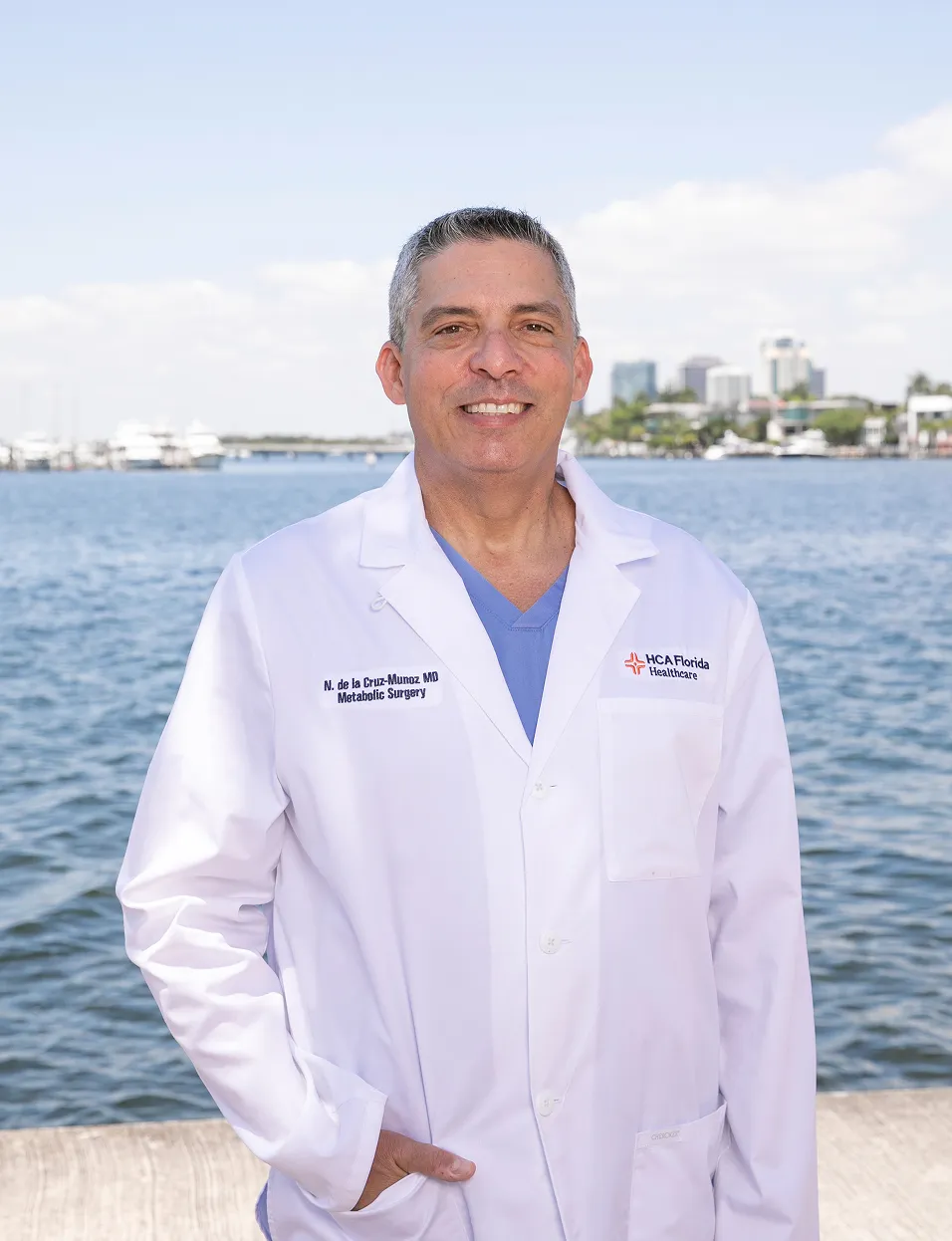

Dr. de la Cruz‑Muñoz specializes in advanced minimally invasive and robotic surgery, metabolic disease management, and comprehensive long‑term patient care. His work integrates clinical expertise, academic leadership, and a commitment to evidence‑based medicine. He has trained surgeons across the country, contributed to national guidelines, and is widely regarded for his outcomes, innovation, and patient‑centered approach.
Patients choose Dr. de la Cruz‑Muñoz for his combination of surgical excellence, metabolic expertise, and lifelong dedication to improving patient health through compassionate, high‑quality care.
Procedures We Offer



Conditions


FAQ
No. The overwhelming majority of people with reflux never develop esophageal cancer. However, chronic, frequent reflux — especially long-standing, severe, erosive reflux — raises the risk and can lead to Barrett's esophagus, the precursor to esophageal adenocarcinoma. That is why persistent reflux should be evaluated rather than simply self-treated indefinitely (Thrift, Nature Reviews Gastroenterology & Hepatology, 2021; Xie, Smyth & Lagergren, New England Journal of Medicine, 2026).
Screening with a one-time upper endoscopy is considered for people with chronic reflux plus additional risk factors — being male, over 50, white, a smoker, obese, or having a family history of Barrett's or esophageal cancer. Because many esophageal cancers occur in people without prominent reflux symptoms, guidelines increasingly emphasize screening based on overall risk factors, not symptoms alone (Muthusamy et al., AGA Clinical Practice Update, 2022; Shaheen et al., ACG Guideline, American Journal of Gastroenterology, 2022).
People Also Ask
Obesity is recognized as a chronic metabolic disease influenced by genetics, hormones, environment, and biological factors — not simply lifestyle choices.
The body has built-in mechanisms that defend weight, including hunger hormones and metabolic adaptations that make long-term weight loss challenging.
Yes. Genetics can significantly influence body weight regulation, appetite, metabolism, and an individual's susceptibility to obesity.
GLP-1 medications help regulate appetite, slow stomach emptying, improve satiety, and support sustainable weight management.
Yes. Obesity is associated with conditions such as Type 2 diabetes, hypertension, sleep apnea, fatty liver disease, and cardiovascular disease.
Dieting alone often cannot overcome the biological adaptations that increase hunger and decrease energy expenditure after weight loss.
Medical evaluation may be appropriate when excess weight affects health, quality of life, or contributes to obesity-related medical conditions.
Yes. Bariatric surgery addresses biological and metabolic factors involved in obesity and can lead to significant long-term health improvements.