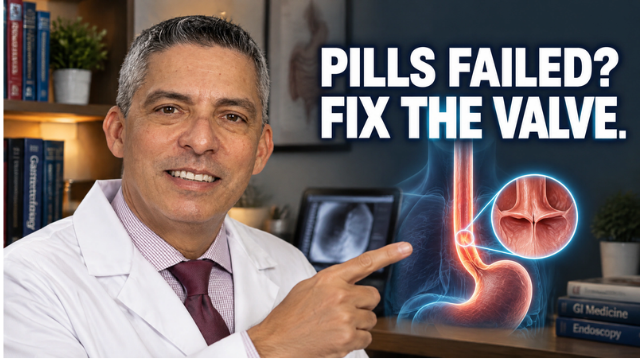
LINX Magnetic Sphincter Augmentation (MSA) for Acid Reflux


Overview
LINX magnetic sphincter augmentation is a laparoscopic, fundic-sparing antireflux operation in which a necklace of titanium-encased magnetic beads is implanted around the distal esophagus to reinforce (augment) the lower esophageal sphincter (LES) and prevent reflux (Katz et al., American College of Gastroenterology, 2022). It was developed as a less invasive and more readily reversible alternative to fundoplication, and was FDA-approved on March 22, 2012 (Ganz, Clinical Gastroenterology and Hepatology, 2017).
The device works dynamically: the magnetic attraction between the beads keeps the sphincter closed against the low-pressure forces that cause reflux, but the beads separate to allow a swallowed food bolus — or air and vomitus — to pass, which is why patients retain the ability to belch and vomit (Gyawali et al., Gastroenterology, 2018). The FDA indication is for patients diagnosed with GERD, as defined by abnormal pH testing, who are seeking an alternative to continuous acid-suppression therapy (PPIs); patients with esophageal motility disorders are contraindicated (Ganz, Clinical Gastroenterology and Hepatology, 2017).
Across more than a decade of study, LINX has delivered consistent, durable reflux control. In the FDA pivotal trial, GERD-health-related quality-of-life scores improved from 27 to 4 at five years, PPU use fell from 100% to about 15%, and moderate/severe regurgitation fell from 57% to roughly 1% — with no device erosions or migrations (Telem et al., Surgical Endoscopy, 2017). A long-term FDA post-approval study now confirms these results beyond five years, with an 81.6% clinical success rate and 90.4% freedom from daily PPIs (Louie et al., Annals of Surgery, 2026). A randomized trial also established LINX's clear superiority over twice-daily PPIs for controlling regurgitation (Katz et al., American College of Gastroenterology, 2022).
Because the device is placed with minimal dissection that preserves the native gastric anatomy, it is often positioned as a first-line surgical option in appropriately selected patients — those without a large hiatal hernia, Barrett's esophagus, or severe esophagitis — though those conditions are no longer absolute contraindications in experienced hands (Katz et al., American College of Gastroenterology, 2022).
How the Procedure Works
Reflux occurs when the lower esophageal sphincter — often weakened or displaced by a hiatal hernia — fails to keep acid and stomach contents out of the esophagus. LINX rebuilds that barrier mechanically while preserving normal physiology (Bell, The Esophagus, 2021):
- Augmenting the sphincter: The ring of magnetic beads encircles the esophagus just above the stomach and adds a calibrated resting resistance (approximately 28 mmHg) that supplements the patient's own weakened LES, preventing low-pressure spontaneous reflux (Bell, The Esophagus, 2021).
- Dynamic opening: When the patient swallows, the pressure of the food bolus overcomes the magnetic attraction and the beads separate — nearly doubling the ring's diameter — to let food pass; the beads then re-approximate to close the valve (Bell, The Esophagus, 2021).
- Preserving physiologic venting: Because the magnetic forces diminish as the beads separate, the device allows the patient to belch and vomit normally — a key difference from fundoplication, which creates a fixed wrap that can restrict venting and cause gas-bloat (Gyawali et al., Gastroenterology, 2018).
- Restoring anatomy: Any hiatal hernia is reduced and the diaphragmatic opening (hiatus) is repaired at the same operation; small hernias require minimal dissection, while large hernias require a more extensive crural repair (Katz et al., American College of Gastroenterology, 2022).
Benefits
- Durable, effective reflux control comparable to fundoplication across symptom relief, PPI discontinuation, and quality-of-life improvement (Maret-Ouda et al., JAMA, 2020; Katz et al., American College of Gastroenterology, 2022).
- Preserved ability to belch and vomit — in direct comparisons, far more LINX patients retained normal belching and vomiting than fundoplication patients (Fadel et al., International Journal of Surgery, 2024; Telem et al., Surgical Endoscopy, 2017).
- Less gas-bloat syndrome than after a Nissen wrap — in pooled data, roughly 10% of LINX versus 32% of fundoplication patients reported excessive gas and bloating (Telem et al., Surgical Endoscopy, 2017; Maret-Ouda et al., JAMA, 2020).
- Freedom from daily PPIs in the large majority of patients — around 90% off daily PPIs at long-term follow-up (Louie et al., Annals of Surgery, 2026).
- Fundic-sparing and more readily reversible — the native gastric anatomy is preserved and the device can be removed if needed, unlike a fundoplication (Katz et al., American College of Gastroenterology, 2022).
- Shorter operative time and hospital stay than fundoplication, with a standardized, reproducible technique (Katz et al., American College of Gastroenterology, 2022; Telem et al., Surgical Endoscopy, 2017).
Who Is a Candidate
LINX is appropriate for patients with objectively confirmed GERD who meet established selection criteria (Ganz, Clinical Gastroenterology and Hepatology, 2017; Bonavina et al., Therapeutic Advances in Gastroenterology, 2013):
- Abnormal acid reflux documented by pH testing, with typical reflux symptoms at least partially responsive to PPI therapy.
- A desire to stop continuous acid-suppression therapy rather than remain on lifelong PPIs — the core FDA indication.
- Normal esophageal motility — adequate peristaltic amplitude and propagation on manometry, since motility disorders are a contraindication (Ganz, Clinical Gastroenterology and Hepatology, 2017).
The classic ideal candidate has a hiatal hernia smaller than 3 cm, no Barrett's esophagus, esophagitis no worse than LA grade A/B, and a BMI under 35 (Bonavina et al., Therapeutic Advances in Gastroenterology, 2013; Vaezi et al., Gastroenterology, 2020). Large hiatal hernias and severe esophagitis were contraindications in the early trials, but subsequent studies show comparable short-term outcomes in these ptients when a more extensive crural repair is performed, so these are no longer absolute exclusions at experienced centers (Katz et al., American College of Gastroenterology, 2022).
Contraindications and important limitation: Esophageal motility disorders (such as Achalasia) must be excluded by manometry before placement (Ganz, Clinical Gastroenterology and Hepatology, 2017). Because the device is metallic, patients generally cannot undergo MRI with scanners stronger than 1.5 Tesla — an important consideration for anyone likely to need future high-field MRI (Katz et al., American College of Gastroenterology, 2022).
How the Procedure Is Performed
LINX is performed under general anesthesia, laparoscopically or robotically, through several small incisions (Levy, JOMI, Robotic Paraesophageal Hernia Repair with LINX):
- Access and exposure: A few small incisions are made and the esophageal hiatus is exposed.
- Hiatal hernia repair: Any hiatal hernia is reduced, adequate intra-abdominal esophageal length (at least 3–4 cm) is confirmed, and the diaphragmatic crura are closed with sutures (Levy, JOMI).
- Creating the retroesophageal window: A narrow plane is developed behind the esophagus — specifically behind the posterior vagus nerve (a "retrovagal window") — which anchors the device and helps prevent migration while preserving both vagus nerves (Levy, JOMI).
- Sizing: A magnetic sizing tool is passed around the esophagus to measure the correct device size; using the standardized "three-above-pop" technique, the surgeon selects a device three sizes larger than the point at which the sizer's magnetic clasp separates, balancing reflux control against dysphagia risk (Levy, JOMI).
- Placing the device: The correctly sized LINX ring is positioned around the LES through the retroesophageal window and its ends are clasped together. Intraoperative endoscopy confirms correct positioning and the absence of esophageal injury (Levy, JOMI).
- Closure: Instruments are removed and the small incisions are closed. The operation typically takes well under an hour to about an hour, shorter than a fundoplication.
Risks and Considerations
LINX has a well-characterized and favorable safety profile, but as with any implant there are risks (Fadel et al., International Journal of Surgery, 2024):
- Dysphagia (difficulty swallowing) is the most common issue — frequent in the early postoperative period and usually transient, declining to roughly 4–6% by several years; it is the leading reason for endoscopic dilation or device removal (Gyawali et al., Gastroenterology, 2018; Louie et al., Annals of Surgery, 2026). In meta-analysis, LINX carries a modestly higher rate of dysphagia than fundoplication (Fadel et al., International Journal of Surgery, 2024).
- Need for endoscopic dilation for persistent dysphagia in roughly 5–6% of patients (Telem et al., Surgical Endoscopy, 2017).
- Device removal (explantation) in approximately 4% in pooled data, and up to about 13% at long-term (>5-year) follow-up — most commonly for dysphagia, persistent reflux, or chest pain; nearly all patients have symptom resolution after removal, conversion to fundoplication, or device replacement (Fadel et al., International Journal of Surgery, 2024; Louie et al., Annals of Surgery, 2026).
- Device erosion into the esophagus is rare — about 0.3% at four years, with a median time to erosion around 26 months — and eroded devices are typically removed endoscopically/laparoscopically without serious complications (Katz et al., American College of Gastroenterology, 2022).
- MRI restriction — the metallic device limits future MRI to scanners of 1.5 Tesla or lower (Katz et al., American College of Gastroenterology, 2022).
- Recurrent reflux or need for daily PPIs in a minority of patients over time, and general surgical risks including bleeding and infection.
Recovery Timeline
Recovery is typically fast, reflecting the minimal dissection:
- Hospital stay: Many patients go home the same day or after a single overnight stay — shorter than after fundoplication (Telem et al., Surgical Endoscopy, 2017).
- Diet — a key difference from fundoplication: Patients are often encouraged to eat a regular diet relatively early and to swallow frequently, because regular use helps keep the beads mobile and reduces the risk of scarring and dysphagia.
- Swallowing: Mild difficulty swallowing is common in the first weeks and usually improves as tissue accommodates to the device; persistent dysphagia should be reported promptly.
- Activity and return to work: Light activity resumes within days; most patients return to desk work within about a week, with heavy lifting restricted for several weeks to protect the crural repair.
Long-Term Expectations
The large majority of patients achieve durable relief of heartburn and regurgitation and stay off daily PPIs long term, with clinical success around 82% and freedom from daily PPIs around 90% beyond five years (Louie et al., Annals of Surgery, 2026). Device retention is high — roughly 90% of patients still have their device at 6–11 years — and no new safety signals have emerged with longer follow-up (Ferrari et al., Scientific Reports, 2020; Ganz, Clinical Gastroenterology and Hepatology, 2017). Compared with fundoplication, long-term reflux control, satisfaction, and reoperation rates are similar, with LINX favored on gas-bloat and the ability to belch and vomit, and fundoplication occasionally favored on complete PPI elimination in some series (Katz et al., American College of Gastroenterology, 2022; Fadel et al., International Journal of Surgery, 2024).
Why Choose Dr. de la Cruz-Muñoz
Matching the right antireflux procedure to the right patient is where experience matters most. Dr. Nestor de la Cruz-Muñoz, MD, FACS, DABOM, individualizes every antireflux operation based on objective esophageal physiologic testing (high-resolution manometry and ambulatory pH-impedance monitoring), offering the full spectrum of options — LINX magnetic sphincter augmentation, Nissen and Toupet fundoplication, hiatal hernia repair, and TIF. For patients with normal motility and favorable anatomy who want to stop lifelong reflux medication while preserving their native anatomy and the ability to belch and vomit, LINX is often the ideal fundic-sparing choice. This evidence-based, physiology-first philosophy delivers durable reflux relief while minimizing the gas-bloat and swallowing side effects that drive dissatisfaction after antireflux surgery.
Total Body Weight Loss (TBWL) Expectations
Expected Metabolic Improvements
Weight Regain Prevention Strategy
GERD / Reflux Considerations
Choosing between LINX and a fundoplication is an individualized, anatomy-driven decision. The SAGES technology assessment concluded that magnetic sphincter augmentation should be considered a first-line surgical option in appropriately selected patients without Barrett's esophagus or a large hiatal hernia, specifically to avoid unnecessary dissection and preserve native gastric anatomy (Telem et al., Surgical Endoscopy, 2017). Observational and meta-analytic data show LINX and fundoplication deliver comparable reflux control and reoperation rates, with LINX generally producing less gas-bloat and better preserved belching/vomiting (Katz et al., American College of Gastroenterology, 2022; Maret-Ouda et al., JAMA, 2020). Importantly, no randomized trial has yet directly compared LINX with fundoplication, so the comparison rests on high-quality observational evidence (Katz et al., American College of Gastroenterology, 2022; Fadel et al., International Journal of Surgery, 2024). Patients with a large hiatal hernia, Barrett's esophagus, severe esophagitis, or esophageal dysmotility are generally better served by a tailored fundoplication (Vaezi et al., Gastroenterology, 2020).
Revision Options
One of LINX's advantages is that it is more readily reversible than a fundoplication. If dysphagia is persistent, the first step is usually endoscopic dilation (Telem et al., Surgical Endoscopy, 2017). If symptoms do not resolve — or if reflux recurs, chest pain persists, or erosion occurs — options include laparoscopic device removal with conversion to a fundoplication, or device replacement, with the great majority of patients achieving symptom resolution after revision (Louie et al., Annals of Surgery, 2026). All revisional decisions should follow repeat objective testing at an experienced foregut center.
Body Composition & Muscle Preservation
Insurance & Qualification Requirements
LINX is FDA-approved and generally covered when medical necessity is documented. Typical requirements include objective confirmation of GERD by abnormal pH testing, a trial of (and partial response to) PPI therapy, and preoperative high-resolution manometry demonstrating normal esophageal motility and excluding a motility disorder (Ganz, Clinical Gastroenterology and Hepatology, 2017; Bonavina et al., Therapeutic Advances in Gastroenterology, 2013). Documentation of hiatal hernia size and the absence of exclusionary findings supports authorization.
Preparing for Surgery (Pre-Op Requirements)
- Esophageal workup: Upper endoscopy, ambulatory pH or pH-impedance monitoring (off PPIs), and high-resolution manometry to confirm pathologic reflux, assess hiatal hernia size and esophagitis grade, and exclude a motility disorder (Bonavina et al., Therapeutic Advances in Gastroenterology, 2013; Ganz, Clinical Gastroenterology and Hepatology, 2017).
- Barium esophagram to characterize anatomy and hiatal hernia when indicated.
- MRI review: Discussion of the 1.5-Tesla MRI limitation, particularly for patients likely to need future high-field MRI (Katz et al., American College of Gastroenterology, 2022).
- Medication review and standard preoperative optimization.
Post-Op Nutrition Overview
- Diet: Unlike fundoplication, patients are generally encouraged to resume a regular diet relatively quickly and to eat and swallow frequently (including small, regular meals), which helps keep the device mobile and reduces the risk of scarring-related dysphagia.
- Activity: Walk early to prevent blood clots; avoid heavy lifting and strenuous core exertion for several weeks to protect the crural repair.
- Follow-up: Scheduled visits to monitor swallowing and reflux control, with ea
Post-Op Activity & Exercise Guidance
Special Considerations for International Patients
Quick Procedure Details
Featured Procedures

Conditions


FAQ
LINX is a small, flexible ring of titanium beads with magnetic cores that a surgeon places laparoscopically around the lower esophagus, just above the stomach, to reinforce the weakened valve (lower esophageal sphincter) that normally keeps acid down (Katz et al., American College of Gastroenterology, 2022). The magnetic attraction between the beads keeps the valve closed against the low-pressure forces that cause reflux, but when you swallow, the force of food separates the beads so the bite can pass — then they close again (Bell, The Esophagus, 2021). Because the magnets simply give way under pressure, you can still belch and vomit normally, which is a key advantage over a traditional fundoplication (Gyawali et al., Gastroenterology, 2018).
Both operations rebuild the antireflux barrier, but in very different ways. A Nissen fundoplication wraps the upper stomach 360° around the esophagus, permanently altering the gastric anatomy; LINX adds a magnetic ring around the sphincter and leaves the stomach untouched (fundic-sparing) (Katz et al., American College of Gastroenterology, 2022). Studies show comparable reflux control and reoperation rates, but LINX patients generally have less gas-bloat and are far more likely to retain the ability to belch and vomit, while fundoplication may achieve slightly higher rates of complete PPI elimination in some series (Maret-Ouda et al., JAMA, 2020; Fadel et al., International Journal of Surgery, 2024; Telem et al., Surgical Endoscopy, 2017). LINX also has a shorter operation and hospital stay and is more readily reversible (Katz et al., American College of Gastroenterology, 2022). No randomized trial has yet directly compared the two, so the choice is individualized to your anatomy and priorities (Katz et al., American College of Gastroenterology, 2022).
This is an important limitation to know before surgery. Because the LINX device is made of metal (titanium and magnets), patients generally can only undergo MRI with scanners of 1.5 Tesla or lower — not the stronger 3-Tesla machines used in many settings (Katz et al., American College of Gastroenterology, 2022). For most people this is not a problem, but if you have a condition that may require repeated or high-field MRI in the future, this should be discussed carefully when choosing between LINX and a fundoplication, which has no such restriction. This is one of several factors weighed during the personalized evaluation before antireflux surgery.
LINX has a strong long-term safety and durability record. Device erosion — the main early concern — is rare, about 0.3% at four years, and is safely managed when it occurs (Katz et al., American College of Gastroenterology, 2022). Roughly 90% of patients still have their device at 6–11 years, with no new safety problems emerging over time (Ferrari et al., Scientific Reports, 2020; Ganz, Clinical Gastroenterology and Hepatology, 2017). Long-term FDA follow-up shows about 82% of patients maintain clinical success and roughly 90% stay off daily reflux medication beyond five years (Louie et al., Annals of Surgery, 2026). The most common issue is difficulty swallowing, usually temporary; when the device does need to be removed (about 13% at long-term follow-up), nearly all patients have their symptoms resolved with removal, conversion to a fundoplication, or replacement (Louie et al., Annals of Surgery, 2026).