Reflux After Bariatric Surgery

Quick Answer
Watch Related Video
Article
Introduction: Reflux Is Not Just Heartburn
For many patients who come into the office, the sleeve is not the rightoperation, and that is often clear before anyone ever picks up a stapler.
Sleeves remain popular because they are fast, familiar, and frequentlyrequested by name. But if you already have reflux, a hiatal hernia, or a weaklower esophageal valve, a sleeve can create years of symptoms and sometimeslead to a second operation. The choice you make before surgery can determinewhether you heal once or end up needing another procedure later.
Reflux after bariatric surgery is one of the most misunderstood problems inthis field. Many patients think of it as heartburn, a nuisance controlled witha pill. But reflux is more than a symptom. It is a mechanical problem. Overtime, uncontrolled acid exposure can damage the lining of the esophagus, causea condition called Barrett's esophagus, and, in the most serious cases,increase the risk of esophageal cancer.
Here is what makes reflux particularly concerning after a sleeve: some patientshave significant reflux-related damage without feeling much at all. No burning.No obvious symptoms. But when we look inside the esophagus or measure acidexposure, the problem is already there.
So this is not simply an article about heartburn. It is about protecting youresophagus, choosing the right operation the first time, and understanding youroptions if reflux develops after surgery.
First, What Do We Actually Mean by "Reflux"?
People use the word "reflux" as if it means the same thing toeveryone. It does not, and that confusion explains why different studies reportvery different numbers. Ask ten studies how many patients develop reflux aftera sleeve, and you may see estimates below 10 percent in some and above 50percent in others. Same operation. Very different answers.
Why? Because they may not be measuring the same thing. One study asks patients,"Do you have heartburn?" Another counts how many patients take refluxmedication. Another uses a camera to look for inflammation. Another places aprobe to measure acid exposure over an entire day. Those are four differentdefinitions of reflux. So whenever someone gives you a percentage, ask onequestion: how was reflux measured?
Here are the terms that matter:
- Acid reflux: stomach contents, including acid, move upward andirritate the esophagus.
- De novo reflux: new reflux. You did not have it before surgery, andnow you do.
- Persistent or worsening reflux: you had reflux before surgery, and itcontinued or became more severe.
- Bile reflux: digestive fluid moving upward from farther down thedigestive tract. Standard acid-blocking medication may not fix it, so itrequires a different evaluation and treatment.
The part that concerns me most: many people assume that if they do not feelreflux, they do not have it. That is not true. After a sleeve, some patientshave significant acid exposure or inflammation without any heartburn. If weonly look for symptoms, we miss the disease until it has already caused damage.That is why objective testing matters. The Lyon Consensus provides a frameworkfor diagnosing reflux using measurable evidence, not symptoms alone.
For the rest of this article, "reflux" means measurable refluxdisease, the kind that can injure the esophagus whether you feel it or not.
Which Operation Causes Reflux, and Which One Fixes It
The sleeve gastrectomy. Over the long term, roughly 20 to 30 percent ofsleeve patients develop significant reflux. Many did not have it beforesurgery. When it starts afterward, we call it de novo reflux. And reflux doesnot stop at heartburn. Over time the esophageal lining can become inflamed and,in some patients, change into Barrett's esophagus, a precancerous condition.
The strongest comparison we have is a randomized trial, one of the highestforms of medical evidence. Researchers assigned similar patients to either asleeve or a bypass, then looked inside the esophagus and measured acid exposurerather than just asking how patients felt (Lorentzen et al., Gastroenterology,2021). The results:
- New inflammation of the esophagus in 47 percent of sleeve patientsversus 9 percent of bypass patients.
- Measurable acid reflux in 49 percent of sleeve patients versus 16percent of bypass patients.
Roughly half of the sleeve patients had measurable acid reflux. The bypasspatients did far better, and in many cases bypass improved reflux that wasalready present before surgery. An 8-year prospective cohort using modern Lyon2.0 criteria found the same pattern persists long term: conclusive GERD waspresent in 94.7 percent of sleeve patients versus 25.0 percent after bypass(Navarini et al., World Journal of Surgery, 2026).
To give the full picture, one large real-world database study reached a softerconclusion, suggesting sleeve patients did not necessarily have worse long-termreflux outcomes and had fewer hospital readmissions (Leslie et al., Annals ofSurgery, 2021). So a genuine debate remains, and the evidence is not perfectlyuniform. But when carefully measured data are combined with what we see inpractice, the weight of evidence points to the sleeve carrying more reflux riskthan the gastric bypass.
The one-anastomosis gastric bypass (OAGB, or mini bypass). Compared withthe OAGB, the sleeve again shows more reflux, roughly three to four times moreoverall and about four times more new reflux (Jamal and Abulfaraj, Journal ofClinical Medicine, 2026). But the OAGB has a trade-off: it can cause bilereflux, a different problem from acid reflux. So the OAGB may reduce acidreflux while creating a different concern that we watch for closely.
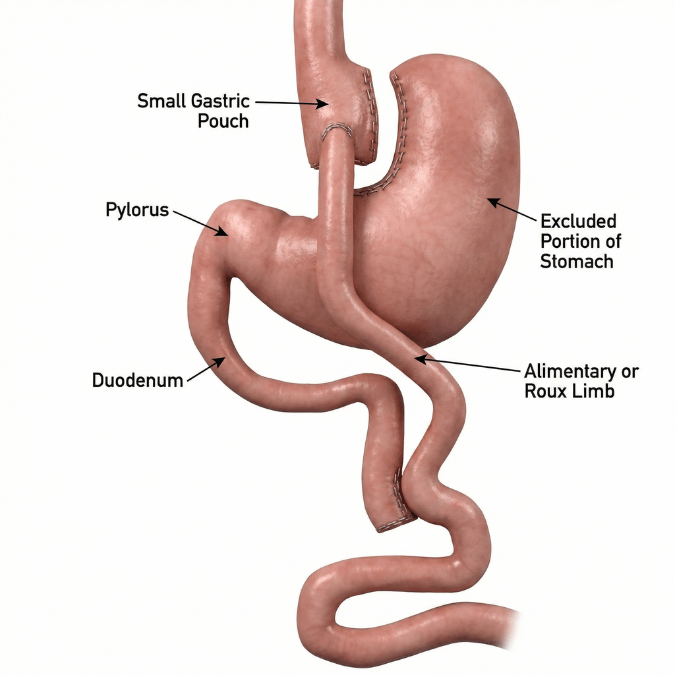
The Roux-en-Y gastric bypass. This is generally the operation associatedwith the lowest reflux risk. If reflux is your main concern, it is often thepreferred option. It is not a permanent guarantee, and years later a smallnumber of patients develop reflux or swallowing problems, but it offers themost protection.
Other procedures. The old adjustable gastric band was notorious forreflux and swallowing problems, one reason it is rarely used today. The largermalabsorptive operations, such as the duodenal switch and SADI, are builtaround a sleeve and can carry some of the same reflux risk, though long-termdata are less complete.
The main point: the gastric bypass generally offers the most protection againstacid reflux, the sleeve can increase reflux risk, and the mini bypass may tradeacid reflux for bile reflux.
Why It Happens: The Plumbing Behind the Problem
Reflux is not simply a problem of too much acid. It is usually a problem withthe valve that keeps stomach contents down. At the top of your stomach, whereit meets the esophagus, there is a natural one-way barrier. Part of it is amuscle, and part of it is the sharp angle where the esophagus meets thestomach, called the angle of His.
During a sleeve gastrectomy, the outer curve of the stomach is removed, turninga large, stretchy pouch into a narrow tube. A narrow tube is a high-pressuresystem. Think of squeezing a tube of toothpaste: as pressure rises, contentsare pushed upward toward the valve. The sharp angle also flattens. So now thereare two problems at once: more pressure pushing upward and a weaker barriertrying to hold it back. The sleeve also does not stretch and relax like anormal stomach, and in some patients it empties more slowly, leaving acid incontact with the esophagus longer.
When reflux develops after a sleeve, several mechanical problems are worthlooking for:
- A hiatal hernia (the upper stomach sliding through the diaphragm intothe chest), especially one that was present before surgery and not repaired.
- The sleeve migrating upward into the chest.
- A twist or kink in the sleeve.
- A narrowing, often at the mid-sleeve incisura, causing food and fluidto back up like a clog in a pipe.
- Too much stomach left at the top, acting as a reservoir where acidcollects.
Each of these requires a different solution, which is why the first step isalways to find the actual cause.
The gastric bypass addresses several of these problems at once. The new pouchis small and produces very little acid, most of the stomach is taken out of thefood pathway, bile is routed away from the pouch, and the pouch usually emptiesefficiently. As weight falls, pressure inside the abdomen often falls too. Thatcombination is why bypass is used when reflux is a major concern. The OAGB alsomoves acid away from the esophagus but, because of how the intestine isconnected, can allow bile back into the pouch.
How Reflux Shows Up, and Where It Goes
Reflux does not always look the way you expect. The classic symptom isheartburn, a burning in the mid-chest, often after meals and worse lying down.The second is regurgitation, when food or sour liquid comes back up, sometimeswaking patients with a bitter taste or a wet pillow. The third is troubleswallowing, or dysphagia, when food feels stuck. Dysphagia always deservesattention because it can signal narrowing, twisting, or another mechanicalproblem.
Reflux does not always stay in the chest. It can cause a chronic cough, ahoarse voice, constant throat-clearing, or a morning sore throat. Some patientsare treated for asthma or allergies that never fully improve because reflux isreaching the throat or airway, especially at night. These are calledextra-esophageal symptoms. In serious cases, reflux can be aspirated into thelungs.
The most important point remains: you can have significant reflux damage andfeel nothing. That is silent reflux. If we rely only on symptoms, we may notfind the problem until the damage is advanced.
Timing matters too. Early reflux in the first weeks after surgery may come fromswelling or healing. The reflux to watch most closely appears later, one, two,or even five years out, often building gradually. From there, reflux can followone of three paths: improvement (early swelling settles, weight loss reducespressure), persistence (daily management with medication), or progression(ongoing irritation leading to inflammation and, over time, Barrett'sesophagus). Early on, you cannot always tell which path you are on by how youfeel, which is exactly why we look, measure, and stay ahead of it.
What Reflux Does If You Leave It Alone
When acid keeps coming up, it damages the esophagus in predictable steps.
The first step is inflammation (esophagitis), like a rug burn inside thefood pipe. After a sleeve this is common, appearing in a large share ofpatients in long-term studies. The second step is a stricture, ornarrowing, from chronic scarring or a tight or twisted sleeve. Food starts toget stuck. This happens in roughly 1 to 3 percent of sleeve patients and canusually be opened with balloon dilation through a scope.
The step that matters most is Barrett's esophagus. When the esophagus isburned by acid for years, the body swaps the normal lining for a tougher,intestine-like tissue. That new tissue is unstable and precancerous, the firststep toward esophageal cancer. In long-term sleeve studies, Barrett's appearedin roughly 4 to 18 percent of patients, compared with about 1 to 2 percent inthe general population (Genco et al., British Journal of Surgery, 2021;Valentini et al., Journal of Gastrointestinal Surgery, 2024). Many of thesepatients felt completely fine.
This is not a reason to avoid surgery. It is the reason for close surveillance.Barrett's is slow, and the jump to cancer is rare, well under 1 percent peryear. With surveillance, we catch changes early, long before they becomedangerous.
A word on the "prazoles," or proton pump inhibitors (PPIs). They workand they calm symptoms. But after a sleeve, patients who start them tend tostay on them, and national data show PPI use after a sleeve is several timeshigher than after a bypass. The pill treats the burn but does not fix thebroken valve and may not fully protect against bile or non-acid reflux. Feelingbetter is not the same as being safe.
How We Actually Find It and Measure It
The first rule is simple: symptoms are not a diagnosis. Some patients havesevere burning with a normal esophagus, and others feel nothing while testingshows real damage. So we look and we measure.
- Endoscopy (EGD): a thin camera examines the esophagus, the valve, andthe sleeve itself. We look for inflammation, erosions, narrowing, a hiatalhernia, a twist, or a retained upper pouch, and we take biopsies to check forBarrett's, which is often invisible to the naked eye. After a sleeve,surveillance may be appropriate even without symptoms.
- Swallow study (barium / upper GI): shows movement and shape in realtime. The scope shows the lining; the swallow study shows the plumbing.
- Reflux monitoring (pH, or pH-impedance): measures acid directly overone to four days, using either a wireless capsule placed at endoscopy or a thinnasal catheter. Impedance testing adds the ability to detect non-acid and bilereflux that a standard pH test can miss, which matters especially after bypassprocedures.
- Manometry: measures how strongly the esophagus contracts. It does notdiagnose reflux but tells us whether the esophagus is strong enough for ananti-reflux procedure and whether a motility disorder is mimicking reflux.
Not every patient needs every test. For routine surveillance, an endoscopy maybe enough. But when significant symptoms exist and another operation is beingconsidered, the complete picture comes first. The goal is to match thetreatment to the cause.
Picking the Right Operation Before the First Cut
The most powerful decision happens before the first incision. The strongestpredictor of reflux after a sleeve is often the simplest: do you already havereflux? Patients with reflux before surgery are more than three times as likelyto have reflux after a sleeve. But because silent reflux is common, symptomsalone are not enough, which is one reason a preoperative endoscopy can be soimportant.
During endoscopy, the valve at the top of the stomach can be graded from 1 to 4using the Hill classification. A grade-1 valve is tight and closes well; agrade-4 valve is wide open. The weaker the valve looks before surgery, thegreater the concern that a sleeve will lead to reflux, and in some studiesevery patient with a grade-4 valve developed reflux and inflammation. Newergrading systems, including one from the American Foregut Society, examine thevalve in more detail, but the principle is the same.
Other risk factors include higher BMI, diabetes, pre-existing reflux, a hiatalhernia, and high triglycerides. Researchers have combined these into riskscores that estimate risk better than a guess.
In practice, when a patient has significant reflux, a loose grade-3 or grade-4valve, or a high predicted risk, the conversation turns toward gastric bypassrather than a sleeve, because the bypass is the operation most often used totreat significant reflux. Professional guidance supports bypass as thepreferred option for patients with severe reflux or severe esophagitis. Theevidence is not perfectly uniform, and any surgeon who presents this as blackand white is oversimplifying. But in a patient with a weak valve, significantinflammation, and nightly heartburn, those warning signs should not be ignored.
Building the Sleeve So It Does Not Reflux
If a sleeve is still the right operation, how it is built matters for years.Several surgical "levers" influence reflux risk:
- Repair the hiatal hernia. Repairing it at the time of the sleeve makesreflux about three times more likely to go into remission in pooled studies,though it does not reliably prevent brand-new (de novo) reflux.
- Protect and rebuild the angle of His. Recreating the sharp angle haslowered reflux rates substantially in some studies (for example, roughly 14percent versus 46 percent after a standard sleeve).
- Do not make the sleeve too tight. Sizing over a smaller bougie (around32 to 36) may add slightly more weight loss but is linked to more reflux andstrictures. A middle range (around 36 to 40) balances weight loss againstpressure.
- Preserve the antrum. The lower stomach acts as a pump. Cutting tooclose to the outlet slows emptying, raises pressure, and can worsen reflux.
- Protect the top and do not over-resect. Stay away from the cardia andavoid removing too much stomach, since both damaging the top junction andcreating excess pressure drive reflux.
Some surgeons add a fundoplication wrap to the sleeve, which can produceexcellent reflux results but carries more complications and a higherreoperation rate. It is a selective tool, not a free one. The practical messagefor patients: ask your surgeon how they build the sleeve. You have every rightto know.
The First Things We Try, and They Work More Often ThanYou Think
Surgery is a real reflux treatment, but it is not where we start. We climb aladder.
1. Lifestyle. Weight loss is one of the best-supported reflux treatmentswe have. Add practical changes: do not eat within three hours of lying down,raise the head of the bed, cut back on alcohol, smoking, caffeine, andchocolate, avoid large greasy meals, and do not overfill a sleeve, since a fullsleeve is a high-pressure sleeve.
2. The acid blocker (PPI). Medicines such as omeprazole and pantoprazolereduce acid and control symptoms for many patients. Take them 30 to 60 minutesbefore a meal, not at bedtime. Two cautions: after a gastric bypass, a PPI isoften continued intentionally to protect against ulcers at the connection; andlong-term, high-dose PPI use can lower magnesium and vitamin B12, nutrientsalready monitored after bariatric surgery. Sleeve patients are far more likelythan bypass patients to stay on acid medication long term.
3. Ask whether it is actually acid. If a PPI fails, especially after abypass, the problem may be bile, not acid. Testing then guides treatment.Options for bile reflux include ursodiol (which has helped most patients insome bypass series), sucralfate as a protective coating, cholestyramine to bindbile, and baclofen to reduce valve relaxations (though it can causedrowsiness).
Most patients improve with these steps. Those who do everything right and stillhave reflux, or who have a mechanical problem no pill can fix, move up theladder.
Fixing Reflux Through the Mouth, With No Incisions
Several tools work through a scope, with no incisions. The catch is that somedo not work well after a sleeve.
- TIF (transoral incisionless fundoplication) rebuilds a valve using thestomach's fundus. After a sleeve, the fundus is gone, so standard TIF usuallyis not possible. It works better before a sleeve or in patients who have nothad bariatric surgery.
- Mucosal procedures (anti-reflux mucosectomy or ablation) remove ortreat a small crescent of lining near the valve so that healing tightens theopening. They help roughly three in four patients but carry real risks ofbleeding and stricture, with the cutting technique riskier than radiofrequency.
- Radiofrequency (Stretta) has shown mixed results in generalpopulations and has been disappointing after a sleeve.
- Electrical stimulation of the valve is not practically available inmost settings today.
- Treating a twist or stricture is a direct fix when the problem is ablockage rather than a weak valve. Balloon dilation (often 30, 35, then 40 mmover several weeks) helps about three in four patients, with a stent as a nextstep and surgery only as a last resort. Aggressive dilation is avoided in thefirst six weeks while the staple line heals.
These tools can be a valuable middle ground, but in many sleeve patients withsignificant mechanical reflux they are a bridge, not a permanent destination.
Fixing Reflux Without Undoing Your Sleeve
Many patients ask a reasonable question: can we fix the reflux withoutconverting to a bypass? Sometimes, yes, but two conditions must be met first.
Gate one: the esophagus must squeeze normally. Every anti-refluxprocedure adds resistance at the bottom of the esophagus, so the esophagusabove must be strong enough to push food through. Manometry checks this.Patients with weak contractions are more likely to develop swallowing problemsafter a tightening procedure.
Gate two: the sleeve must be open, with no significant twist or stricture.If a mid-sleeve narrowing is the real problem, tightening the top only trapsmore pressure above the blockage. The narrowing must be opened instead. Thisrequires confirming the sleeve is open and straight with endoscopy and acontrast swallow.
If both gates are passed, anatomy-sparing options include:
- Hiatal hernia repair for a migrated sleeve, which has reduced refluxin up to 72 percent of patients in some studies, though durability is aconcern.
- Ligamentum teres cardiopexy, using the round ligament as a sling, withencouraging early results (roughly 80 to 86 percent symptom improvement) butuncertain long-term durability, with reflux returning in up to about 75 percentin one sleeve series.
- The LINX magnetic ring, which allowed about 80 percent of sleevepatients to stop acid medication in early studies but is a permanent implantwith risks of swallowing difficulty, rare erosion (under 1 percent), and MRIlimitations, plus limited long-term sleeve data.
- Fundoplication, which generally is not possible after a sleeve becausethe fundus has been removed.
These procedures can help selected patients, but none has the long-termevidence of conversion to a gastric bypass.
The Operation That Actually Fixes It: ConversionSurgery
For severe reflux after a sleeve, converting to a Roux-en-Y gastric bypass isthe gold standard. Reflux improves or resolves in roughly 60 to 100 percent ofpatients, with most reducing or stopping acid medication (Matar et al., ObesitySurgery, 2021; Ibele et al., Surgical Endoscopy, 2023). A systematic reviewfound GERD resolution of 79.7 percent at one year and 91.3 percent at two years(Matar et al., 2021).
The bypass works because it addresses three problems at once: a small pouchproduces very little acid, bile is routed far downstream away from theesophagus, and pressure in the upper stomach falls. In five-year randomizeddata, sleeve patients were about 11 times more likely than bypass patients toneed another operation for severe reflux.
An honest caveat: one careful study using objective testing rather thansymptoms alone found clear improvement in about half of patients, and those whomet modern objective reflux criteria were most likely to benefit (Cymbal etal., Surgery for Obesity and Related Diseases, 2026). The lesson is to confirmreflux is truly the problem before recommending a bypass. Reassuringly, in alarge matched analysis, conversion had complication, leak, and bleeding ratessimilar to primary bypass.
Other options and why they usually are not first choice for reflux:
- OAGB conversion: more weight loss and technically simpler, but lessreliable for reflux. Reflux resolved in about 80 percent after Roux-en-Y versusabout 69 percent after OAGB in direct comparisons, with more de novo refluxafter OAGB because bile can still reach the pouch (Noel et al., ObesitySurgery, 2026; Jamal and Abulfaraj, 2026). If the OAGB itself is causingreflux, test first: pure bile reflux may be fixed by diverting bile downstream,while acid or mixed reflux may require converting to a standard Roux-en-Y.
- SADI and duodenal switch: powerful weight-loss and metabolicoperations, but they leave the high-pressure sleeve in place, so they do nottreat reflux as reliably. In one series of the full duodenal switch, refluxresolved in about 45 percent while nearly 19 percent developed new reflux.
- Re-sleeve: usually the wrong choice for reflux. It recreates the samehigh-pressure tube, and the leak rate is far higher than a first-time sleeve.
Match the operation to the reason you are having revision surgery, and confirmthe diagnosis before you commit. Every revision requires a full evaluationagain: nutrition, psychology, endoscopy and imaging, reflux and motilitytesting, and a review of medications and weight history.
Which Fix Actually Lasts: Durability and Reoperation
Almost every option looks good at one year. The real test is five and tenyears.
- Bypass conversion has the deepest, longest track record. In five-yearrandomized trials, essentially no bypass patients needed a repeat refluxoperation. Its later reoperations are usually for other issues (ulcers,internal hernias, dumping), not failure of the reflux repair itself.
- Ligament wrap (cardiopexy) looks appealing early (about 80 percentimproved at one year, low 30-day reoperation rate), but soft tissue can stretchand the hernia can return. Longer-term recurrence has been high in some sleeveseries, which is why expert consensus has not endorsed it as a proven durablesolution.
- Magnetic ring has long-term effectiveness data beyond five years, butmostly in patients who never had bariatric surgery. About 13 percent eventuallyhave the device removed for swallowing problems, persistent reflux, or rareerosion. Sleeve-specific long-term data remain limited.
The durability of any treatment depends on identifying the true problem first.Tighten the top when the real problem is a mid-sleeve twist, and the repairwill not last. There is no risk-free option, only the one that best matchesyour anatomy, your priorities, and your willingness to accept uncertainty.
The Part You Cannot Feel: Surveillance After Surgery
Much of the damage after a sleeve happens silently, so we look on a schedulewhether you feel anything or not. The tool is an upper endoscopy, a few-minuteprocedure under sedation. We are looking especially for Barrett's esophagus,the precancerous change that can precede esophageal cancer. After a sleeve,Barrett's rates run roughly 4 to 18 percent, well above the general population.Caught early, it is manageable. Caught late, it can become serious.
Expert groups differ slightly on timing. The International Federation for theSurgery of Obesity and Metabolic Disorders (IFSO) recommends endoscopy one yearafter sleeve or one-anastomosis bypass, then every two to three years (Brown etal., Obesity Surgery, 2020). The American bariatric society recommendsendoscopy by three years in symptom-free patients, then every five years ifnormal, and the French society recommends years one, three, five, and ten. Thenumbers differ, but the message is consistent: you need routine endoscopieseven when you feel completely well.
For patients with a one-anastomosis gastric bypass, we also monitor forbile-related pouch inflammation, which can increase after the fourth year, andfor ulcers at the connection. As with the sleeve, how you feel may not matchwhat the scope shows, so endoscopy at one, three, and five years is reasonableeven when you feel great.
If years have passed since surgery with no endoscopy, do not feel guilty. Useit as a reason to call your surgical or gastroenterology team today. You didthe hard part by changing your life. Now protect that change.
Where Experts Agree, and Where They Do Not
Across the surgical societies, the gastroenterology experts, the internationalbariatric federation, and a worldwide consensus panel, the message isremarkably consistent: start with appropriate medical treatment; if medicationfails, gastric bypass has the deepest evidence and broadest support; repair ahiatal hernia when it is part of the problem; use BMI, weight-loss history, andmetabolic conditions to guide the decision; and treat sleeve-sparing proceduresas selective options, not proven replacements for bypass.
A 2023 to 2024 Delphi consensus of 46 experts from 25 countries supportedconversion to bypass across every weight scenario, with more than 97 percentagreement whether patients lost enough weight, too little, or too much. Thepanel did not endorse most sleeve-sparing procedures as standard solutions andcould not reach consensus for or against the magnetic ring, which accuratelyreflects the unsettled state of the field.
What We Still Do Not Know
Three honest gaps remain. First, no large trial has randomly assigned sleevepatients with reflux to bypass, ligament wrap, or magnetic ring and followedthem for years, so "most proven" does not mean these options won afair head-to-head race. Second, the field still does not agree on exactly whatcounts as reflux, which is why reported rates vary so widely. Third, predictionmodels for who will develop reflux are improving but have not yet been proven,in real time, to lead to better long-term outcomes.
None of this makes treatment a coin toss. Some things are firmly established:the sleeve causes more reflux than the bypass, much of the damage can besilent, and bypass remains the most reliable fix. Build your decisions on thosepillars, respect the unknowns, and work with a surgeon who treats this problemregularly, investigates the true cause before operating, confirms the esophagusworks and the sleeve is open before any anatomy-sparing procedure, recommendssurveillance even when you feel well, and is honest about what is proven versuswhat reflects best judgment.
Never let anyone tell you that reflux is simply something you have to livewith. Now you know it is not.
Further Information
For additional context and a deeper professionalperspective, you can read the companion LinkedIn article linked below.
Reflux occurs when stomach contents move upward into the esophagus. A natural barrier at the junction between the stomach and esophagus helps keep contents down. A sleeve gastrectomy changes the stomach into a narrow tube, which can increase pressure and alter the angle where the esophagus meets the stomach. These changes may make reflux more likely, especially if a hiatal hernia or a weakened valve is also present.
Reflux may irritate and inflame the esophageal lining. In some patients, long-term exposure can lead to scarring or Barrett’s esophagus, a change in the lining that requires medical surveillance. Reflux can also be “silent,” meaning measurable reflux or tissue damage may exist without familiar symptoms such as heartburn.
Medical Topics Covered

Dr. de la Cruz‑Muñoz specializes in advanced minimally invasive and robotic surgery, metabolic disease management, and comprehensive long‑term patient care. His work integrates clinical expertise, academic leadership, and a commitment to evidence‑based medicine. He has trained surgeons across the country, contributed to national guidelines, and is widely regarded for his outcomes, innovation, and patient‑centered approach.
Patients choose Dr. de la Cruz‑Muñoz for his combination of surgical excellence, metabolic expertise, and lifelong dedication to improving patient health through compassionate, high‑quality care.
Procedures We Offer






Conditions

FAQ
Yes. Gastric bypass is the best bariatric procedure for treating severe GERD, especially reflux caused by a sleeve gastrectomy. By rerouting digestion and reducing acid exposure to the esophagus, bypass provides long‑term relief for patients with esophagitis, hiatal hernia, or chronic reflux symptoms.
Sometimes. Hiatal hernia repair, a ligament wrap, or a magnetic ring can help selected patients, but only if the esophagus squeezes normally and the sleeve is open with no twist or stricture. These options have weaker long-term evidence than conversion to a gastric bypass.
People Also Ask
Obesity is recognized as a chronic metabolic disease influenced by genetics, hormones, environment, and biological factors — not simply lifestyle choices.
The body has built-in mechanisms that defend weight, including hunger hormones and metabolic adaptations that make long-term weight loss challenging.
Yes. Genetics can significantly influence body weight regulation, appetite, metabolism, and an individual's susceptibility to obesity.
GLP-1 medications help regulate appetite, slow stomach emptying, improve satiety, and support sustainable weight management.
Yes. Obesity is associated with conditions such as Type 2 diabetes, hypertension, sleep apnea, fatty liver disease, and cardiovascular disease.
Dieting alone often cannot overcome the biological adaptations that increase hunger and decrease energy expenditure after weight loss.
Medical evaluation may be appropriate when excess weight affects health, quality of life, or contributes to obesity-related medical conditions.
Yes. Bariatric surgery addresses biological and metabolic factors involved in obesity and can lead to significant long-term health improvements.