
Sleeve vs. Bypass: A Complete Patient Guide to Choosing the Right Operation

Quick Answer
Watch Related Video
Article
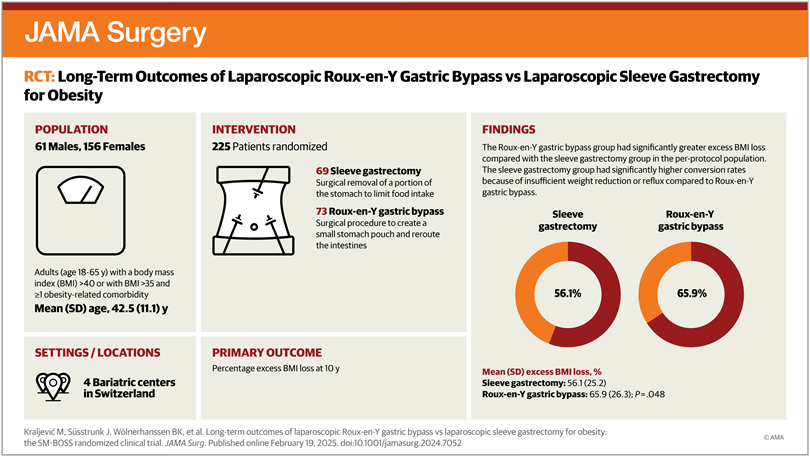
TABLE OF CONTENTS1. Why Most Patients Ask the Wrong Question2. Two Patients, Two Right Answers3. What Each Operation Actually Is4. How They Work: Why Restriction Is the Least Important Part5. The Study That Proves Weight Loss Is Not the Whole Story6. Weight Loss: What the Ten-Year Randomized Data Show7. The Hidden Number Inside Every Statistic8. Diabetes Remission9. Blood Pressure, Cholesterol, and Cardiovascular Risk10. Reflux and Barrett's Esophagus: The Defining Difference11. Revision vs. Reintervention: Two Different Fears12. Safety: The Sleeve's Strongest Argument13. Vitamins and Nutritional Deficiency: The Myth and the Real Risk14. Complications Unique to Each Operation15. What Daily Life Actually Feels Like16. How Surgeons Actually Decide17. Special Situations18. FAQ19. People Also Ask20. Sleeve vs. Bypass by the Numbers21. Key Takeaways---INTRODUCTIONMost people choose the wrong operation for the right reason.They choose the sleeve because it sounds safer and smaller and less permanent.They choose the bypass because someone told them it was stronger. Neither ofthose is a medical decision. Both are emotional decisions dressed up in medicallanguage.Here is the number that should reframe this entire conversation. In SM-BOSS,the Swiss Multicenter Bypass or Sleeve Study, which randomized 217 patients andfollowed them beyond ten years, nearly one in three sleeve patients ended upneeding a second operation. Specifically, 29.9 percent were converted to adifferent anatomy, most of them for weight recurrence or for reflux, comparedwith 5.5 percent of bypass patients.That is not an indictment of the sleeve. The sleeve gastrectomy is an excellentoperation and for the right patient it is the correct and definitive one. It isan indictment of how the decision gets made.This guide covers what the ten-year randomized trials, the national registries,and the meta-analyses actually show. Where the bypass clearly wins. Where thesleeve clearly wins. And the places where the evidence genuinely conflicts,which we will name rather than smooth over.By the end you will not have a universal answer. You will have something moreuseful: the framework a bariatric surgeon uses to match the operation to thepatient.---Why Most Patients Ask the Wrong QuestionBefore comparing anything, it helps to understand what is actually beingdecided.This is not a diet you can abandon. It is not a medication you can stop nextmonth. This is a permanent anatomical change to the digestive system, performedto treat a chronic, relapsing disease.Obesity is not a willpower problem. It is a disease of energy regulation drivenby hormones, genetics, environment, and neurobiology. Like every chronicdisease, it has periods of control and periods of recurrence.Bariatric surgery is the most effective treatment available for that disease.But it is a treatment, not a cure. And these two operations treat it throughpartially different mechanisms.So the real question is never which operation is better. The real question iswhich mechanism a particular body needs.One point deserves emphasis before any comparison begins. Both operations work.Both are safe, with perioperative mortality in modern series ranging fromroughly 0.03 to 0.2 percent, which is in the same range as gallbladder surgeryand lower than hip replacement. Both dramatically outperform diet, exercise,and medication alone for long-term weight loss and metabolic disease.This is not a choice between a good operation and a bad one. It is a choicebetween two very good operations that fail in different directions. Knowingwhich direction you are vulnerable to is the entire game.---Two Patients, Two Right AnswersConsider two patients. Both are composites of real presentations.The first is a 41-year-old woman with a BMI of 43. No diabetes. No reflux.Otherwise healthy. She works twelve-hour shifts, has two children, and cannotimagine managing a complex lifelong vitamin regimen. She has done her researchand she wants a sleeve.She is right. For her, the sleeve is very likely the correct operation.The second is a 53-year-old man with a BMI of 46. Type 2 diabetes for fourteenyears, insulin dependent, HbA1c 9.1. He has been on a proton pump inhibitor forsix years, and his last endoscopy showed erosive esophagitis and afour-centimeter hiatal hernia. His brother had a sleeve, loved it, and told himto get the same thing.He also wants a sleeve.Giving that man a sleeve would very likely worsen his reflux and undertreat hisdiabetes, with a meaningful chance he returns within five years asking aboutconversion to bypass.Same question. Two completely different right answers. That is what thiscomparison is really about.---What Each Operation Actually IsSleeve gastrectomy. Approximately 75 to 85 percent of the stomach isremoved along the greater curvature. What remains is a narrow tube roughly theshape of a banana. The portion removed includes the fundus, the upper dome ofthe stomach and the primary production site for the hunger hormone ghrelin.Critically, the intestine is not touched. The pylorus, the muscular valve atthe bottom of the stomach that controls how quickly food empties, stays exactlywhere it is. Food travels the normal route: mouth, esophagus, sleeve, pylorus,duodenum, small intestine.One organ. One staple line. No rerouting.Roux-en-Y gastric bypass. A small pouch is created at the top of thestomach, roughly the size of an egg and holding about 30 milliliters. The smallintestine is then divided and a limb of it is brought up and connected directlyto that pouch. The remainder of the stomach, the duodenum, and the firstportion of the jejunum are bypassed. Digestive juices from the liver andpancreas travel down a separate limb and rejoin the food stream furtherdownstream.Two connections. An entirely new route. The pylorus bypassed.If you remember nothing else about the anatomy, remember this sentence: thesleeve removes stomach, the bypass reroutes intestine. Every singledifference in outcome discussed below flows from that one sentence.---How They Work: Why Restriction Is the Least Important PartBoth operations restrict how much food can be eaten at one sitting. That is theobvious part, and honestly the least important part. If restriction were thewhole story, the operation with the smaller stomach would win every time. Itdoes not.Both operations dramatically change hormones. Removing the fundus in a sleeveremoves the ghrelin factory, and ghrelin levels drop. In the bypass, the fundusis excluded from the food stream, producing a similar effect.Both operations accelerate delivery of nutrients to the distal small intestine,triggering a surge in GLP-1 and PYY. These are the satiety hormones. Theysignal fullness to the brain and improve how the pancreas handles glucose.These are the same pathways the GLP-1 medications target, except surgeryproduces the effect internally and continuously.Here is where they diverge. The bypass adds two mechanisms the sleeve does nothave. First, foregut exclusion: food no longer passes through the duodenum andproximal jejunum, and there is strong evidence this produces metabolicsignaling changes independent of weight. Second, more pronounced hindgutstimulation, because nutrients reach the distal bowel faster and in higherconcentration. The bypass also alters bile acid circulation and the gutmicrobiome more substantially.The practical translation: the bypass is a more aggressive metabolic operation,not simply a more aggressive weight loss operation. Those are different things,and the next section proves it.---The Study That Proves Weight Loss Is Not the Whole StoryThis is the single most misunderstood concept in the entire comparison.Most people assume the bypass controls diabetes better simply because itproduces more weight loss. That assumption is wrong, and there is now dataproving it.Investigators using the Scandinavian Obesity Surgery Registry and the SwedishNational Diabetes Register took 1,440 patients who all had type 2 diabetesbefore surgery, 720 who had bypass and 720 who had sleeve, and matched them oneto one on age, sex, baseline BMI, comorbidities, HbA1c, number of diabetesmedications, insulin use, diabetes duration, year of surgery, and critically,percentage total weight loss at nadir.In other words, they compared bypass and sleeve patients who lost exactly thesame amount of weight.At two years, complete diabetes remission occurred in 68.6 percent of bypasspatients versus 60.8 percent of sleeve patients. The bypass group also hadhigher rates of pharmacological diabetes remission and higher rates ofhypertension remission.Same weight loss. Different metabolic outcome.That finding is profound. The bypass is not simply a better weight lossoperation for people with diabetes. It changes metabolism through mechanismsthat have nothing to do with the number on the scale.This is why, for a patient on insulin with an HbA1c of nine and a fifteen-yearhistory of type 2 diabetes, the thinking shifts strongly toward bypass. Notbecause they need to lose more weight. Because their pancreas needs more helpthan restriction alone can deliver.---Weight Loss: What the Ten-Year Randomized Data ShowTwo landmark randomized controlled trials have followed patients for a decadeor more. This is the highest quality evidence available.SM-BOSS randomized 217 patients and followed them beyond ten years. Inthe intention-to-treat analysis, excess BMI loss was 60.6 percent after sleeveand 65.2 percent after bypass, which was not statistically significant. Totalweight loss was 27.7 percent after bypass versus 25.5 percent after sleeve,also not statistically significant.SLEEVEPASS, from Finland, randomized 240 patients and followed them toten years. At five years, mean excess weight loss was 49 percent after sleeveand 57 percent after bypass. Bypass was numerically better but the trial couldnot establish clinical superiority. At ten years, the same pattern held.Meta-analyses pool trials for statistical power. A 2025 systematic review ofnine randomized trials with at least five years of follow-up, covering 1,489patients, found bypass produced significantly greater excess weight loss byroughly fourteen percentage points and significantly greater total weight lossby 5.67 percentage points. A 2026 meta-analysis restricted specifically toten-year data found a smaller gap: 2.38 percent greater total weight loss and4.92 percent greater excess weight loss after bypass.The plain-language translation. The bypass produces more weight loss.That is consistent across essentially every analysis. But the size of theadvantage is smaller than most people assume and appears to narrow over tenyears. We are talking roughly two to six percentage points of total body weightin the long run. For a 300-pound patient, that is somewhere between six andeighteen pounds.Real, but rarely the deciding factor by itself.---The Hidden Number Inside Every StatisticThere is a catch buried in those weight loss numbers, and it is the mostimportant statistical concept in this entire comparison.In SM-BOSS, the intention-to-treat analysis showed no significant weight lossdifference. But the per-protocol analysis, meaning only patients who still hadthe operation they were originally assigned, showed bypass clearly ahead: 65.9percent versus 56.1 percent excess BMI loss.Why the discrepancy? Because 29.9 percent of sleeve patients were converted toa different anatomy for insufficient weight loss or reflux, compared with only5.5 percent of bypass patients. When those converted patients went on to losemore weight after their bypass, that additional weight loss was counted in thesleeve column.So there are two different questions hiding inside every headline about thiscomparison.Question one: on average, how do patients who start with a sleeve end upcompared to patients who start with a bypass? Answer: roughly similar, but ameaningful fraction of the sleeve group needed a second operation to get there.Question two: if I keep the operation I have, which produces more weightloss? Answer: the bypass, clearly.Most patients think they are asking question two. Most published summaries areanswering question one.---Diabetes RemissionFor many patients, diabetes is the primary indication, not weight.The 2025 meta-analysis of randomized trials with five or more years offollow-up found significantly higher type 2 diabetes remission after bypass,with a risk ratio of 0.72 favoring bypass, though HbA1c levels were similarbetween groups.A blinded randomized trial from New Zealand followed 114 patients with type 2diabetes for five years. Remission, defined strictly as HbA1c below six percentwith no glucose-lowering medications, occurred in 47 percent of bypass patientsversus 33 percent of sleeve patients.Real-world data adds nuance. The PCORnet Bariatric Study compared 6,233 bypassand 3,477 sleeve patients with type 2 diabetes. At five years, total bodyweight loss was 24.1 percent after bypass and 16.1 percent after sleeve.Remission rates were high and close together, 86.1 percent after bypass and83.5 percent after sleeve.But look at what happened after remission. Among patients who achieved it,relapse at five years was 33.1 percent after bypass and 41.6 percent aftersleeve, with a hazard ratio of 0.75 favoring bypass. HbA1c at five years wasreduced 0.4 percentage points more after bypass.So the bypass does not just get more patients into remission. It keeps themthere longer.The honest counterpoint. A meta-analysis of randomized studies foundbypass had a higher chance of remission at one year and at five years by broadcriteria, but no consistent advantage at three years, and the authors concludedthe advantage may be primarily short to medium term. The 2026 ten-yearmeta-analysis found no significant difference in diabetes remission at thedecade mark.The reasonable interpretation: the bypass gets patients into remission faster,gets more of them there, and holds it longer, but over a very long horizon someof that advantage narrows. For long-standing insulin-dependent diabetes, thatearly and durable advantage matters, because those are precisely the patientswhose remaining beta cell function is most time-sensitive.---Blood Pressure, Cholesterol, and Cardiovascular RiskIn SLEEVEPASS at five years there were no statistically significant differencesfor dyslipidemia resolution or quality of life, but bypass produced betterresolution of hypertension based on antihypertensive medication use.The weight-loss-matched Scandinavian registry study found bypass hadsignificantly higher hypertension remission, with an odds ratio of 0.70 forsleeve, but no significant difference in dyslipidemia remission. Importantly,it found no significant difference in the risk of major adverse cardiovascularevents between the two procedures.The 2025 meta-analysis of randomized trials found no significant differences indyslipidemia, hypertension, obstructive sleep apnea, or joint pain.The takeaway here is deliberately more moderate than the diabetes discussion.Both operations produce large improvements in blood pressure, lipids, and sleepapnea. The bypass may have a modest edge on hypertension. For most othercardiometabolic outcomes the operations are close, and the evidence does notsupport choosing one over the other on those grounds alone.Cholesterol will not break the tie. Reflux will.---Reflux and Barrett's Esophagus: The Defining DifferenceIf there is one section to remember, it is this one. Reflux is the mostconsistent, most reproducible, and most clinically consequential differencebetween these two operations.The randomized trials. In SM-BOSS at five years, reflux remissionoccurred in 60.4 percent of bypass patients versus 25 percent of sleevepatients, and reflux worsened in 31.8 percent after sleeve versus 6.3 percentafter bypass. At ten years, sleeve patients had significantly more new-onsetreflux.In SLEEVEPASS at ten years, patients underwent actual endoscopy rather thansymptom questionnaires alone. Esophagitis was found in 31 percent of sleevepatients versus 7 percent of bypass patients. Proton pump inhibitor use was 64percent after sleeve versus 36 percent after bypass. Reflux quality of lifescores were significantly worse after sleeve.The finding that should change practice. The Oseberg randomized trialused the most rigorous testing available, combining questionnaires, 24-hour pHmonitoring, high-resolution manometry, and endoscopy. Sleeve patients had asubstantially higher one-year risk of acid reflux and new-onset esophagitisthan bypass patients. And most patients with esophagitis or acid reflux wereasymptomatic.Most of the reflux damage after sleeve was silent. Feeling fine is not the sameas being fine.Barrett's esophagus: where the data genuinely conflict. This deserveshonesty rather than resolution.A prospective multicenter study with more than ten years of endoscopicfollow-up found erosive esophagitis in 74.7 percent of sleeve patients versus22 percent of bypass patients, and Barrett's esophagus in 16.8 percent ofsleeve patients and in none of the other groups studied.But SLEEVEPASS, a randomized trial with protocol endoscopy, found de novoBarrett's in 4 percent after sleeve and 4 percent after bypass, with nosignificant difference, and all findings were short-segment with no dysplasia.And a large claims analysis of 8,362 matched pairs found reflux more commonafter sleeve, but Barrett's actually more prevalent in the bypass group at 1.1percent versus 0.7 percent, with no difference in histologic diagnoses.What this means practically. Sleeve gastrectomy clearly causes morereflux symptoms, more esophagitis, and more acid-suppression medication usethan bypass. That is not in dispute anywhere in the literature. Whether itcauses clinically significant Barrett's esophagus at high rates is genuinelydebated, with high-quality studies pointing in different directions.The appropriate response to that uncertainty is straightforward. Significantpreoperative reflux, a large hiatal hernia, or any evidence of Barrett's arguesstrongly for bypass. And regardless of which operation is performed, endoscopicsurveillance matters, because the Oseberg data tell us the damage can becompletely silent.---Revision vs. Reintervention: Two Different FearsPatients hear the word revision and assume it means the same thing for bothoperations. It does not. Two different things are being counted, and they pointin opposite directions.Surgical revision means converting one operation into another becausethe first did not do its job. Here the sleeve has the higher rate. In aMedicare cohort of 95,405 patients, cumulative surgical revision at five yearswas 2.91 percent after sleeve versus 1.46 percent after bypass. A commercialclaims analysis of 194,248 patients found a 21 percent higher risk ofrevisional surgery after sleeve. And SM-BOSS converted 29.9 percent of itssleeve patients.Reintervention means any additional procedure: endoscopy, hernia repair,obstruction surgery, ulcer management. Here the bypass has the higher rate. Inthat same Medicare cohort, cumulative reintervention at five years was 33.57percent after bypass versus 25.23 percent after sleeve.So the pattern is this: the sleeve is more likely to need to be convertedinto something else, and the bypass is more likely to need something done toit.If the fear is a second major operation to fix inadequate results, that arguestoward bypass. If the fear is a lifetime of procedures, scopes, and emergencyvisits, that argues toward sleeve. Neither fear is irrational. They are justdifferent fears, and it is worth knowing which one is actually driving thedecision.---Safety: The Sleeve's Strongest ArgumentBoth operations are remarkably safe. Perioperative mortality across modernseries ranges from 0.03 to 0.2 percent. Thirty-day serious adverse events aregenerally under six percent, ranging from 0.8 to 5.6 percent for sleeve and 1.4to 9.4 percent for bypass. Readmission runs 2.8 to 4.8 percent for sleeve and4.7 to 6.5 percent for bypass.The long-term comparative data is where the sleeve makes its strongest case.In the Medicare cohort of 95,405 patients followed five years, sleevegastrectomy was associated with lower cumulative mortality at 4.27 percentversus 5.67 percent, lower complications at 22.10 percent versus 29.03 percent,and lower reintervention at 25.23 percent versus 33.57 percent.A separate Medicare analysis of 30,105 patients found that among disabledbeneficiaries, three-year mortality was 2.1 percent after sleeve versus 3.2percent after bypass, with lower complications, reinterventions, emergencydepartment use, and rehospitalization.The commercial claims analysis found sleeve associated with a 23 percent lower30-day readmission rate, 18 percent fewer emergency room visits, and 13 percentless gastrointestinal bleeding.The randomized data agrees on one specific point. The 2025 meta-analysis ofnine randomized trials found sleeve was associated with significantly lowerlate major complications, with a risk ratio of 0.41, while early complicationsdid not differ significantly.One important caveat. The Medicare population is older and sicker thanthe average bariatric patient. A 57-year-old with multiple comorbidities is notthe same risk profile as a 38-year-old with a BMI of 42 and no other medicalproblems. The direction of the finding is real. The absolute numbers do nottransfer to every patient.But the message stands: the sleeve is the safer of two safe operations,especially over the long run and especially in higher-risk patients.---Vitamins and Nutritional Deficiency: The Myth and the Real RiskHere is where conventional wisdom needs correcting.The standard teaching is that the bypass causes malnutrition and the sleevedoes not. That is too simple, and believing it can cause harm.A meta-analysis of ten randomized controlled trials found no significantdifference between the operations in anemia, iron deficiency, or folatedeficiency. The one clear difference was vitamin B12, where deficiency risk was1.86 times higher after bypass.The ten-year nutritional secondary analysis of SLEEVEPASS provides the bestlong-term randomized data available. Deficiencies were rare after bothoperations. Only iron deficiency was significantly more common after bypass, at41 percent versus 14 percent by ferritin.But buried in that same analysis is the finding that matters most clinically: supplementadherence was significantly lower after sleeve, at 71 percent versus 89percent.Consider what that means. The bypass carries a higher biological requirement,so patients and surgeons take supplementation seriously and adherence stayshigh. The sleeve is perceived as the low-maintenance operation, sosupplementation quietly lapses. Those two effects partially cancel out, whichis exactly why the deficiency rates end up closer than anyone predicts.The practical instruction: choosing the sleeve does not release anyonefrom lifelong supplementation and lifelong lab monitoring. The perception thatit does is itself the risk factor.---Complications Unique to Each OperationEach operation has a signature complication profile.After sleeve gastrectomy: leak at the angle of His, which is uncommonbut notoriously harder to manage than a bypass leak because of thehigher-pressure tubular anatomy; stenosis or twisting of the sleeve;progressive reflux; and in some patients, Barrett's esophagus.After gastric bypass: marginal ulcer at the gastrojejunal connection,particularly in smokers and chronic NSAID users; internal hernia, where bowelslips through a mesenteric defect and can obstruct or strangulate; small bowelobstruction; anastomotic stricture; and dumping syndrome. The bypass alsogenerates roughly double the rate of upper endoscopy over the years compared tothe sleeve.Notice the pattern. The sleeve's problems are mostly problems of pressure andacid. The bypass's problems are mostly problems of connections and reroutedanatomy. That traces directly back to the core distinction: one operationremoves an organ, the other reroutes a system.---What Daily Life Actually Feels LikeStatistics are not the same as living with an operation.A cross-sectional comparison found that bypass patients reported more diarrheaand more indigestion, while sleeve patients reported more reflux. Thirty-twopercent of sleeve patients were on acid-reducing medication versus twelvepercent of bypass patients.Chronic abdominal pain deserves honest mention. In a cross-cohort analysis, itrose to 28.7 percent and 26.9 percent at two years after the two procedures,comparable between them. That is a real number that does not get discussedenough in consultations.The Oseberg randomized trial examined patient-reported outcomes at three years.Dumping and overall gastrointestinal symptom burden did not differsignificantly between groups, but the bypass group had greater weight-relatedquality of life improvement, less reflux, and higher diabetes remission.So the lived experience difference is not that one operation is comfortable andthe other is not. They are uncomfortable in different ways. Bypass patientstrade some bowel symptoms for better reflux control and better metabolicoutcomes. Sleeve patients trade reflux risk for simpler anatomy and fewerinterventions.---How Surgeons Actually DecideLean toward gastric bypass with:- Significant reflux, erosive esophagitis, or a sizable hiatal hernia- Any evidence of Barrett's esophagus- Type 2 diabetes that is insulin dependent, long-standing, or poorlycontrolled- Very high BMI where every percentage point of weight loss matters- Severe dyslipidemia- Prior failure of a restrictive procedureLean toward sleeve gastrectomy with:- No meaningful reflux- Higher perioperative risk from age, cardiac disease, or pulmonary disease,where the shorter and simpler operation matters- Inflammatory bowel disease, where leaving the small intestine untouched ispreferable- Transplant candidacy or likely future need for endoscopic access to the bileduct, which is far more difficult after bypass- A genuine chronic NSAID requirement, given marginal ulcer risk- Severe adhesions from prior abdominal surgery making bypass technicallyhazardousFactors that should not decide this: fear of the word bypass, what afamily member had, a social media consensus, the belief that the sleeve isreversible (it is not, most of the stomach has been removed), and the beliefthat the sleeve is a starter surgery. For the right patient, the sleeve is adefinitive operation, not a stepping stone.---Special SituationsPregnancy. Women planning pregnancy should generally wait twelve toeighteen months after either operation to allow weight stabilization andnutritional optimization, with careful iron and B12 monitoring throughout.Kidney stones. Bypass increases oxalate-related stone risk. Patientswith a stone history should discuss this specifically.Smoking. Continuing to smoke after a bypass substantially raisesmarginal ulcer risk. This is a genuine consideration in procedure selection,not just a lecture.Staged approaches. Sleeve first with a planned second-stage procedurelater remains a legitimate strategy in patients with very high BMI, and it isdifferent from a sleeve that unexpectedly requires conversion.The uncomfortable truth about both operations. The operation is roughlytwenty percent of the result. Both procedures vastly outperform diet, exercise,and medication alone. But once either is chosen, the difference between anexcellent ten-year outcome and a disappointing one has very little to do withwhich staple line was created. It has to do with follow-up attendance, proteinintake, resistance training to protect the muscle that drives metabolism,lifelong supplementation and lab monitoring, and whether the emotional eatingthat no operation can touch ever gets addressed.
Obesity By The Numbers
Do I need vitamins for life after a sleeve?Yes. This is one of the most dangerous misconceptions in bariatric surgery. Theten-year nutritional analysis of SLEEVEPASS found supplement adherence of only71 percent after sleeve compared with 89 percent after bypass, preciselybecause the sleeve is perceived as low maintenance. Deficiencies were rareafter both operations in that trial, but that outcome depended on thesupplementation actually being taken. Lifelong supplementation and lifelong labmonitoring are required after both procedures.Can a sleeve be converted to a bypass later?Yes, and it is a common operation. In SM-BOSS, 29.9 percent of sleeve patientswere eventually converted, most often for reflux or for weight recurrence.Conversion to Roux-en-Y gastric bypass is the standard approach for intractablereflux after sleeve. Conversion carries higher complication rates than aprimary bypass, which is one reason getting the initial choice right matters.Is the sleeve reversible?No. Approximately 75 to 85 percent of the stomach is permanently removed andcannot be restored. The sleeve is often described as less invasive than bypass,which is accurate, but that is not the same as reversible. Neither operationshould be chosen on the assumption that it can be undone.Which operation has more long-term complications?It depends on which complication. The 2025 meta-analysis of nine randomizedtrials found sleeve associated with significantly lower late majorcomplications, with a risk ratio of 0.41. But the sleeve has a higher rate ofsurgical revision to a different operation, at 2.91 versus 1.46 percent at fiveyears, while the bypass has a higher rate of overall reintervention, at 33.57versus 25.23 percent at five years.What is dumping syndrome and will I get it?Dumping syndrome occurs when food, particularly simple sugar, passes rapidlyinto the small intestine without the pylorus regulating flow. Early dumpingcauses cramping, nausea, diarrhea, flushing, and rapid heart rate within 10 to30 minutes of eating. Late dumping causes reactive hypoglycemia one to threehours later. It is far more common after bypass, where the pylorus is bypassed,than after sleeve, where it is preserved. Some patients consider it a usefuldeterrent to sugar intake. Others find it debilitating.Can I take NSAIDs after either operation?Chronic NSAID use substantially increases marginal ulcer risk after gastricbypass and is generally avoided. NSAIDs are somewhat better tolerated aftersleeve, though still not encouraged. A genuine ongoing NSAID requirement, suchas for inflammatory arthritis, is a meaningful argument in favor of sleeve.Does insurance cover both operations?Most plans cover both when medical necessity criteria are met, typically BMI of40 or above, or BMI of 35 or above with obesity-related conditions. Coveragerequirements vary. Many insurers require a supervised weight-loss program,nutritional counseling, and psychological evaluation before authorization.Insurance rarely dictates which of the two operations is chosen.
People Also Ask
What is the failure rate of gastric sleeve surgery?There is no single agreed definition of failure. Using conversion to anotheroperation as the measure, SM-BOSS reported 29.9 percent of sleeve patientsconverted over more than ten years, though that trial had unusually intensivefollow-up. Using surgical revision in a real-world Medicare population, thefive-year cumulative rate was 2.91 percent. Using weight recurrence, roughlyone in six bariatric patients across procedures experiences 10 percent orgreater regain from their lowest weight.Which surgery has the fastest recovery?The sleeve. It is a single-organ operation with one staple line and nointestinal anastomoses, so operative time is shorter and the early recovery isgenerally simpler. Both operations are typically performed laparoscopically orrobotically with a one to two night hospital stay and return to most activitywithin two to four weeks.Can you have a bypass if you already had a sleeve?Yes. Sleeve to Roux-en-Y gastric bypass is the most commonly performedrevisional bariatric procedure in the United States. It is the gold standardconversion for intractable reflux after sleeve, with reflux resolution reportedin 80 to 94 percent of patients, and it also produces additional weight loss.Which operation is better for a BMI over 50?Higher BMI generally favors the more powerful metabolic operations. Bypassproduces more weight loss than sleeve, and the duodenal switch proceduresproduce more than bypass. However, higher BMI also correlates with higherperioperative risk, which is why staged approaches, starting with sleeve andadding a second-stage procedure later, remain a legitimate strategy in thispopulation.Do you lose weight faster with sleeve or bypass?Both produce rapid early weight loss, with the bypass generally slightly fasterin the first year. The more meaningful difference is durability. In SLEEVEPASSat five years, mean excess weight loss was 49 percent after sleeve and 57percent after bypass, and that gap reflects differences in maintenance ratherthan initial speed.What happens if you regain weight after either surgery?Some regain from the lowest weight is expected after every bariatric procedure.Options include intensive nutritional and behavioral support, GLP-1 receptoragonist medication layered on top of the surgery, endoscopic revision for adilated gastrojejunal anastomosis after bypass, and surgical revision. Thesingle strongest predictor of trouble after either operation is loss tofollow-up, not procedure type.
Sleeve vs. Bypass by the Numbers (Related Stats Box)
Outcome
Sleeve Gastrectomy
Gastric Bypass
Excess BMI loss, SM-BOSS, 10+ yr, ITT
60.6%
65.2%
Excess BMI loss, SM-BOSS, per protocol
56.1%
65.9%
Total weight loss, SM-BOSS, 10+ yr
25.5%
27.7%
Excess weight loss, SLEEVEPASS, 5 yr
49%
57%
Additional TWL from meta-analysis, 5+ yr
reference
+5.67 percentage points
Additional TWL from meta-analysis, 10 yr
reference
+2.38 percentage points
Conversion to another operation, SM-BOSS
29.9%
5.5%
Diabetes remission, weight-matched registry, 2 yr
60.8%
68.6%
Diabetes remission, blinded RCT, 5 yr, strict criteria
33%
47%
Diabetes relapse after remission, 5 yr
41.6%
33.1%
Reflux remission, SM-BOSS, 5 yr
25%
60.4%
Reflux worsened, SM-BOSS, 5 yr
31.8%
6.3%
Endoscopic esophagitis, SLEEVEPASS, 10 yr
31%
7%
PPI use, SLEEVEPASS, 10 yr
64%
36%
De novo Barrett's, SLEEVEPASS, 10 yr
4%
4%
Perioperative mortality, modern series
0.03 to 0.2%
0.03 to 0.2%
30-day serious adverse events
0.8 to 5.6%
1.4 to 9.4%
30-day readmission
2.8 to 4.8%
4.7 to 6.5%
Cumulative mortality, Medicare, 5 yr
4.27%
5.67%
Cumulative complications, Medicare, 5 yr
22.10%
29.03%
Cumulative reintervention, Medicare, 5 yr
25.23%
33.57%
Cumulative surgical revision, Medicare, 5 yr
2.91%
1.46%
Late major complications, RCT meta-analysis
reference
RR 0.41 favoring sleeve
Iron deficiency by ferritin, SLEEVEPASS, 10 yr
14%
41%
B12 deficiency risk, RCT meta-analysis
reference
1.86x higher after bypass
Supplement adherence, SLEEVEPASS, 10 yr
71%
89%
Acid-reducing medication use, cross-sectional
32%
12%
Chronic abdominal pain, 2 yr
28.7%
26.9%
Number of anastomoses
0
2
Pylorus preserved
Yes
No
Dumping syndrome risk
Low
Up to 40%
The sleeve reduces ghrelin and increases GLP‑1/PYY modestly. The bypass dramatically increases GLP‑1/PYY, reduces acid exposure, improves insulin sensitivity, and alters gut hormone signaling more profoundly.
Medical Topics Covered


Dr. de la Cruz‑Muñoz specializes in advanced minimally invasive and robotic surgery, metabolic disease management, and comprehensive long‑term patient care. His work integrates clinical expertise, academic leadership, and a commitment to evidence‑based medicine. He has trained surgeons across the country, contributed to national guidelines, and is widely regarded for his outcomes, innovation, and patient‑centered approach.
Patients choose Dr. de la Cruz‑Muñoz for his combination of surgical excellence, metabolic expertise, and lifelong dedication to improving patient health through compassionate, high‑quality care.
Procedures We Offer








FAQ
Neither is universally better. Ten-yearrandomized trials show the bypass produces modestly more weight loss, roughlytwo to six percentage points of total body weight, along with higher diabetesremission and substantially better reflux control. The sleeve is simpler andshows lower five-year mortality, complications, and reinterventions in largeregistry data. The correct choice depends on reflux status, diabetes severityand duration, perioperative risk, and individual anatomy.
Less than most people expect. Meta-analyses ofrandomized trials with five or more years of follow-up show bypass ahead byroughly 5.67 percentage points of total weight loss, and analyses restricted toten-year data show a smaller gap of about 2.38 percentage points. For a300-pound patient, that is roughly six to eighteen pounds at a decade out.
Both are very safe, with perioperative mortalityof roughly 0.03 to 0.2 percent. Over the longer term, the sleeve has anadvantage. In a Medicare cohort of 95,405 patients followed five years, sleevewas associated with lower cumulative mortality at 4.27 versus 5.67 percent,fewer complications, and fewer reinterventions. That population was older andsicker than the average bariatric patient, so absolute numbers do not transferdirectly to younger patients.
It substantially increases the risk. InSLEEVEPASS at ten years, endoscopic esophagitis was found in 31 percent ofsleeve patients versus 7 percent of bypass patients, and PPI use was 64 percentversus 36 percent. The Oseberg trial found that most patients with esophagitisor acid reflux after surgery were asymptomatic, meaning the damage can besilent. Patients with significant preoperative reflux are generally betterserved by bypass.
Bypass, particularly for long-standing orinsulin-dependent diabetes. A registry study that matched 1,440 patients on theexact amount of weight lost still found higher complete remission after bypassat 68.6 versus 60.8 percent, demonstrating a weight-independent metaboliceffect. Bypass also shows lower relapse after remission, at 33.1 versus 41.6percent at five years.
People Also Ask
Obesity is recognized as a chronic metabolic disease influenced by genetics, hormones, environment, and biological factors — not simply lifestyle choices.
The body has built-in mechanisms that defend weight, including hunger hormones and metabolic adaptations that make long-term weight loss challenging.
Yes. Genetics can significantly influence body weight regulation, appetite, metabolism, and an individual's susceptibility to obesity.
GLP-1 medications help regulate appetite, slow stomach emptying, improve satiety, and support sustainable weight management.
Yes. Obesity is associated with conditions such as Type 2 diabetes, hypertension, sleep apnea, fatty liver disease, and cardiovascular disease.
Dieting alone often cannot overcome the biological adaptations that increase hunger and decrease energy expenditure after weight loss.
Medical evaluation may be appropriate when excess weight affects health, quality of life, or contributes to obesity-related medical conditions.
Yes. Bariatric surgery addresses biological and metabolic factors involved in obesity and can lead to significant long-term health improvements.