

How I Choose the Right Bariatric Procedure: My Surgical Decision Framework

Quick Answer
Watch Related Video
Article
Most people think choosing a bariatric procedure is like choosing from a menu.
Sleeve? Bypass? SADI? DS?
But that's not how I practice.
The right surgery is not chosen based on preference, popularity, or what a friend had. It's chosen based on your biology, your anatomy, your metabolic severity, and your long-term health risks.
And most importantly, it's chosen together.
This is my real decision-making framework.
Shared Decision-Making Is the Foundation
The first step in choosing the right procedure is not the anatomy. It's not the comorbidities. It's not the imaging.
It's the conversation.
Shared decision-making means I explain your biology, your risks, and your long-term health trajectory. I explain what each surgery can and cannot do. And then we choose the safest, most effective option together.
This is not a paternalistic process. It's a partnership.
Current guidelines from the American Society for Metabolic and Bariatric Surgery and the American Diabetes Association recommend that all patients with severe obesity be engaged in a shared decision-making conversation about the risks and benefits of surgery, and that patients should be referred to surgeons comfortable performing multiple procedures so they have the greatest opportunity to make an informed choice. Studies have shown that when patients with diabetes are given complete information about the metabolic differences between procedures, significantly more choose gastric bypass over the sleeve, and those who choose the bypass have higher diabetes remission rates.
That's the power of real information. When patients understand the biology, they make better decisions
I Don't Choose Surgery Based on Hunger Biology
A common misconception is that surgeons choose procedures based on hunger.
Sleeve reduces hunger. Bypass reduces hunger more. SADI reduces hunger even more.
But hunger biology is not how I choose a procedure.
The two factors that actually determine long-term outcomes are insulin biology and metabolic disease severity.
Insulin biology refers to how your body handles glucose, insulin, and insulin resistance. Metabolic disease severity refers to how advanced your metabolic dysfunction is: diabetes, prediabetes, fatty liver, cardiovascular risk.
These two factors predict long-term weight trajectory, diabetes remission, cardiovascular protection, risk of complications, and durability of results.
The data support this. A meta-analysis of randomized controlled trials found that gastric bypass produced significantly higher diabetes remission than sleeve gastrectomy, with nearly three times the odds of remission. The Oseberg trial, a triple-blind randomized study, confirmed that gastric bypass produced diabetes remission in 50 percent of patients at 5 years versus 20 percent after sleeve. And duodenal switch procedures push those numbers even higher: validation studies of the Individualized Metabolic Surgery score found that DS-type procedures achieved 81 percent long-term diabetes remission in patients with moderate disease and 42 percent in severe disease, rates significantly superior to those observed after sleeve or bypass.
The more severe the metabolic disease, the more powerful the operation needs to be. That's the principle.
Hunger biology is real. But it's not the driver.
Esophageal Function Matters, and Reflux Is Last
Anatomy matters, but not in the oversimplified way most people think.
Here is my actual hierarchy:
1. Prior surgeries. They change the entire surgical landscape.
2. Esophageal function. Weak motility, dysmotility, or poor contraction patterns can make certain surgeries unsafe or ineffective.
3. Anatomical constraints. Stomach shape, hiatal hernias, scar tissue, foregut anatomy.
4. Reflux (last). Reflux matters, but it is not the primary determinant. It is one piece of a much larger picture.
This is a more nuanced, foregut-driven approach than what most patients have heard.
The esophageal function piece deserves more explanation, because it's the most overlooked factor in bariatric surgery selection. Systematic reviews of preoperative esophageal testing have found that the prevalence of esophageal motility disorders and GERD is significant in patients with morbid obesity, and that procedure selection should be tailored not only for weight reduction but also for prevention of further deterioration in esophageal function and its consequences, including Barrett's esophagus and esophageal adenocarcinoma. In large cohorts of bariatric patients, esophageal manometry has found pathology in 25 percent of patients overall, rising to over 40 percent in those with symptoms.
What does this mean in practice? Studies of patients with confirmed esophageal motility disorders who underwent sleeve gastrectomy found that achalasia was not resolved after surgery and was constantly associated with disabling food blockage or GERD symptoms. Nutcracker esophagus also led to poor outcomes, with the majority of patients requiring conversion to gastric bypass. In other words, performing a sleeve on a patient with certain motility disorders can create problems that are worse than the original disease.
That's why I test. And that's why esophageal function sits above reflux in my hierarchy.
Reflux still matters. The data are clear: an 8-year prospective study found that nearly 95 percent of sleeve patients met criteria for conclusive GERD, compared to only 25 percent after gastric bypass. A 10-year multicenter prospective study found Barrett's esophagus in nearly 17 percent of sleeve patients and zero percent after bypass. If you have significant reflux, the sleeve is the wrong operation. But reflux is the last filter, not the first.
My Real Framework: Preventing the Complications of the Complications
I am not just treating obesity.
I am preventing the complications of obesity, and the complications of those complications.
This includes cardiovascular disease, myocardial infarction, stroke, kidney failure, neuropathy, retinopathy, long-term disability, and premature mortality.
The data on this are striking. Meta-analyses of population-based cohort studies have found that bariatric surgery reduces the risk of major adverse cardiovascular events by 47 percent, myocardial infarction by 60 percent, cardiovascular death by 57 percent, and all-cause death by 56 percent. Separate analyses have confirmed a 52 percent reduction in cardiovascular mortality and a 55 percent reduction in heart failure. For patients with diabetes, the mortality benefit is even greater: a median life expectancy gain of more than 9 years.
This is why metabolic severity matters so much. This is why insulin biology matters so much. The "right" surgery is the one that protects your future health, not just your weight.
When a Sleeve Fits My Framework, and When It Doesn't
The sleeve is an excellent operation for the right biology.
I choose a sleeve when metabolic disease is mild, insulin resistance is not severe, cardiovascular risk is low, anatomy supports it, esophageal function is normal, and long-term metabolic needs are modest.
I do not choose a sleeve when diabetes is advanced, insulin resistance is severe, cardiovascular risk is high, esophageal motility is abnormal, or prior surgeries complicate the anatomy.
The sleeve produces about 25 percent total body weight loss at one year and diabetes remission in 60 to 78 percent of patients. For a patient with a BMI of 38, no diabetes, no reflux, and normal esophageal function, that's an excellent outcome with the simplest, safest procedure available. Mortality is 0.1 percent, similar to gallbladder surgery.
But for a patient with a BMI of 50, insulin-dependent diabetes, and an HbA1c of 9, the sleeve is unlikely to produce enough metabolic change. That patient needs a more powerful tool.
When I Choose Bypass or SADI: The High-Power Tools
Sometimes a sleeve is not enough.
I choose bypass or SADI when metabolic disease is moderate to severe, insulin resistance is high, cardiovascular risk is significant, diabetes requires stronger hormonal change, a patient has regained weight after a sleeve, or long-term metabolic protection is the priority.
Meta-analyses comparing SADI-S to Roux-en-Y gastric bypass have found that SADI-S produces significantly higher total weight loss (mean difference of about 10 percent), significantly higher excess weight loss, and significantly higher diabetes remission (nearly 3.5 times the odds), with a similar number of long-term complications. In patients with BMI above 50, randomized trials with 15-year follow-up have shown the duodenal switch produces 37.5 percent total weight loss versus 22.8 percent for bypass.
These surgeries are not "more extreme." They are more powerful. And they are the right tool for the right biology.
But they also demand more. The nutritional monitoring requirements after duodenal switch procedures are the highest of any bariatric operation. Fat-soluble vitamin deficiencies (A, D, E, K), iron, zinc, and copper all require aggressive supplementation and regular lab monitoring. A patient who cannot commit to lifelong follow-up and supplementation is not a good candidate for these procedures, regardless of their BMI or metabolic severity.
My Actual Algorithm: The One I Use in Clinic
Here is the real decision tree I use with every patient:
1. Metabolic severity
2. Insulin biology
3. Cardiovascular risk
4. Esophageal function
5. Anatomy and prior surgeries
6. Reflux (last)
7. Shared decision-making
The right surgery is the one that protects your future health, not just your weight.
Real science. Real surgery. Real results.
Obesity By The Numbers
Procedure selection is driven by metabolic disease severity, insulin resistance, esophageal motility, foregut anatomy, cardiovascular risk, and long‑term metabolic protection.
Medical Topics Covered
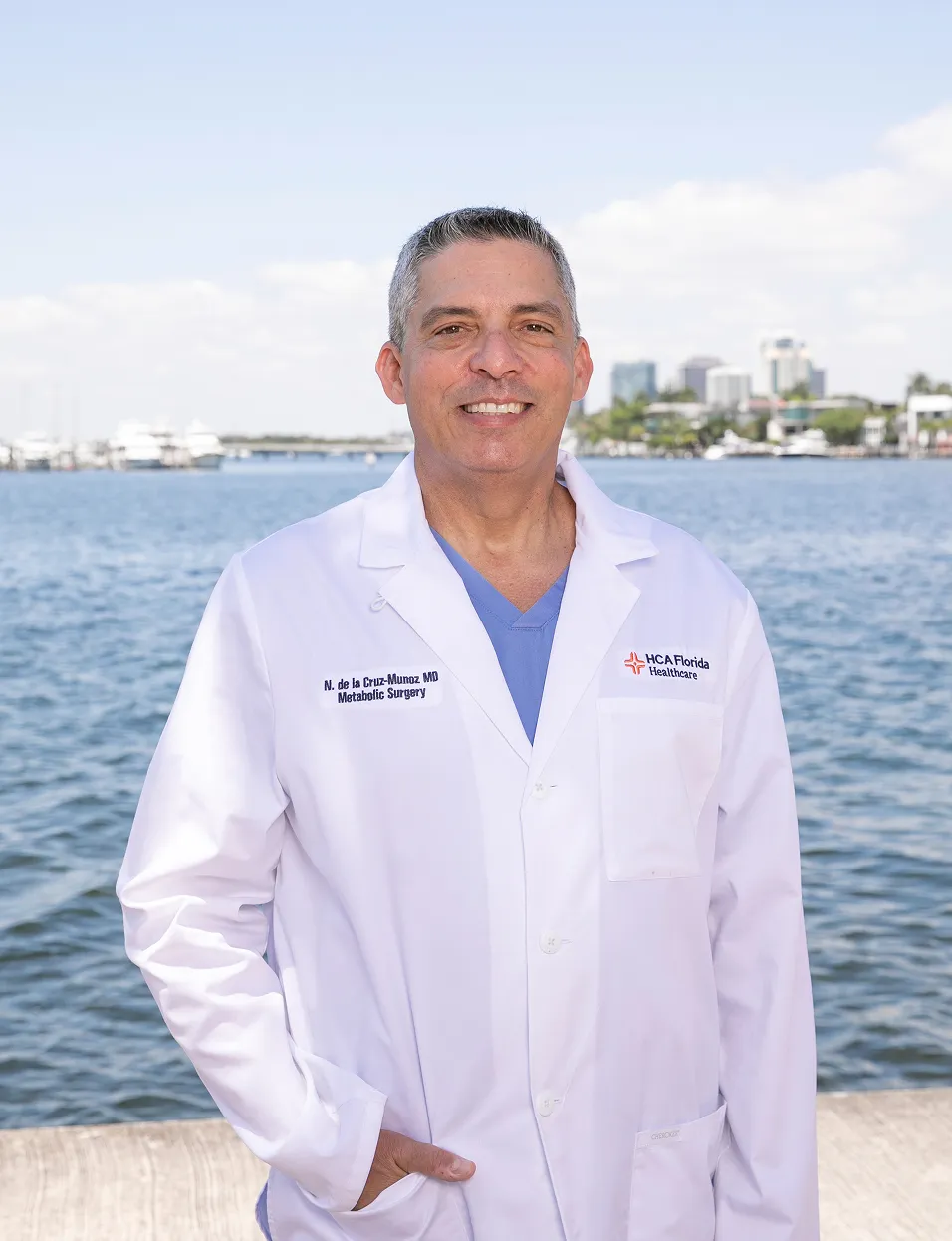

Dr. de la Cruz‑Muñoz specializes in advanced minimally invasive and robotic surgery, metabolic disease management, and comprehensive long‑term patient care. His work integrates clinical expertise, academic leadership, and a commitment to evidence‑based medicine. He has trained surgeons across the country, contributed to national guidelines, and is widely regarded for his outcomes, innovation, and patient‑centered approach.
Patients choose Dr. de la Cruz‑Muñoz for his combination of surgical excellence, metabolic expertise, and lifelong dedication to improving patient health through compassionate, high‑quality care.
Procedures We Offer
Conditions

FAQ
People Also Ask
Obesity is recognized as a chronic metabolic disease influenced by genetics, hormones, environment, and biological factors — not simply lifestyle choices.
The body has built-in mechanisms that defend weight, including hunger hormones and metabolic adaptations that make long-term weight loss challenging.
Yes. Genetics can significantly influence body weight regulation, appetite, metabolism, and an individual's susceptibility to obesity.
GLP-1 medications help regulate appetite, slow stomach emptying, improve satiety, and support sustainable weight management.
Yes. Obesity is associated with conditions such as Type 2 diabetes, hypertension, sleep apnea, fatty liver disease, and cardiovascular disease.
Dieting alone often cannot overcome the biological adaptations that increase hunger and decrease energy expenditure after weight loss.
Medical evaluation may be appropriate when excess weight affects health, quality of life, or contributes to obesity-related medical conditions.
Yes. Bariatric surgery addresses biological and metabolic factors involved in obesity and can lead to significant long-term health improvements.