Which Bariatric Surgery Is Best for You?

Quick Answer
Watch Related Video
There is no single best bariatric surgery.
There is only the best bariatric surgery for you.
That distinction matters more than almost anything else you will read about weight loss surgery. Right now, millions of patients choose an operation because it is popular, because a friend had it, or because a video told them it was the safest and least invasive option. And too many of them are never warned about the reflux that can get worse, the diabetes that does not fully resolve, or the weight that comes back and leads to a revision that was completely avoidable.
Choosing the wrong operation does not just cost you results. It can cost you years. You can end up back in a surgeon's office, heavier, sicker, and facing a second surgery you never needed. This guide walks you through exactly how an experienced bariatric surgeon selects the right operation, so you can make an informed decision the first time.
Why There Is No One-Size-Fits-All Bariatric Surgery
Imagine walking into a car dealership and the salesperson hands you the keys to a truck before asking where you drive, how many kids you have, or whether you even need a truck. That is what it looks like when a surgeon recommends the same operation to every patient.
The right choice depends on your weight, your medical conditions, your anatomy, your esophageal function, your prior surgeries, your mental health, your nutritional habits, and your goals. It also depends on finding a surgeon who is comfortable performing multiple procedures, not just one, so the recommendation is driven by what you need rather than limited by what the surgeon can do.
A 2020 JAMA review on the benefits and risks of bariatric surgery emphasized that all patients with severe obesity should be engaged in a shared decision-making conversation, and that the choice of procedure should be driven primarily by informed patient preferences (Arterburn et al., JAMA, 2020). The AACE/TOS/ASMBS clinical practice guidelines similarly base procedure selection on individualized goals, available expertise, patient preferences, and personalized risk stratification rather than a fixed hierarchy (Mechanick et al., Obesity, 2020). Shared decision-making is not a formality. One single-unit study found that a structured shared decision-making process actually changed which procedures diabetic patients selected and altered surgical outcomes (Lo and Hsu, Obesity Surgery, 2023).
The Five Bariatric Procedures on the Table
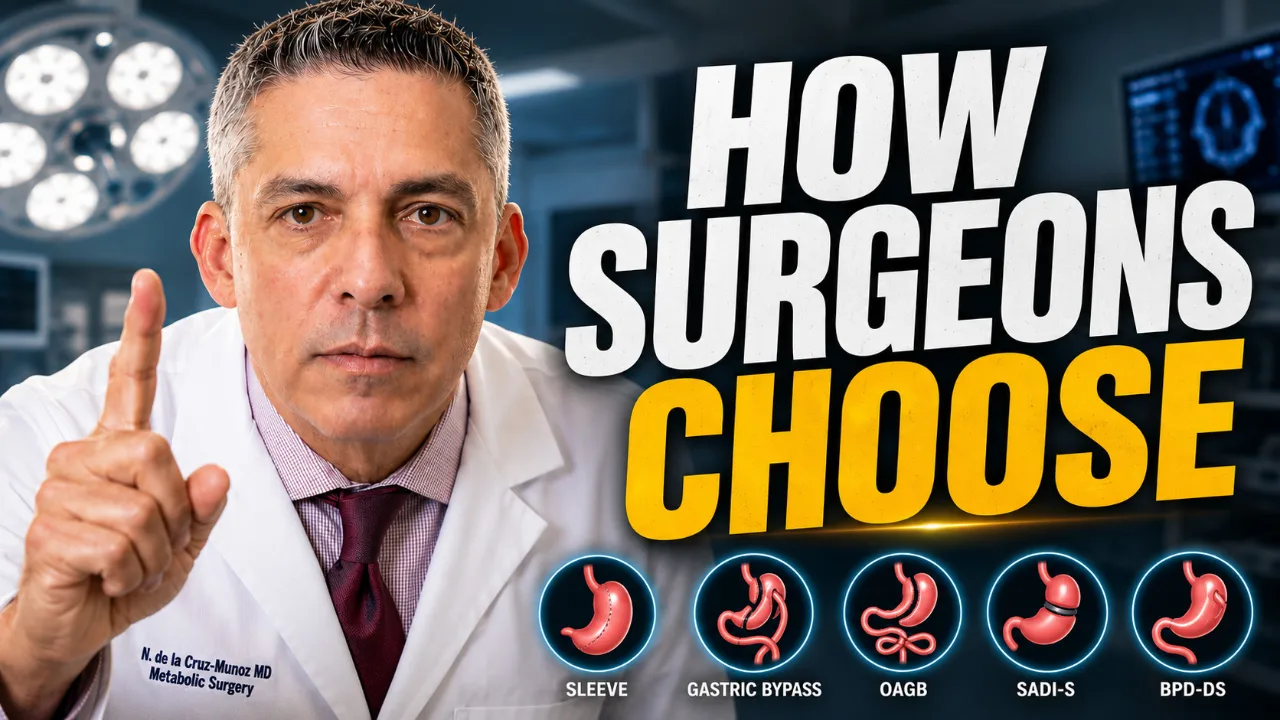
There are five primary metabolic and bariatric operations performed today. They exist on a spectrum, from simpler and less metabolically powerful to more complex and more metabolically powerful.
Sleeve gastrectomy.
The most commonly performed bariatric surgery in the world. About 80 percent of the stomach is removed, leaving a narrow tube, with no intestinal rerouting. Expected weight loss is roughly 25 percent of total body weight at one year, with an excellent safety profile and mortality under 0.1 percent (Elmaleh-Sachs et al., JAMA, 2023).
Roux-en-Y gastric bypass.
Often called the gold standard. A small stomach pouch is connected directly to the jejunum, bypassing most of the stomach and the entire duodenum, with two intestinal connections. Expected weight loss is approximately 30 percent of total body weight, backed by the strongest long-term data of any bariatric procedure (Elmaleh-Sachs et al., JAMA, 2023).
One-anastomosis gastric bypass (OAGB).
A long, narrow stomach pouch connected to a loop of jejunum with a single connection instead of two. It offers weight loss and metabolic benefits similar to the Roux-en-Y, with a simpler technique and shorter operative time. It is now among the most commonly performed bariatric procedures worldwide.
SADI-S (single-anastomosis duodeno-ileal bypass with sleeve).
A sleeve plus a single connection from the duodenum to the distal ileum. It produces powerful weight loss and high diabetes resolution, with growing long-term data.
Biliopancreatic diversion with duodenal switch (BPD-DS).
A sleeve plus division of the duodenum plus two intestinal connections. It is the most powerful operation for weight loss and diabetes resolution, but it carries the highest nutritional risk and is typically reserved for patients with the highest BMI or the most severe metabolic disease (Mechanick et al., Obesity, 2020).
Factor 1: Your Weight and Body Composition
The first thing a surgeon evaluates is your BMI and where you fall on the spectrum of obesity.
- BMI 35 to 45: Any of the five procedures can work well. The choice depends on the other factors below.
- BMI 45 to 50: A gastric bypass, one-anastomosis gastric bypass, or SADI-S becomes more attractive, because the sleeve alone may not produce enough weight loss.
- BMI above 50: The data favor the more powerful malabsorptive procedures such as the duodenal switch or SADI-S for durable weight loss.
BMI alone does not tell the whole story. Body composition, age, and metabolic reserve also matter. Older patients at higher risk of muscle loss may do better with a less malabsorptive procedure combined with aggressive protein intake and resistance training. Younger patients may benefit from a more durable operation upfront rather than facing a revision in 10 to 15 years.
Factor 2: Your Medical Conditions
Different operations have different strengths against different diseases.
Type 2 diabetes.
Every bariatric procedure improves diabetes, but the degree and durability vary. Procedures that reroute the intestine, such as the gastric bypass and duodenal switch, tend to produce more powerful and more durable glycemic control than the sleeve. A 5-year secondary analysis of the Oseberg trial and a separate randomized trial both found higher diabetes remission after gastric bypass than after sleeve gastrectomy (Wagen Hauge et al., Lancet Diabetes Endocrinology, 2025; Murphy et al., Diabetes Care, 2022). A large real-world cohort and a Cochrane network meta-analysis reinforce that bypass generally outperforms sleeve for diabetes outcomes (McTigue et al., JAMA Surgery, 2020; Kiesswetter et al., Cochrane Database of Systematic Reviews, 2026). If your diabetes is long-standing and insulin-dependent, a bypass or duodenal switch deserves strong consideration. If it is mild and controlled on a single medication, the sleeve may be perfectly adequate.
Gastroesophageal reflux disease (GERD).
This is one of the most important factors, and it is where the sleeve has a real weakness. The sleeve tends to make reflux worse, while the bypass improves it. An 8-year prospective cohort study found conclusive GERD in 94.7 percent of sleeve patients versus 25 percent after gastric bypass (Navarini et al., World Journal of Surgery, 2026). A 10-year multicenter study found Barrett's esophagus, a precancerous condition, in 16.8 percent of sleeve patients, almost exclusively in the sleeve group (Genco et al., British Journal of Surgery, 2021). Randomized and pooled data confirm the same pattern (Lorentzen et al., Gastroenterology, 2021; Valentini et al., Journal of Gastrointestinal Surgery, 2024). The practical rule: if you have significant GERD, especially esophagitis on endoscopy or daily acid-suppressing medication, the bypass is generally favored over the sleeve. If you have Barrett's esophagus, the sleeve is contraindicated.
Sleep apnea, hypertension, and dyslipidemia.
These improve with every procedure, but the more powerful the weight loss, the higher the resolution rate. For severe sleep apnea combined with a high BMI, a more powerful procedure is often preferred.
Factor 3: Your Esophagus and Stomach
Before choosing an operation, a surgeon needs to know what is happening inside your esophagus and stomach. That is why a preoperative upper endoscopy is standard for bariatric candidates.
Endoscopy frequently uncovers findings that change the plan, such as a hiatal hernia, gastritis, Barrett's esophagus, or an H. pylori infection. A large hiatal hernia may favor a bypass with hernia repair. Barrett's esophagus rules out the sleeve. An active H. pylori infection should be treated before surgery. In select patients with swallowing difficulty or atypical reflux, esophageal manometry and pH testing add further information that directly influences whether a sleeve, a bypass, or another operation is the safest choice.
The preoperative workup is not a box to check. It is how the surgeon discovers the information that can change the entire recommendation.
Factor 4: Your Prior Surgeries and Anatomy
If you have had prior abdominal surgery, especially in the upper abdomen, scar tissue and adhesions can make certain procedures more technically demanding. In general, the sleeve is the simplest procedure to perform in a re-operative abdomen, and the duodenal switch is the most complex.
If you have already had a bariatric procedure, your revision options depend on what was done before. A failed sleeve with reflux typically converts to a bypass. A failed sleeve with weight regain may convert to a bypass, SADI-S, or one-anastomosis bypass depending on the clinical picture. Patients with inflammatory bowel disease, particularly Crohn's disease, may be best served by a sleeve to avoid intestinal connections.
Factor 5: Nutritional Compliance and Lifestyle
Every bariatric procedure requires lifelong vitamin and mineral supplementation, but the intensity varies enormously. Nutritional risk is lowest after a sleeve, moderate after a bypass (particularly for iron, vitamin B12, calcium, and vitamin D), and highest after a duodenal switch or SADI-S (Mechanick et al., Obesity, 2020).
The more powerful the operation, the more powerful the lifelong commitment it requires. For a patient who struggles to take medications consistently, has a history of poor follow-up, or has limited access to high-quality protein, a highly malabsorptive procedure carries greater long-term risk and should be recommended with caution.
Factor 6: Mental Health and Behavioral Readiness
Every candidate undergoes a psychological evaluation that screens for depression, anxiety, binge eating disorder, emotional eating, and substance use. These conditions do not automatically disqualify you, but they must be identified and addressed because they directly affect outcomes.
Alcohol is also absorbed more rapidly after gastric bypass and duodenal switch. A history of alcohol misuse should be discussed openly and factored into the procedure choice.
Factor 7: Your Goals and Preferences
After all the medical factors are weighed, one more piece matters: what do you want? Some patients prioritize maximum weight loss and accept more complexity. Others want simplicity and fewer long-term requirements. Some prioritize diabetes control, others quality of life. All of these preferences are valid.
This is what shared decision-making truly means. The surgeon brings the medical expertise. You bring the knowledge of your own life. Together, you find the right answer. No surgeon should ever tell you a given operation is the only option, and no patient should choose a procedure based solely on what a friend had or what they saw on social media.
A Real-World Example
Consider a patient we will call Maria. (Maria is a composite of several patients, not a real individual.) She came in after two years of online research, convinced she wanted the sleeve. Her sister had the sleeve. Her coworker had the sleeve. Every video she watched said the sleeve was safe, simple, and effective. And it is all of those things, for the right patient.
But Maria was not the right patient. She had a BMI of 52, had been on insulin for eleven years, and her endoscopy revealed Grade B esophagitis and a four-centimeter hiatal hernia. Giving her the sleeve simply because she asked for it would likely have worsened her reflux, left her diabetes only partially controlled, and set her up for a revision within five to seven years.
Instead, the conversation was different. The data were laid out. A gastric bypass with hiatal hernia repair offered her the best chance at reflux resolution, durable diabetes remission, and long-term weight loss. She asked hard questions and got honest answers, and together the decision was a bypass. Eighteen months later, she was off insulin, her reflux was gone, and she had lost a substantial amount of weight, with no revision needed. That is what happens when the operation matches the patient, not the trend.
If you are exploring your options in South Florida, see bariatric surgery in Miami for how evaluation and procedure selection work at our practice.
Further Information
For additional context and a deeper professional perspective, you can read the companion LinkedIn article linked below.
Frequently Asked Questions
Which bariatric surgery is the best? There is no universally best procedure. The sleeve gastrectomy, Roux-en-Y gastric bypass, one-anastomosis gastric bypass, SADI-S, and duodenal switch each have distinct strengths. The best operation is the one that matches your BMI, medical conditions, anatomy, and goals, chosen with a surgeon through shared decision-making.
Is the gastric sleeve or gastric bypass better for reflux? The gastric bypass is generally better for reflux. Studies show that GERD frequently worsens after sleeve gastrectomy and that Barrett's esophagus, a precancerous condition, is found almost exclusively after the sleeve, whereas reflux typically improves after gastric bypass. If you have significant GERD or Barrett's esophagus, the bypass is usually preferred and the sleeve may be contraindicated.
Which weight loss surgery is best for type 2 diabetes? Procedures that reroute the intestine, such as the gastric bypass and duodenal switch, tend to produce more powerful and more durable diabetes control than the sleeve. Long-standing, insulin-dependent diabetes often responds best to these operations, while mild, well-controlled diabetes may respond adequately to a sleeve.
Why do I need an endoscopy before bariatric surgery? A preoperative upper endoscopy checks for conditions such as hiatal hernia, gastritis, Barrett's esophagus, and H. pylori infection. These findings can directly change which operation is safest and most effective for you, which is why the workup is a critical part of choosing the right procedure rather than a formality.
What is the most powerful bariatric surgery for weight loss? The biliopancreatic diversion with duodenal switch is the most powerful operation for weight loss and diabetes resolution, followed by SADI-S. However, these procedures also carry the highest nutritional risk and require the most intensive lifelong supplementation and follow-up.
Medical Topics Covered


Dr. de la Cruz‑Muñoz specializes in advanced minimally invasive and robotic surgery, metabolic disease management, and comprehensive long‑term patient care. His work integrates clinical expertise, academic leadership, and a commitment to evidence‑based medicine. He has trained surgeons across the country, contributed to national guidelines, and is widely regarded for his outcomes, innovation, and patient‑centered approach.
Patients choose Dr. de la Cruz‑Muñoz for his combination of surgical excellence, metabolic expertise, and lifelong dedication to improving patient health through compassionate, high‑quality care.
Procedures We Offer







Conditions









FAQ
Neither is universally better. Ten-year randomized trials show the bypass produces modestly more weight loss, along with higher diabetes remission and substantially better reflux control. The sleeve is simpler and shows lower five-year mortality, complications, and reinterventions in large registry data. The correct choice depends on reflux status, diabetes severity and duration, perioperative risk, and individual anatomy.
Neither is universally "better" — it depends on your esophageal motility. The Nissen (360°) gives the strongest reflux control but more gas-bloat and swallowing side effects, while the Toupet (270°) lowers those side effects and is favored when manometry shows weak esophageal squeeze, with comparable control of heartburn and regurgitation (Rausa et al., Langenbeck's Archives of Surgery, 2023). This is precisely why preoperative manometry is essential.
Both relieve the obstruction, but they suit different patients. Endoscopic stenting is less invasive and lets patients eat sooner with a shorter hospital stay, making it a good choice for those with limited life expectancy or poor fitness. Its downside is a higher rate of re-obstruction and repeat procedures (Troncone et al., World Journal of Gastroenterology, 2020). Surgical gastrojejunostomy is more durable, allows a wider range of foods, and needs fewer reinterventions, so it is favored for patients who are surgically fit and expected to live longer than about two months (Ahmed et al., American Gastroenterological Association, 2021). A newer middle option, EUS-guided gastroenterostomy, combines endoscopic recovery with surgery-like durability but requires specialized expertise (Martinet et al., Langenbeck's Archives of Surgery, 2024).
If you have corrected your eating technique and still vomit, a structural or functional problem may be present. After a sleeve, a stricture (narrowing) is the classic cause and often appears two to six months out. After a bypass, marginal ulcers, a gastrojejunal stricture, or an internal hernia should be considered. In patients with persistent post-bypass vomiting, endoscopy finds a significant abnormality about 62 percent of the time, so evaluation is worthwhile.
People Also Ask
Obesity is recognized as a chronic disease by major medical organizations, including the American Medical Association. It is influenced by genetics, hormones, brain signaling, environment, sleep, stress and medications — not simply willpower. Like other chronic diseases, it often requires long-term treatment, which may include nutrition, activity, behavioral support, medications and surgery. Lifestyle matters, but biology largely determines how the body responds.
The body has powerful systems that defend its weight. When you lose weight, hunger hormones rise, fullness hormones drop, the brain becomes more focused on food and metabolism slows — a process called metabolic adaptation. Genetics, sleep, stress, medications and the modern food environment add to the challenge. These are biological forces, not character flaws, which is why medical treatment is often needed.
Genetics play a major role. Studies of twins and adopted children suggest that roughly 40–70% of the variation in body weight is inherited, influencing appetite, fullness, metabolism and where fat is stored. Many genes each contribute a small effect, and a few rare single-gene forms cause severe early obesity. Genes interact with environment, sleep, stress and medications, so a family history raises risk but does not determine destiny.
GLP-1 medications mimic a natural gut hormone released after eating. They act on the brain to reduce hunger and increase fullness, slow stomach emptying so meals last longer, quiet "food noise," and improve insulin release and blood sugar. Tirzepatide also acts on a second hormone, GIP. In clinical trials, these medications produced average weight loss of about 15–20% (Wilding et al., New England Journal of Medicine, 2021; Jastreboff et al., New England Journal of Medicine, 2022).
Yes. Obesity is associated with more than 200 health conditions, including type 2 diabetes, high blood pressure, high cholesterol, heart disease, stroke, sleep apnea, fatty liver disease, reflux, osteoarthritis, infertility and PCOS, depression and at least 13 types of cancer. Losing weight — through medical treatment or bariatric surgery — improves or resolves many of these conditions.
Dieting alone usually cannot overcome the body's biological defenses against weight loss. As weight falls, hunger hormones rise, fullness hormones fall and metabolism slows — changes that can last for years. Most people regain the majority of diet-related weight loss within several years. That is not a failure of willpower, and it is why treatments that address appetite biology, such as GLP-1 medications and bariatric surgery, are more effective for many people with obesity.
Consider medical evaluation when excess weight affects your health, mobility or quality of life, or when you have related conditions such as prediabetes, diabetes, high blood pressure, sleep apnea, fatty liver or joint pain. Guidelines support medications for adults with a BMI of 30 or higher, or 27 or higher with a weight-related condition, and surgery for a BMI of 35 or higher, or 30 or higher with metabolic disease. Early treatment can help prevent complications.
Yes. Bariatric surgery treats the biological drivers of obesity, changing hunger and fullness hormones, insulin sensitivity and the weight the body defends. It is the most effective and durable treatment for severe obesity, producing large, sustained weight loss and improving or resolving diabetes, high blood pressure, sleep apnea and fatty liver. Long-term studies show it also reduces the risk of heart disease, cancer and early death.