

Gastric Outlet Obstruction Surgery


Overview
Gastric outlet obstruction is a clinical syndrome in which a mechanical narrowing at the gastric antrum, pylorus, or proximal duodenum blocks the passage of stomach contents into the small intestine, producing nausea, projectile or retained-food vomiting, early satiety, bloating, weight loss, dehydration, and electrolyte derangement (Jue et al., American Society for Gastrointestinal Endoscopy, 2021; Diaz et al., Journal of Trauma and Acute Care Surgery, 2026). Historically the leading cause was peptic ulcer disease, but with acid-suppression therapy and H. pylori eradication, malignancy — most often distal gastric, pancreatic head, and duodenal cancer — now accounts for the majority of cases (50–80%) (Jeong et al., Cancers, 2025; Jue et al., American Society for Gastrointestinal Endoscopy, 2021).
The goal of surgery is to re-establish a durable route for the stomach to empty so the patient can eat, stay hydrated, maintain nutrition, and — in the malignant setting — tolerate systemic chemotherapy (Troncone et al., World Journal of Gastroenterology, 2020). Treatment is individualized to the cause (benign vs. malignant), the patient's fitness and prognosis, and the local anatomy. Options span endoscopic therapies (balloon dilation, enteral stenting, EUS-guided gastroenterostomy), surgical bypass (gastrojejunostomy), drainage procedures (pyloroplasty), and definitive resection when the obstructing lesion is resectable (Diaz et al., Journal of Trauma and Acute Care Surgery, 2026; Ahmed et al., American Gastroenterological Association, 2021).
How the Procedure Works
Surgery relieves GOO through one of three mechanical strategies:
- Bypass (gastrojejunostomy): A new connection (anastomosis) is created between the stomach above the blockage and a loop of jejunum below it, so food detours around the obstruction. This is the most common palliative operation and provides the most durable relief with the fewest reinterventions compared with stenting (Troncone et al., World Journal of Gastroenterology, 2020; Ahmed et al., American Gastroenterological Association, 2021).
- Drainage/widening (pyloroplasty): For benign pyloric stenosis, the narrowed pyloric channel is cut lengthwise and sewn closed crosswise (Heineke-Mikulicz technique) to widen the outlet and restore emptying (Diaz et al., Journal of Trauma and Acute Care Surgery, 2026).
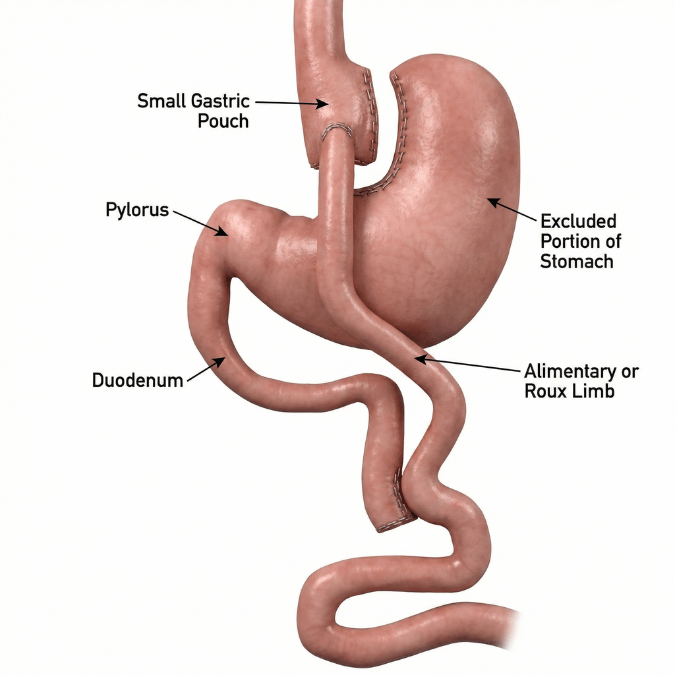
- Resection with reconstruction: When the obstructing tumor or ulcer is resectable, the diseased segment is removed and continuity is restored with a Billroth I, Billroth II, or Roux-en-Y reconstruction (Diaz et al., Journal of Trauma and Acute Care Surgery, 2026; Merrill and Mullen, JOMI, 2024).
A recognized limitation of conventional gastrojejunostomy is delayed gastric emptying (DGE), which can affect up to 50% of patients because food pools in the bypassed antrum. Stomach-partitioning (partial gastric partitioning) gastrojejunostomy — which staples across the stomach to divert contents through the new anastomosis — significantly reduces DGE and is increasingly preferred (Ahmed et al., American Gastroenterological Association, 2021; Kumagai et al., Langenbeck's Archives of Surgery, 2016; Jeong et al., Cancers, 2025).
Benefits
Durable, long-lasting relief of obstruction with fewer recurrent obstructions and reinterventions than enteral stenting, especially in patients expected to live longer than 2 months (Ahmed et al., American Gastroenterological Association, 2021; Troncone et al., World Journal of Gastroenterology, 2020).
Fewer dietary restrictions than a stent — patients can generally tolerate a wider range of food textures (Ahmed et al., American Gastroenterological Association, 2021).
Restores nutrition and enables oncologic therapy so patients with malignant GOO can resume eating and continue chemotherapy (Martinet et al., Langenbeck's Archives of Surgery, 2024).
Minimally invasive options: Laparoscopic gastrojejunostomy reduces blood loss, delayed gastric emptying, time to oral intake, and hospital stay versus open surgery (Ojima et al., Journal of Gastrointestinal Surgery, 2017; Navarra et al., Surgical Endoscopy, 2006).
Stomach-partitioning technique meaningfully lowers the rate of delayed gastric emptying without increasing overall complications (Kumagai et al., Langenbeck's Archives of Surgery, 2016).
Who Is a Candidate
- Patients with confirmed mechanical GOO (benign or malignant) whose symptoms are not relieved by, or are not suitable for, endoscopic therapy (Diaz et al., Journal of Trauma and Acute Care Surgery, 2026).
- Surgically fit patients with malignant GOO and a life expectancy generally greater than 2 months, in whom surgical bypass offers more durable palliation than a stent (Ahmed et al., American Gastroenterological Association, 2021).
- Patients with resectable obstructing tumors, who are candidates for curative-intent resection (Diaz et al., Journal of Trauma and Acute Care Surgery, 2026).
- Patients with benign refractory pyloric or duodenal stricture (e.g., peptic, caustic, or post-surgical) after failure of dilation (Diaz et al., Journal of Trauma and Acute Care Surgery, 2026).
Poor nutritional status, ascites, and poor functional status are independent predictors of clinical failure after surgical gastrojejunostomy and must be weighed in decision-making (Ahmed et al., American Gastroenterological Association, 2021).
How the Procedure Is Performed
The operation is tailored to the cause and is most often performed laparoscopically or robotically. Fo.r a benign pyloric stricture, a Heineke-Mikulicz pyloroplasty widens the outlet.
For a bypass, a loop of jejunum is brought up (antecolic or retrocolic) and joined to the stomach with a hand-sewn or stapled anastomosis, with optional stomach partitioning to reduce delayed gastric emptying (Merrill and Mullen, JOMI, 2024; Kumagai et al., Langenbeck's Archives of Surgery, 2016).
Emerging incisionless magnetic gastrojejunostomy (GT Metabolics / magnetic compression anastomosis): Magnetic compression anastomosis (MCA, or "magnamosis") creates a connection between the stomach and jejunum without sutures or staples. Two self-centering magnets are delivered — endoscopically, laparoscopically, or via a hybrid technique — and mate across the two bowel walls. The compressed tissue between the magnets becomes ischemic and sloughs while the surrounding tissue heals, leaving a patent, healed anastomosis; the magnets then pass naturally in the stool (Zhang et al., Scientific Reports, 2024; Kamada et al., Journal of the American College of Surgeons, 2021). GT Metabolics is the device company developing magnet-assisted anastomosis systems (the same core technology behind its magnetic duodeno-ileostomy work); its application to an incisionless or minimal-access gastrojejunostomy is an emerging, largely investigational use. The supporting evidence to date is the broader MCA literature — human series for GI obstruction achieving 100% technical success without general anesthesia in selected patients (Kamada et al., Journal of the American College of Surgeons, 2021), and preclinical porcine/cadaver feasibility work demonstrating patent, functional magnetic gastrojejunostomy with subsequent spontaneous magnet expulsion (Watanabe et al., Surgical Endoscopy, 2020; Wang et al., Scientific Reports, 2024). Patients considering this approach should understand it is early-stage technology and that large comparative trials are not yet available.
Risks and Considerations
- Delayed gastric emptying — up to 50% after conventional gastrojejunostomy, markedly reduced with stomach partitioning (Ahmed et al., American Gastroenterological Association, 2021; Kumagai et al., Langenbeck's Archives of Surgery, 2016).
- Anastomotic leak, bleeding, and infection (Diaz et al., Journal of Trauma and Acute Care Surgery, 2026).
- Anastomotic stricture or restenosis — reported with magnetic compression anastomosis and sometimes requiring balloon dilation (Kamada et al., Journal of the American College of Surgeons, 2021).
- Marginal ulceration, afferent limb syndrome, or bile reflux depending on reconstruction type (Merrill and Mullen, JOMI, 2024).
- Clinical failure — more likely with poor nutrition, ascites, and poor performance status (Ahmed et al., American Gastroenterological Association, 2021).
- Device-specific risks of MCA — magnet malposition, incomplete anastomosis, or rare perforation (Kamada et al., Journal of the American College of Surgeons, 2021; Wang et al., Scientific Reports, 2024).
Recovery Timeline
Recovery depends on approach and underlying disease. Laparoscopic gastrojejunostomy is associated with faster return of oral intake (often within ~2 days), less delayed gastric emptying, and shorter stay than open surgery (Ojima et al., Journal of Gastrointestinal Surgery, 2017; Navarra et al., Surgical Endoscopy, 2006). Diet is advanced from liquids to solids as emptying resumes. In the MCA series, anastomosis formation took a mean of ~13 days with magnets passing thereafter (Kamada et al., Journal of the American College of Surgeons, 2021).
Long-Term Expectations
For benign disease, a well-constructed bypass or pyloroplasty can provide lasting relief. For malignant GOO, surgical bypass delivers more durable palliation and fewer reinterventions than stenting, with the trade-off of greater upfront morbidity and longer initial hospitalization (Troncone et al., World Journal of Gastroenterology, 2020; Martinet et al., Langenbeck's Archives of Surgery, 2024). Overall prognosis in malignant cases is driven by the underlying cancer.
Why Choose Dr. de la Cruz-Muñoz
Dr. Nestor de la Cruz-Muñoz is a fellowship-trained, board-certified metabolic and bariatric and advanced foregut surgeon with extensive experience in complex gastric and anastomotic surgery — gastrojejunostomy, stomach-partitioning bypass, pyloroplasty, gastric resection and reconstruction, and revisional foregut operations. His practice emphasizes minimally invasive (laparoscopic and robotic) techniques to speed recovery, a complete objective workup before surgery, and multidisciplinary decision-making that matches the operation to each patient's cause of obstruction, anatomy, and goals. As an early adopter of magnet-assisted anastomosis technology, he can counsel patients transparently on where emerging options such as magnetic compression gastrojejunostomy do and do not yet fit.
Total Body Weight Loss (TBWL) Expectations
Expected Metabolic Improvements
Weight Regain Prevention Strategy
GERD / Reflux Considerations
Reconstruction type influences reflux. Billroth II and loop gastrojejunostomy can cause bile reflux, whereas Roux-en-Y reconstruction is preferred when bile reflux is a concern or the gastric remnant is small (Merrill and Mullen, JOMI, 2024). Bile and alkaline reflux should be considered in post-operative symptom evaluation.
Revision Options
A Billroth II can be converted to a Roux-en-Y reconstruction to address refractory bile reflux or afferent limb problems (Merrill and Mullen, JOMI, 2024). Recurrent or malfunctioning bypass may require re-operation, and anastomotic strictures may be managed with endoscopic dilation (Kamada et al., Journal of the American College of Surgeons, 2021). Failed or occluded enteral stents can be salvaged with surgical or EUS-guided gastroenterostomy (Martinet et al., Langenbeck's Archives of Surgery, 2024).
Body Composition & Muscle Preservation
Insurance & Qualification Requirements
Coverage is handled as medically necessary treatment of a documented mechanical gastric outlet obstruction, supported by cross-sectional imaging (CT with oral contrast) and endoscopy with biopsy. Documentation should establish the cause (benign vs. malignant), failure or unsuitability of less-invasive options where relevant, and the patient's fitness and prognosis.
Preparing for Surgery (Pre-Op Requirements)
Pre-operative resuscitation with IV fluids and correction of electrolyte abnormalities (classically hypochloremic, hypokalemic metabolic alkalosis), nasogastric decompression of the obstructed stomach, nutritional assessment and optimization, EGD with biopsy to exclude malignancy, CT staging, and standard anesthetic clearance (Diaz et al., Journal of Trauma and Acute Care Surgery, 2026).
Post-Op Nutrition Overview
Staged diet progression from clear liquids to soft solids as gastric emptying returns; small, frequent meals; attention to hydration; and, after resection or Roux-en-Y reconstruction, monitoring for and supplementation of iron, vitamin B12, calcium, and fat-soluble vitamins as indicated by the specific anatomy.
Post-Op Activity & Exercise Guidance
Early ambulation from day one to reduce thromboembolic and pulmonary risk, graded return to normal activity, and avoidance of heavy lifting during early healing after an abdominal operation.
Special Considerations for International Patients
Quick Procedure Details
Document medical necessity with objective imaging and endoscopic findings, the obstructing etiology, and the rationale for the chosen surgical approach versus endoscopic alternatives. Investigational magnetic anastomosis approaches may require specific trial enrollment or additional authorization.
Featured Procedures

Conditions

FAQ
It is surgery to relieve a mechanical blockage that prevents the stomach from emptying into the small intestine, causing vomiting, early fullness, weight loss, and dehydration (Jue et al., American Society for Gastrointestinal Endoscopy, 2021). Surgery is needed when the blockage cannot be managed with endoscopic treatments like dilation or stenting, or when a bypass or resection offers more durable relief — particularly in patients who are fit for surgery and expected to live longer than about two months (Ahmed et al., American Gastroenterological Association, 2021). The most common operation is a gastrojejunostomy, which routes food around the blockage into the small intestine (Troncone et al., World Journal of Gastroenterology, 2020).
Both relieve the obstruction, but they suit different patients. Endoscopic stenting is less invasive and lets patients eat sooner with a shorter hospital stay, making it a good choice for those with limited life expectancy or poor fitness. Its downside is a higher rate of re-obstruction and repeat procedures (Troncone et al., World Journal of Gastroenterology, 2020). Surgical gastrojejunostomy is more durable, allows a wider range of foods, and needs fewer reinterventions, so it is favored for patients who are surgically fit and expected to live longer than about two months (Ahmed et al., American Gastroenterological Association, 2021). A newer middle option, EUS-guided gastroenterostomy, combines endoscopic recovery with surgery-like durability but requires specialized expertise (Martinet et al., Langenbeck's Archives of Surgery, 2024).
Magnetic compression anastomosis (MCA) creates a connection between the stomach and small intestine without stitches or staples. Two magnets are placed across the two bowel walls; they mate, the pinched tissue between them slowly heals into a new opening, and the magnets later pass out naturally in the stool (Zhang et al., Scientific Reports, 2024; Kamada et al., Journal of the American College of Surgeons, 2021). Companies such as GT Metabolics are developing magnet-assisted anastomosis systems, and applying this to an incisionless gastrojejunostomy is an emerging use. Human experience with MCA for GI obstruction has shown high technical success in selected patients, and preclinical studies confirm a patent, functional magnetic gastrojejunostomy — but large comparative trials of the specific device are not yet available, so it should be viewed as early-stage technology (Kamada et al., Journal of the American College of Surgeons, 2021; Watanabe et al., Surgical Endoscopy, 2020).
The most common reason is delayed gastric emptying, where food pools in the bypassed part of the stomach instead of draining through the new connection — it can affect up to half of patients after a conventional gastrojejunostomy (Ahmed et al., American Gastroenterological Association, 2021). The leading fix is a stomach-partitioning (partial gastric partitioning) gastrojejunostomy, which staples across the stomach to funnel food through the new opening and has been shown to cut delayed gastric emptying by roughly two-thirds without adding complications (Kumagai et al., Langenbeck's Archives of Surgery, 2016; Jeong et al., Cancers, 2025). A laparoscopic approach also lowers the rate of delayed emptying compared with open surgery (Ojima et al., Journal of Gastrointestinal Surgery, 2017).

