

Surgical Management of Bleeding Ulcer


Overview
Peptic ulcer bleeding is the most common gastrointestinal emergency and the leading complication of peptic ulcer disease, accounting for roughly 73% of its hospital admissions, with a 30-day mortality reported up to 11% (Almadi et al., Lancet, 2024; Mujadzic et al., Digestive Diseases and Sciences, 2024). The overwhelming majority of bleeds are controlled with resuscitation, high-dose proton pump inhibitors, and endoscopic hemostasis, and most rebleeds are managed with repeat endoscopy or transcatheter arterial embolization (TAE) (Gralnek et al., European Society of Gastrointestinal Endoscopy, 2026; Laine et al., American College of Gastroenterology, 2021).
Surgery is now a last resort, required in only about 2% of acute upper GI bleeds, but it is indispensable when endoscopy fails and TAE is either unavailable or unsuccessful — and in hemodynamically unstable patients who cannot wait (Aaron et al., American College of Surgeons, 2021; Tarasconi et al., World Society of Emergency Surgery, 2020; Gralnek et al., European Society of Gastrointestinal Endoscopy, 2026). The goal is rapid, durable hemostasis while matching the operation to the ulcer's location, size, and bleeding source.
How the Procedure Works
Surgery stops ulcer bleeding through one of three mechanical strategies, chosen by the location and characteristics of the bleeding vessel (Tarasconi et al., World Society of Emergency Surgery, 2020):
- Direct control of the bleeding vessel (oversewing/ligation): The ulcer base is exposed and the feeding vessel is suture-ligated. For a posterior duodenal ulcer, this is done through a duodenotomy, and because the gastroduodenal artery (GDA) has a rich collateral network, a three-point (triple) ligation of the GDA, right gastroepiploic, and superior pancreaticoduodenal arteries is required rather than a single stitch (Aaron et al., American College of Surgeons, 2021; Hudnall et al., EAST, 2022).
- Acid-reducing drainage (vagotomy plus drainage): A vagotomy reduces acid secretion and is paired with a drainage procedure (e.g., pyloroplasty) to preserve gastric emptying; for intractable bleeding, this has been associated with lower mortality than simple local oversew alone (Schröder et al., Annals of Surgery, 2014).
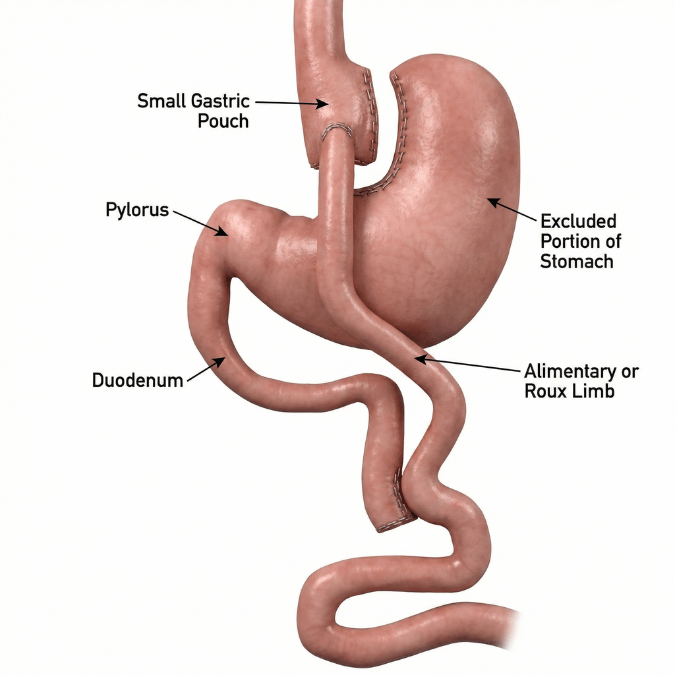
- Resection (gastrectomy with reconstruction): The ulcer-bearing segment is removed and continuity restored with a Billroth I, Billroth II, or Roux-en-Y reconstruction. Bleeding gastric ulcers should be resected or at least biopsied to exclude malignancy (Tarasconi et al., World Society of Emergency Surgery, 2020; Hudnall et al., EAST, 2022).
Benefits
- Definitive, durable hemostasis — surgery produces less further bleeding than TAE, making it the more effective option when rebleeding control is paramount (Laine et al., American College of Gastroenterology, 2021).
- Life-saving in instability — immediate surgery is the appropriate choice for hemodynamically unstable patients refractory to endoscopy, where delay is dangerous (Tarasconi et al., World Society of Emergency Surgery, 2020).
- Addresses malignancy — resection or biopsy of a bleeding gastric ulcer rules out or treats cancer that endoscopy alone may miss (Aaron et al., American College of Surgeons, 2021).
- Lower mortality with vagotomy/drainage than simple oversew for intractable bleeding ulcers (Schröder et al., Annals of Surgery, 2014).
Who Is a Candidate
- Patients with refractory bleeding — ongoing or recurrent hemorrhage after failed repeat endoscopy when TAE is unavailable or has failed (Gralnek et al., European Society of Gastrointestinal Endoscopy, 2026; Tarasconi et al., World Society of Emergency Surgery, 2020).
- Patients with hemodynamic instability and/or an ulcer larger than 2 cm at first endoscopy, in whom surgery may be undertaken without further repeat endoscopy (Tarasconi et al., World Society of Emergency Surgery, 2020).
- Patients with features predicting endoscopic failure — hypotension at rebleeding and ulcer size >2 cm (Laine et al., American College of Gastroenterology, 2021).
- Patients with hemorrhagic shock and severe physiologic derangement, who are candidates for damage-control surgery (Tarasconi et al., World Society of Emergency Surgery, 2020).
How the Procedure Is Performed
An open approach is recommended for acute upper GI bleeding surgery, given the need for rapid control in often-unstable patients (Aaron et al., American College of Surgeons, 2021). The surgeon should be present at or informed by preoperative endoscopy to localize the bleeding source, and intraoperative endoscopy can help pinpoint the lesion (Tarasconi et al., World Society of Emergency Surgery, 2020).
For a duodenal ulcer, a duodenotomy exposes the ulcer on the posterior wall; the bleeding GDA is controlled with triple-point suture ligation, taking care to distinguish the GDA from the proper hepatic artery before ligation (Aaron et al., American College of Surgeons, 2021; Hudnall et al., EAST, 2022). For a gastric ulcer, simple oversewing with excision or biopsy usually suffices, but resection is performed when malignancy is suspected or the lesion is complex (Aaron et al., American College of Surgeons, 2021). Vagotomy with drainage or, selectively, vagotomy with antrectomy/resection and reconstruction (including Roux-en-Y gastrojejunostomy) is added based on the clinical scenario (Schröder et al., Annals of Surgery, 2014; Hudnall et al., EAST, 2022).
Risks and Considerations
- Rebleeding — recurrence is notably higher after oversew/vagotomy than after gastric resection in duodenal ulcer bleeding (17% vs. 3% in a randomized trial) (Millat et al., World Journal of Surgery, 1993).
- Duodenal leak/stump leak — higher after gastric resection than after oversewing plus vagotomy (13% vs. 3%) (Millat et al., World Journal of Surgery, 1993).
- High operative mortality — overall postoperative mortality is substantial (~22-23% in trial populations), reflecting the critically ill, often elderly comorbid patients who reach surgery (Millat et al., World Journal of Surgery, 1993).
- Greater complexity and worse outcomes with duodenal location — higher 90-day mortality and reoperation rates than gastric ulcers (Tarasconi et al., World Society of Emergency Surgery, 2020).
- Greater morbidity with resection — vagotomy/gastric resection carries significantly greater postoperative morbidity than local procedures alone (Schröder et al., Annals of Surgery, 2014).
Recovery Timeline
Recovery is dictated by the patient's pre-operative physiologic state and the extent of surgery. Many patients require ICU care after emergency hemostasis, particularly after damage-control surgery (Tarasconi et al., World Society of Emergency Surgery, 2020). Early refeeding within 24 hours after durable hemostasis shortens hospital stay, and high-dose PPI therapy (80 mg IV load, then 8 mg/h infusion or intermittent high-dose for 72 hours) is continued to support ulcer healing and prevent rebleeding (Almadi et al., Lancet, 2024; Gralnek et al., European Society of Gastrointestinal Endoscopy, 2026).
Long-Term Expectations
Durable outcomes depend on treating the underlying ulcer cause. Helicobacter pylori eradication (with confirmation of cure) and discontinuation of NSAIDs eliminate the need for indefinite acid suppression in most patients, whereas idiopathic and aspirin-associated ulcers require cause-specific long-term management (Laine, New England Journal of Medicine, 2016; Almadi et al., Lancet, 2024). Without addressing the cause, rebleeding risk remains high.
Why Choose Dr. de la Cruz-Muñoz
Dr. Nestor de la Cruz-Muñoz is a board-certified advanced foregut and metabolic surgeon with extensive experience in complex gastric and duodenal surgery — ulcer oversewing and GDA ligation, vagotomy and drainage, gastric resection, and Roux-en-Y and other reconstructions. His practice emphasizes a complete objective evaluation, multidisciplinary coordination with gastroenterology and interventional radiology, and matching the operation to the bleeding source, the patient's physiology, and the underlying ulcer cause — so that emergency hemostasis is paired with a durable, cause-directed long-term plan.
Total Body Weight Loss (TBWL) Expectations
Expected Metabolic Improvements
Weight Regain Prevention Strategy
GERD / Reflux Considerations
Reconstruction type influences later reflux. Billroth II and loop reconstructions can cause bile (alkaline) reflux, whereas Roux-en-Y reconstruction is preferred when bile reflux is a concern (Hudnall et al., EAST, 2022). Ongoing PPI therapy is part of post-operative ulcer and reflux management.
Revision Options
Persistent or recurrent bleeding after surgery may require repeat operation or salvage TAE (Tarasconi et al., World Society of Emergency Surgery, 2020). Billroth II can be converted to Roux-en-Y for refractory bile reflux or afferent-limb problems, and anastomotic strictures can be managed endoscopically (Hudnall et al., EAST, 2022).
Body Composition & Muscle Preservation
Insurance & Qualification Requirements
Surgical management of a bleeding ulcer is an emergency, medically necessary intervention supported by documented failure (or unavailability) of endoscopic and angiographic therapy, endoscopic stigmata of high-risk bleeding (Forrest classification), and/or hemodynamic instability. Documentation of resuscitation, transfusion requirement, and endoscopic findings establishes medical necessity.
Preparing for Surgery (Pre-Op Requirements)
Aggressive resuscitation with crystalloids and blood products, correction of coagulopathy, high-dose IV PPI, and source localization by endoscopy are the priorities. Because this is an emergency, optimization occurs in parallel with mobilization to the operating room; endoscopy should not be performed before adequate resuscitation (Almadi et al., Lancet, 2024).
Post-Op Nutrition Overview
Early oral nutrition within 24 hours of durable hemostasis is recommended and reduces length of stay (Gralnek et al., European Society of Gastrointestinal Endoscopy, 2026; Almadi et al., Lancet, 2024). Iron therapy should be started before discharge in patients with iron deficiency or anemia, and after resection or Roux-en-Y reconstruction, monitoring for iron, B12, calcium, and fat-soluble vitamin deficiency is appropriate (Gralnek et al., European Society of Gastrointestinal Endoscopy, 2026).
Post-Op Activity & Exercise Guidance
Early ambulation to reduce thromboembolic and pulmonary complications, graded return to activity, and avoidance of heavy lifting during early healing after a laparotomy. Resumption of anticoagulation is guided by thromboembolic risk and should occur as soon as clinically indicated (Gralnek et al., European Society of Gastrointestinal Endoscopy, 2026).
Special Considerations for International Patients
Quick Procedure Details
Document medical necessity with endoscopic stigmata (Forrest class), transfusion and resuscitation requirements, failure/unavailability of endoscopic and angiographic therapy, and the operative findings and chosen reconstruction.
Featured Procedures

FAQ
Most bleeding ulcers are controlled with endoscopy and high-dose acid-suppressing medication, and surgery is needed in only about 2% of cases (Aaron et al., American College of Surgeons, 2021). Surgery becomes necessary when endoscopy fails and angiographic embolization is unavailable or unsuccessful, or when a patient is hemodynamically unstable and cannot safely wait — and it may be chosen upfront for patients with very large ulcers (over 2 cm) or ongoing instability (Gralnek et al., European Society of Gastrointestinal Endoscopy, 2026; Tarasconi et al., World Society of Emergency Surgery, 2020).
Both are valid rescue options after failed endoscopy, and they involve a trade-off. Transcatheter arterial embolization (TAE) is less invasive, causes far fewer major complications, and shortens hospital stay, but has a higher rate of further bleeding (Laine et al., American College of Gastroenterology, 2021). Surgery is more effective at preventing rebleeding but carries greater complication risk. Current guidelines favor TAE as the first salvage option when available and skilled operators are present, reserving surgery for when TAE is unavailable or fails — though the choice depends on local expertise, patient comorbidities, and how each patient weighs rebleeding against complications (Laine et al., American College of Gastroenterology, 2021; Lu and Chiang, Therapeutic Advances in Gastroenterology, 2024).
The operation is matched to the ulcer. For a bleeding duodenal ulcer, the surgeon opens the duodenum and suture-ligates the gastroduodenal artery with a triple-point stitch, because that artery's rich collateral supply means a single tie is not enough (Aaron et al., American College of Surgeons, 2021). For a bleeding gastric ulcer, simple oversewing with excision or biopsy usually suffices — and biopsy is important because gastric ulcers can be cancerous (Tarasconi et al., World Society of Emergency Surgery, 2020). In selected cases, surgeons add a vagotomy with drainage — which has been linked to lower mortality than oversew alone for intractable bleeding — or perform a gastric resection with reconstruction (Schröder et al., Annals of Surgery, 2014; Hudnall et al., EAST, 2022).

