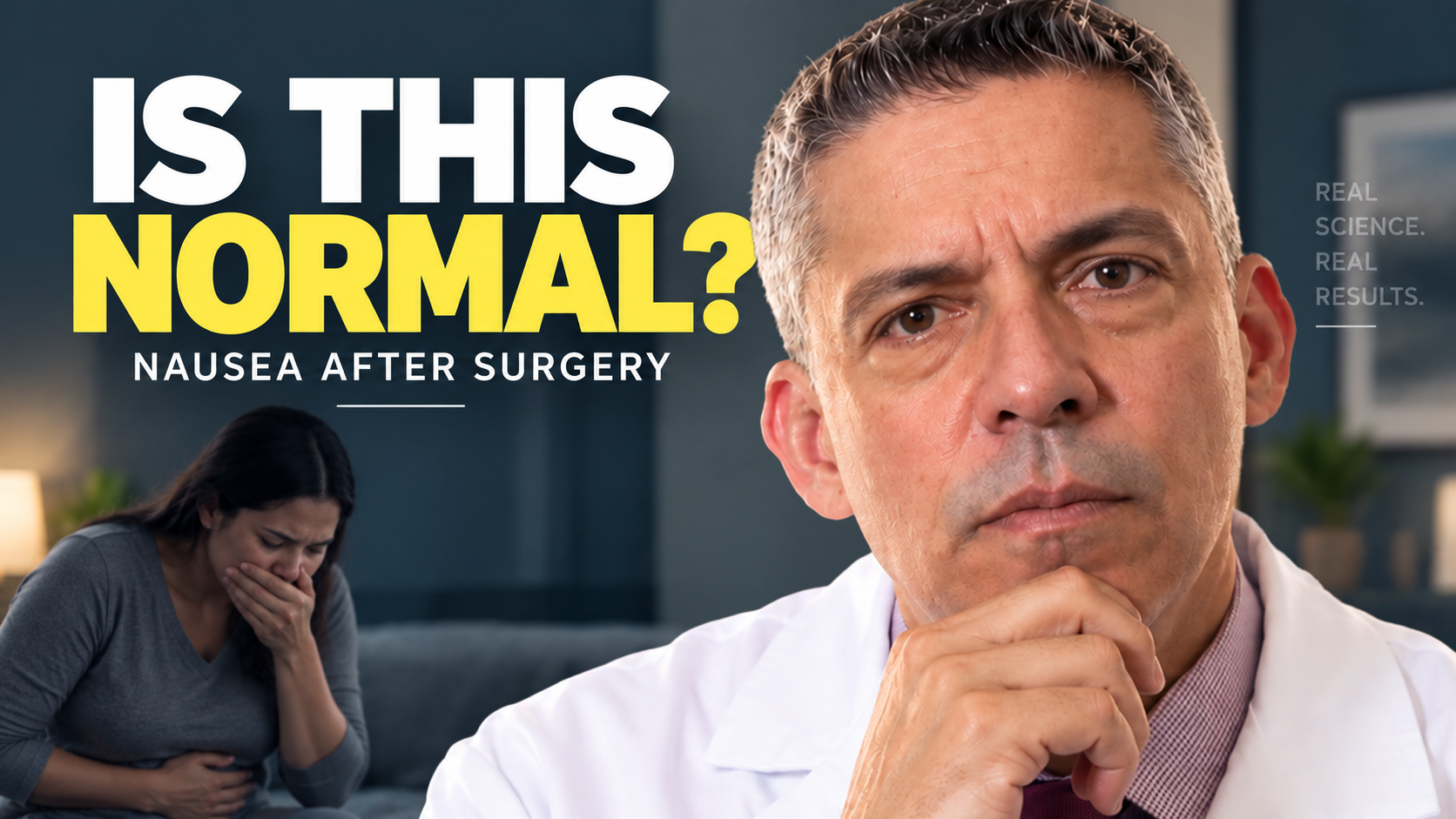
Chronic Abdominal Pain After Bariatric Surgery

Quick Answer
Watch Related Video
Article
Chronic Abdominal Pain After Bariatric Surgery: Causes, Internal Hernias, and When You Need a Diagnostic Laparoscopy
If you've had weight-loss surgery — gastric bypass, sleeve, mini-bypass, SADI, duodenal switch, or even an old lap-band — and you're living with abdominal pain that keeps coming back, you are not imagining it, and you are not alone. Chronic abdominal pain is one of the most common reasons patients return to a bariatric clinic, and it is also one of the most frequently dismissed. Scans come back "normal." Bloodwork looks "fine." And patients are told to wait it out. Meanwhile, a correctable — and occasionally life-threatening — problem may be hiding in plain sight.
This page explains why pain happens after every type of bariatric surgery, why the usual tests so often miss the cause, and why a diagnostic laparoscopy is frequently the only way to get a real answer.
Pain after weight-loss surgery is common — and the cause is often fixable
Chronic abdominal pain after bariatric surgery (sometimes called CAP) is genuinely common, and its causes are remarkably varied. A 2026 systematic review grouped the causes into six categories: anatomical, functional, biliary, nutritional, abdominal-wall, and miscellaneous (Zevallos and Pouwels, Surgical Endoscopy, 2026). The most important point for patients is this: some of these causes are structural and surgically correctable, while others are functional and treated medically — and telling them apart is exactly what a careful bariatric evaluation is designed to do.
The broad categories of causes include:
- Anatomical: internal hernia, adhesions, marginal ulcer, gastrojejunal stricture, small bowel obstruction, gastrogastric fistula, hiatal hernia, and GERD (Zevallos and Pouwels, Surgical Endoscopy, 2026).
- Functional: functional dyspepsia, irritable bowel syndrome, gastroparesis, dumping syndrome, chronic nausea/vomiting, and small intestinal bacterial overgrowth (SIBO) (Zevallos and Pouwels, Surgical Endoscopy, 2026).
- Biliary: gallstones/biliary colic, common bile duct stones, sphincter of Oddi dysfunction, bile reflux, and exocrine pancreatic insufficiency (Zevallos and Pouwels, Surgical Endoscopy, 2026).
- Nutritional: micronutrient deficiencies, food intolerance, and protein-calorie malnutrition (Zevallos and Pouwels, Surgical Endoscopy, 2026).
- Abdominal wall: incisional/ventral hernia and anterior cutaneous nerve entrapment syndrome (ACNES) (Zevallos and Pouwels, Surgical Endoscopy, 2026).
- Miscellaneous: opioid-induced hyperalgesia, psychological contributors, and eroded sutures or staples (Zevallos and Pouwels, Surgical Endoscopy, 2026).
After gastric bypass specifically, the most common culprits are internal hernia, marginal ulcer, biliary disease, and problems at the jejunojejunostomy — and several of these (internal hernia, a perforated marginal ulcer) can require urgent or emergent surgery (Fry and Finks, JAMA Surgery, 2023).
This affects every type of bariatric surgery — not just gastric bypass
A dangerous myth is that internal hernia and chronic post-surgical pain only happen after the classic Roux-en-Y gastric bypass. In reality, any operation that reroutes the small bowel and creates a mesenteric defect carries internal-hernia risk. What differs is how often it happens:
- Roux-en-Y gastric bypass (RYGB): internal hernia prevalence is reported at roughly 3% to 14%, and one long-term series found 12.8% at an average of 3.7 years (Fry and Finks, JAMA Surgery, 2023; Pennestrì et al., Langenbeck's Archives of Surgery, 2022).
- One-anastomosis / mini gastric bypass (OAGB): once believed to almost never cause internal hernia — but published case series show it is more common, and more often missed, than previously thought. The threshold for diagnostic laparoscopy in a symptomatic OAGB patient should be low (Khogeer et al., Obesity Surgery, 2021; Facchiano et al., Obesity Surgery, 2020).
- Biliopancreatic diversion with duodenal switch (BPD/DS): reported internal hernia rates range from about 0.4% to 18%, and in a 5-year randomized trial, internal herniation occurred only in the BPD/DS group — a consequence of the additional ileo-ileal anastomosis and extra mesenteric defect (Pennestrì et al., Langenbeck's Archives of Surgery, 2022; Axer et al., Obesity Surgery, 2026).
- Single-anastomosis duodeno-ileal bypass with sleeve (SADI-S): internal hernia is uncommon because the mesentery is typically left wide open rather than closed, so there is less of a discrete defect to trap bowel — though long-term volvulus remains a theoretical concern (Pennestrì et al., Langenbeck's Archives of Surgery, 2022).
- Sleeve gastrectomy and gastric band: these do not reroute the bowel, so internal hernia is not the issue — but chronic pain still occurs, most often from GERD, gastroparesis, or biliary disease (Zevallos and Pouwels, Surgical Endoscopy, 2026).
The bottom line: if your gut was rerouted — RYGB, OAGB, SADI, or DS — recurrent crampy, postprandial pain deserves evaluation by a surgeon who understands your specific anatomy.
Internal hernia: the complication that hides
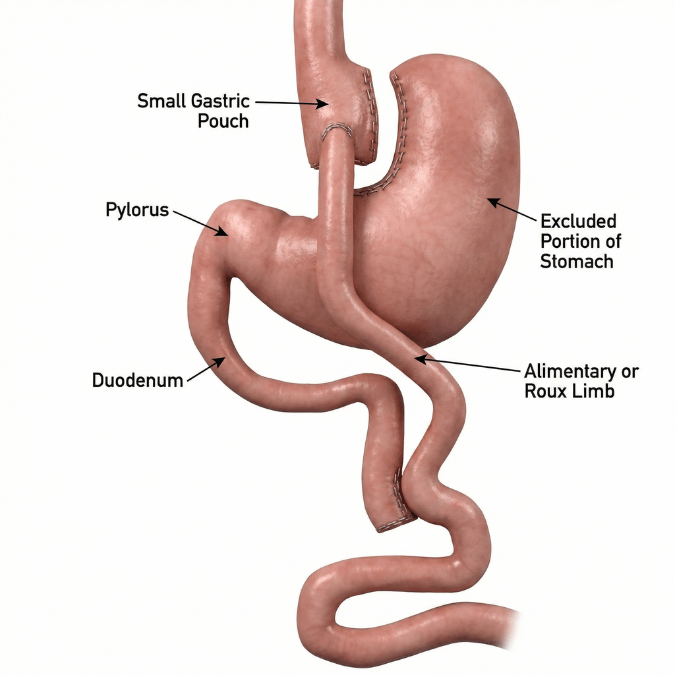
An internal hernia occurs when loops of small bowel slip through one of the mesenteric gaps created during surgery. After gastric bypass, the classic sites are Petersen's space (between the Roux limb mesentery and the transverse mesocolon) and the jejunojejunostomy (Brolin) defect; a retrocolic reconstruction adds a third defect in the transverse mesocolon (Fry and Finks, JAMA Surgery, 2023).
What makes internal hernia so treacherous is its presentation. It often shows up as chronic, vague, postprandial crampy abdominal pain with nausea — symptoms easy to attribute to diet or "just getting used to" the surgery. But it can also progress suddenly to bowel obstruction, strangulation, ischemia, and perforation, which is why severe pain or obstructive symptoms demand emergent exploration (Fry and Finks, JAMA Surgery, 2023). A benign physical exam and normal labs do not rule it out (Fry and Finks, JAMA Surgery, 2023).
Why your CT scan can be "normal" when something is really wrong
This is the single most important thing for post-bypass patients to understand: a normal CT scan does not rule out an internal hernia.
- A systematic review and meta-analysis of 20 studies (1,637 patients) found CT has a pooled sensitivity of 82% and specificity of 84.8% for internal hernia — meaning at least one in six patients with a true internal hernia will have a normal-appearing scan (Nawas et al., Annals of Surgery, 2022).
- Real-world numbers can be worse: in one series, CT was falsely negative in 44–50% of patients who were later found to have an internal hernia at surgery (Altinoz et al., American Journal of Surgery, 2020).
There are two reasons for this blind spot. First, CT is simply an imperfect test. Second — and this is the key — internal hernias are frequently intermittent: the bowel herniates and causes pain, then slips back out before you get to the scanner, so the imaging catches a "quiet" moment (Fry and Finks, JAMA Surgery, 2023).
That said, imaging still matters when it's done and read well. The most useful CT signs are venous congestion, the mesenteric swirl sign, and the mushroom sign, and a structured read by a dedicated abdominal radiologist is the most accurate non-surgical tool available (Nawas et al., Annals of Surgery, 2022; van Hogezand et al., Surgery for Obesity and Related Diseases, 2026). In a 2026 prospective study, structured radiologic suspicion — not clinical suspicion alone — was strongly associated with confirmed internal hernia (van Hogezand et al., Surgery for Obesity and Related Diseases, 2026). The message is not "ignore the CT"; it's "don't let a normal CT end the conversation when symptoms persist."
Warning signs that should prompt evaluation
See a bariatric surgeon if you have any of the following after weight-loss surgery:
- Recurrent crampy or colicky abdominal pain, especially after meals
- Pain associated with nausea, bloating, or vomiting
- Episodes that come and go but keep returning
- Pain that wakes you at night or is worsening over time
Seek emergency care immediately for severe, constant abdominal pain, persistent vomiting, inability to keep down fluids, abdominal distension, or signs of obstruction — these can signal a strangulating internal hernia, which is a surgical emergency (Fry and Finks, JAMA Surgery, 2023).
Diagnostic laparoscopy: the gold standard when the answer stays hidden
When symptoms strongly suggest a structural problem — particularly internal hernia — but imaging and endoscopy are inconclusive, diagnostic laparoscopy is the definitive test. Exploratory surgery is considered the reference standard against which all imaging is measured, and it is more accurate than CT for detecting internal hernia (Nawas et al., Annals of Surgery, 2022; Altinoz et al., American Journal of Surgery, 2020).
Its great advantage is that it is both diagnostic and therapeutic in a single operation. Through a few small (typically 5-millimeter) incisions, the surgeon directly inspects the abdomen, "runs the bowel" from the ileocecal valve back toward the stomach, and examines each mesenteric defect. If an internal hernia is found, the bowel is reduced, its viability assessed, and the defect closed with permanent (non-absorbable) suture — all at the same time. This is a Laparoscopic Internal Henria Repair. (Fry and Finks, JAMA Surgery, 2023; Alsulaimy et al., Obesity Surgery, 2017).
What the data show about outcomes
Diagnostic laparoscopy for post-bariatric pain works — and the numbers help set realistic expectations:
- In a Cleveland Clinic series of 35 post-bariatric patients with chronic abdominal pain of unknown cause, 57% had positive findings (adhesions, chronic cholecystitis, mesenteric defects, internal hernia, necrotic omentum), and symptoms improved in 70% of patients who had a correctable finding fixed (Alsulaimy et al., Obesity Surgery, 2017).
- In a 2026 prospective study, diagnostic laparoscopy performed for suspected internal hernia confirmed it in 36% of explored patients, underscoring both the value of exploration and the reality of negative explorations when imaging is normal (van Hogezand et al., Surgery for Obesity and Related Diseases, 2026).
- A broader experience of 387 patients undergoing diagnostic laparoscopy for acute and chronic abdominal pain established a diagnosis in 76% and had a therapeutic effect in 48% (Alsulaimy et al., Obesity Surgery, 2017).
What if the exploration finds nothing?
A negative exploration is possible, and it is more likely when imaging is normal. While disappointing, it is genuinely useful: it makes a surgical cause very unlikely and redirects care toward functional diagnoses that are treated medically rather than with an operation — functional dyspepsia, IBS, gastroparesis, dumping syndrome, or SIBO (Zevallos and Pouwels, Surgical Endoscopy, 2026; van Hogezand et al., Surgery for Obesity and Related Diseases, 2026). These are common: new-onset IBS-like symptoms have been reported in 22–33% of patients after bariatric surgery, and dumping syndrome affects roughly 13% of post-bariatric patients with chronic pain (Zevallos and Pouwels, Surgical Endoscopy, 2026).
An important caveat about recurrence
Closing a mesenteric defect reduces risk but does not eliminate it — defects can reopen, and internal hernia can recur, so recurrent symptoms should always be taken seriously even after a prior repair. For this reason, the mesenteric defects should be re-inspected during any future abdominal operation after gastric bypass, such as a gallbladder removal or hernia repair (Fry and Finks, JAMA Surgery, 2023).
Why patients choose Dr. Nestor de la Cruz-Muñoz
Dr. Nestor de la Cruz-Muñoz, MD, FACS, DABOM, is a metabolic and bariatric surgeon and board-certified obesity medicine specialist with deep expertise in the altered anatomy of every modern bariatric operation — and in the long-term complications that general surgeons and emergency departments frequently miss. Internal hernia is routinely overlooked precisely because the pain is intermittent and the CT can be normal (Fry and Finks, JAMA Surgery, 2023; Nawas et al., Annals of Surgery, 2022). Knowing when recurring post-bariatric pain warrants exploration despite a normal scan, performing a systematic inspection of every mesenteric defect, and durably closing defects with permanent suture are the skills that drive lasting symptom relief (Alsulaimy et al., Obesity Surgery, 2017). Patients who had their original surgery elsewhere — anywhere — and are now living with unexplained pain are welcome for evaluation.
If you've been told your tests are "normal" but you know something isn't right, you deserve a second look from a surgeon who understands exactly how your anatomy was changed.
Further Information
Medical Topics Covered

Dr. de la Cruz‑Muñoz specializes in advanced minimally invasive and robotic surgery, metabolic disease management, and comprehensive long‑term patient care. His work integrates clinical expertise, academic leadership, and a commitment to evidence‑based medicine. He has trained surgeons across the country, contributed to national guidelines, and is widely regarded for his outcomes, innovation, and patient‑centered approach.
Patients choose Dr. de la Cruz‑Muñoz for his combination of surgical excellence, metabolic expertise, and lifelong dedication to improving patient health through compassionate, high‑quality care.
Procedures We Offer





Conditions
FAQ
Yes — any bariatric operation that reroutes the small bowel can cause an internal hernia, including one-anastomosis (mini) gastric bypass, SADI-S, and duodenal switch, not just Roux-en-Y gastric bypass (Khogeer et al., Obesity Surgery, 2021; Axer et al., Obesity Surgery, 2026). The risk is highest when an operation creates more mesenteric defects — for example, the extra anastomosis in BPD/DS — and lowest in operations like sleeve gastrectomy and gastric band, which don't reroute the bowel (Pennestrì et al., Langenbeck's Archives of Surgery, 2022; Zevallos and Pouwels, Surgical Endoscopy, 2026).
Yes. A normal CT does not rule out an internal hernia. Pooled data show CT sensitivity is only about 82%, so roughly one in six confirmed internal hernias is missed, largely because the hernia is intermittent and can slip back out before the scan (Nawas et al., Annals of Surgery, 2022). In some surgical series, CT was falsely negative in 44–50% of confirmed cases (Altinoz et al., American Journal of Surgery, 2020). When symptoms strongly suggest internal hernia despite normal imaging, diagnostic laparoscopy is the definitive test (Fry and Finks, JAMA Surgery, 2023).
Diagnosis depends on a careful history, an understanding of your exact surgical anatomy, and the targeted use of imaging, labs, and endoscopy — followed by diagnostic laparoscopy when a structural cause is suspected but can't be confirmed (Fry and Finks, JAMA Surgery, 2023). Causes span anatomical, functional, biliary, nutritional, and abdominal-wall categories, so a structured, systematic workup is essential (Zevallos and Pouwels, Surgical Endoscopy, 2026). When a correctable problem is found at laparoscopy and fixed, about 70% of patients experience meaningful pain relief (Alsulaimy et al., Obesity Surgery, 2017).
People Also Ask
Obesity is recognized as a chronic metabolic disease influenced by genetics, hormones, environment, and biological factors — not simply lifestyle choices.
The body has built-in mechanisms that defend weight, including hunger hormones and metabolic adaptations that make long-term weight loss challenging.
Yes. Genetics can significantly influence body weight regulation, appetite, metabolism, and an individual's susceptibility to obesity.
GLP-1 medications help regulate appetite, slow stomach emptying, improve satiety, and support sustainable weight management.
Yes. Obesity is associated with conditions such as Type 2 diabetes, hypertension, sleep apnea, fatty liver disease, and cardiovascular disease.
Dieting alone often cannot overcome the biological adaptations that increase hunger and decrease energy expenditure after weight loss.
Medical evaluation may be appropriate when excess weight affects health, quality of life, or contributes to obesity-related medical conditions.
Yes. Bariatric surgery addresses biological and metabolic factors involved in obesity and can lead to significant long-term health improvements.