What Your BMI Actually Means for Your Surgery Options

Quick Answer
Watch Related Video
Why Your Starting BMI Matters More Than Most Patients Realize
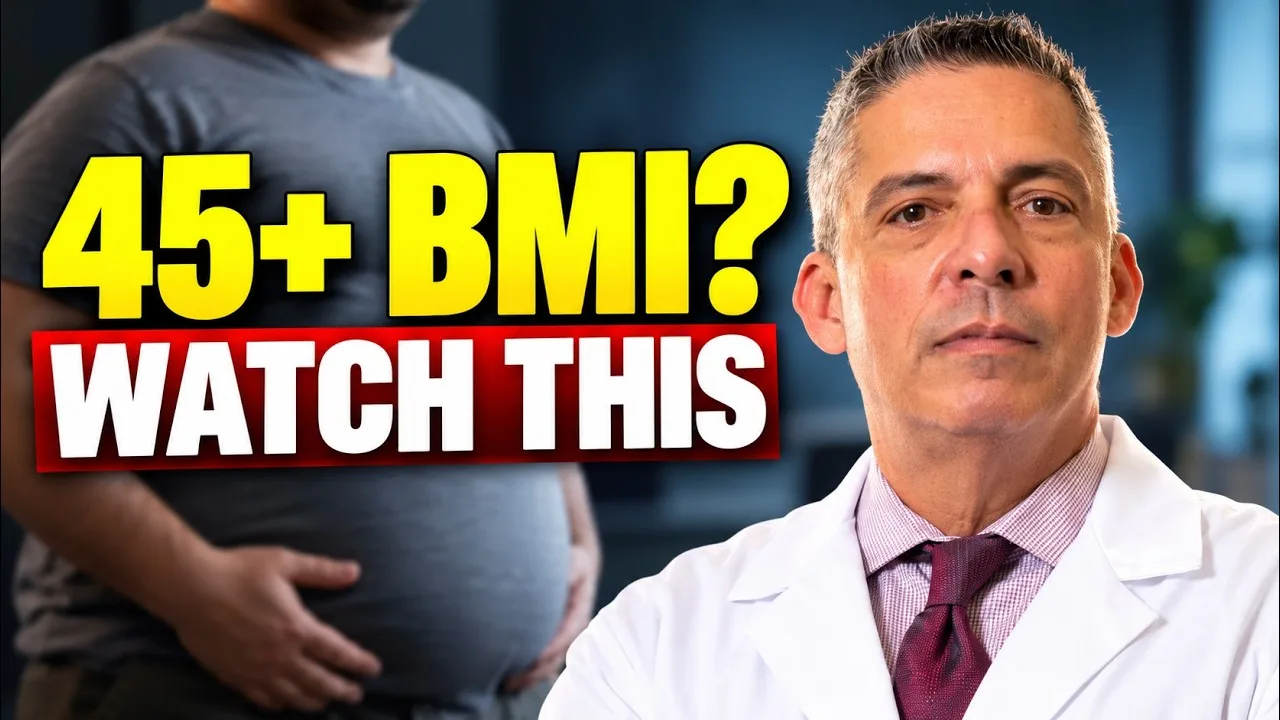
One of the most common things I hear in consultation is, "I just want the sleeve. It's the simplest one." I understand why. The sleeve is the most commonly performed bariatric operation in the world, it is safe, and it works well for many people. But it is not the right operation for everyone, and one of the biggest factors in that decision is a number you already know: your BMI.
A higher starting BMI does not automatically mean you will lose more weight in a way that gets you where you need to be. In fact, the higher your BMI, and the more health problems you are dealing with, the less likely a sleeve alone is to give you the result you need. That is when it may be worth learning about procedures you might not have heard of.
What BMI Is, and What It Isn't
Body mass index is your weight in kilograms divided by your height in meters squared. It is a quick screening tool, and it is the number insurance companies and surgical guidelines use to decide who qualifies for surgery.
- 25 to 29.9: overweight
- 30 to 34.9: class 1 obesity
- 35 to 39.9: class 2 obesity
- 40 and above: class 3 obesity
- 50 and above: often called super obesity in surgical studies
BMI has real limits. It does not distinguish muscle from fat, and it does not tell you where fat is stored. Visceral fat around the organs is far more dangerous than fat under the skin. It also underestimates risk in some groups: metabolic disease appears at lower BMIs in people of Asian descent, which is why guidelines use lower cutoffs for them. Still, when it comes to choosing an operation, BMI tells us something very important: how far you have to go.
Who Qualifies for Bariatric Surgery Today?
In 2022, the American Society for Metabolic and Bariatric Surgery and the International Federation for the Surgery of Obesity and Metabolic Disorders updated the indications for bariatric surgery for the first time in three decades (Eisenberg et al., Surgery for Obesity and Related Diseases, 2022):
- BMI of 35 or higher: surgery is recommended, whether or not you have other health conditions.
- BMI of 30 to 34.9 with metabolic disease such as type 2 diabetes: surgery should be considered.
- People of Asian descent: surgery should be considered starting at a BMI of 27.5.
Many insurance plans still use the older 1991 criteria, which require a BMI of 40, or 35 with a related condition. Either way, qualifying is only the first question. The second, and more important, question is which operation will get you to a healthy weight and keep you there.
The Math Most Patients Never See
Most bariatric operations produce weight loss as a percentage of your starting weight. A sleeve gastrectomy produces weight loss that is roughly the same percentage of your starting weight whether you start at a BMI of 38 or 58. But the end point is very different. To see why, take the same hypothetical 25 percent loss for two patients:
- Start at a BMI of 38 and lose 25 percent: you end near a BMI of 28.5. That is a huge health win.
- Start at a BMI of 55 and lose 25 percent: you end near a BMI of 41. That is still class 3 obesity.
The patient who started at 55 lost far more pounds. But they are still living with severe obesity and most of the health risks that come with it. That is why a higher BMI often calls for a more powerful operation, not just the most familiar one.
How the Procedures Compare
Sleeve Gastrectomy
The sleeve removes about 75 to 80 percent of the stomach and lowers the hunger hormone ghrelin. In the SLEEVEPASS randomized trial, sleeve patients lost about 49 percent of their excess weight at five years, compared with about 57 percent after gastric bypass (Salminen et al., JAMA, 2018). The Swiss SM-BOSS trial found a similar pattern (Peterli et al., JAMA, 2018). The sleeve is an excellent operation for many patients at lower BMIs who do not have significant reflux. At very high BMIs, it often leaves patients short of their goal.
Roux-en-Y Gastric Bypass
Gastric bypass produces somewhat more weight loss than the sleeve, stronger and more durable diabetes remission, and it is the operation of choice for patients with reflux. For many patients in the middle BMI range, especially those with diabetes or GERD, it is the best balance of power and safety.
SADI-S and Duodenal Switch
The duodenal switch and its simplified version, SADI-S, are the most powerful bariatric operations available. They combine a sleeve with a bypass of a longer segment of intestine, which produces the greatest weight loss and the highest rates of diabetes remission.
For patients with very high BMIs, the data are striking. In a randomized trial of patients with a BMI of 50 to 60, the duodenal switch produced substantially greater weight loss at five years than gastric bypass, along with better improvements in cholesterol and blood sugar (Risstad et al., JAMA Surgery, 2015). The trade-off is that these operations require strict, lifelong vitamin supplementation and follow-up, because more of the intestine is bypassed.
SADI-S uses one intestinal connection instead of two, which simplifies the operation while keeping much of the weight-loss power of the duodenal switch. Newer approaches, such as magnetic anastomosis with MagDI, aim to create a similar bypass without staples.
If a higher BMI has you looking at these operations and you live in South Florida, see SADI-S surgery in Miami for how the consultation and planning process works with our team.
BMI Is Not the Only Factor
Your BMI points us in a direction, but it does not make the decision alone. When I recommend an operation, I also weigh:
- Reflux and hiatal hernia: the sleeve can make reflux worse, so significant GERD usually points toward gastric bypass.
- Type 2 diabetes: longer-standing or insulin-dependent diabetes responds best to bypass, SADI-S or duodenal switch.
- Your ability to take vitamins and keep follow-up appointments: the more powerful the operation, the more important lifelong supplements and labs become.
- Prior surgeries and anatomy: previous abdominal operations can change what is safest.
- Your goals: how much weight you need to lose to improve your health, and what trade-offs you are willing to accept.
A General Guide by BMI
Every patient is different, but here is how starting BMI often shapes the conversation in my practice:
- BMI 30 to 40: the sleeve is often a strong option if there is no significant reflux. Gastric bypass is favored with reflux or diabetes. Medical weight loss and endoscopic options may also fit.
- BMI 40 to 50: gastric bypass and the sleeve are both common choices, with SADI-S worth discussing when diabetes is severe or weight-loss goals are large.
- BMI 50 and above: SADI-S or duodenal switch deserve serious consideration, because they give the best chance of reaching a healthy weight. Some patients do a staged approach: a sleeve first, then conversion to SADI-S later if needed.
This is a starting point for discussion, not a rule. The right choice comes from a full evaluation.
Frequently Asked Questions
Does a higher BMI mean I will lose more weight?
You will usually lose more pounds, but not necessarily a higher percentage of your weight. Because most operations remove a similar percentage, patients who start at a very high BMI are more likely to end with a BMI that is still in the obese range unless they choose a more powerful operation.
Can I still have a sleeve if my BMI is over 50?
Yes, and some patients do well. A sleeve can also be the first step of a staged plan, with conversion to SADI-S or duodenal switch later if more weight loss is needed. The key is understanding the expected result before you decide.
What if my BMI is under 35?
Under the 2022 guidelines, surgery should be considered at a BMI of 30 to 34.9 if you have metabolic disease such as type 2 diabetes, and at 27.5 for people of Asian descent. Insurance coverage at these levels varies, so check your plan.
Should I lose weight before my consultation?
Don't try to lower your BMI on your own before you are evaluated. If your BMI drops below your plan's threshold before approval, you could lose eligibility. Your surgical team will guide any pre-operative weight loss.
The Bottom Line
A higher starting BMI changes the math. The same percentage of weight loss can leave one patient at a healthy weight and another still living with severe obesity. That is why the most popular operation is not always the right one.
The right operation is the one that fits your body, your health conditions and your goals, and gives you the best chance of improving your health for the long term. Understanding what your BMI means is the first step toward choosing it.
Further Information
Medical Topics Covered


Dr. de la Cruz‑Muñoz specializes in advanced minimally invasive and robotic surgery, metabolic disease management, and comprehensive long‑term patient care. His work integrates clinical expertise, academic leadership, and a commitment to evidence‑based medicine. He has trained surgeons across the country, contributed to national guidelines, and is widely regarded for his outcomes, innovation, and patient‑centered approach.
Patients choose Dr. de la Cruz‑Muñoz for his combination of surgical excellence, metabolic expertise, and lifelong dedication to improving patient health through compassionate, high‑quality care.
Procedures We Offer








FAQ
No. BMI is a measure based on height and weight, but it does not distinguish muscle from fat or show where fat is distributed. Clinicians may consider other health information, such as obesity-related conditions, metabolic markers, and body composition, as part of an evaluation. How those measures affect eligibility and coverage varies.
TIF works best for patients with objectively confirmed, regurgitation-predominant GERD who have had symptoms and PPI use for at least 6 months, who want to avoid lifelong medication or conventional surgery, and who have favorable anatomy (Thrumurthy et al., JAMA, 2026). Standalone TIF requires a small or absent hiatal hernia (≤2 cm, Hill grade I/II) and no severe esophagitis (LA grade C or D) (Katz et al., American College of Gastroenterology, 2022). It is not appropriate for patients with a large hiatal hernia, severe erosive esophagitis, long-segment Barrett's esophagus, a BMI over 35, or an esophageal motility disorder such as achalasia (Vaezi et al., Gastroenterology, 2020). If you have a hernia larger than 2 cm, you may still be a candidate for cTIF, which repairs the hernia laparoscopically and performs the TIF in the same session (Jaber et al., Surgical Endoscopy, 2024). A complete workup — endoscopy, pH testing, and often manometry — determines candidacy.
The best candidates are patients who had Roux-en-Y gastric bypass and are regaining weight (or never lost enough) because the outlet between the pouch and intestine has stretched — typically to 25 mm or more — and who are committed to long-term follow-up (Jirapinyo et al., Gastrointestinal Endoscopy, 2020; Vansteenbrugge et al., Obesity Surgery, 2023). It also treats dumping syndrome from a dilated outlet. TORe is not appropriate if the outlet is already narrow, if there is an active marginal ulcer, or if there is a large hiatal hernia (Reicher et al., Obesity Surgery, 2023).
The best candidates are patients with significant weight regain or inadequate weight loss after a band, often with a higher BMI (generally over 50) and metabolic disease such as type 2 diabetes, who can commit to lifelong vitamin, mineral, and protein supplementation (Peabody et al., SOARD, 2025; Süsstrunk et al., SOARD, 2023). Patients whose main problem is reflux or esophageal dysmotility are usually better served by converting to a gastric bypass instead, which is why a pre-op upper GI study is essential (Pearlstein et al., Obesity Surgery, 2019).
People Also Ask
Obesity is recognized as a chronic disease by major medical organizations, including the American Medical Association. It is influenced by genetics, hormones, brain signaling, environment, sleep, stress and medications — not simply willpower. Like other chronic diseases, it often requires long-term treatment, which may include nutrition, activity, behavioral support, medications and surgery. Lifestyle matters, but biology largely determines how the body responds.
The body has powerful systems that defend its weight. When you lose weight, hunger hormones rise, fullness hormones drop, the brain becomes more focused on food and metabolism slows — a process called metabolic adaptation. Genetics, sleep, stress, medications and the modern food environment add to the challenge. These are biological forces, not character flaws, which is why medical treatment is often needed.
Genetics play a major role. Studies of twins and adopted children suggest that roughly 40–70% of the variation in body weight is inherited, influencing appetite, fullness, metabolism and where fat is stored. Many genes each contribute a small effect, and a few rare single-gene forms cause severe early obesity. Genes interact with environment, sleep, stress and medications, so a family history raises risk but does not determine destiny.
GLP-1 medications mimic a natural gut hormone released after eating. They act on the brain to reduce hunger and increase fullness, slow stomach emptying so meals last longer, quiet "food noise," and improve insulin release and blood sugar. Tirzepatide also acts on a second hormone, GIP. In clinical trials, these medications produced average weight loss of about 15–20% (Wilding et al., New England Journal of Medicine, 2021; Jastreboff et al., New England Journal of Medicine, 2022).
Yes. Obesity is associated with more than 200 health conditions, including type 2 diabetes, high blood pressure, high cholesterol, heart disease, stroke, sleep apnea, fatty liver disease, reflux, osteoarthritis, infertility and PCOS, depression and at least 13 types of cancer. Losing weight — through medical treatment or bariatric surgery — improves or resolves many of these conditions.
Dieting alone usually cannot overcome the body's biological defenses against weight loss. As weight falls, hunger hormones rise, fullness hormones fall and metabolism slows — changes that can last for years. Most people regain the majority of diet-related weight loss within several years. That is not a failure of willpower, and it is why treatments that address appetite biology, such as GLP-1 medications and bariatric surgery, are more effective for many people with obesity.
Consider medical evaluation when excess weight affects your health, mobility or quality of life, or when you have related conditions such as prediabetes, diabetes, high blood pressure, sleep apnea, fatty liver or joint pain. Guidelines support medications for adults with a BMI of 30 or higher, or 27 or higher with a weight-related condition, and surgery for a BMI of 35 or higher, or 30 or higher with metabolic disease. Early treatment can help prevent complications.
Yes. Bariatric surgery treats the biological drivers of obesity, changing hunger and fullness hormones, insulin sensitivity and the weight the body defends. It is the most effective and durable treatment for severe obesity, producing large, sustained weight loss and improving or resolving diabetes, high blood pressure, sleep apnea and fatty liver. Long-term studies show it also reduces the risk of heart disease, cancer and early death.