Roux-en-Y Duodenal Switch (BPD/DS) Explained: A Complete Patient Guide

Quick Answer
Watch Related Video
Quick answer: The biliopancreatic diversion with duodenal switch, known as the Roux DS or BPD-DS, produces the greatest weight loss and the highest rate of diabetes remission of any standard bariatric operation, backed by more than two decades of long-term data. It is also the most complex procedure and the most demanding afterward, requiring the most intensive vitamin supplementation and lifelong lab monitoring of any weight-loss surgery. The trade-off is real: more weight loss and better metabolic control, but a higher rate of nutritional deficiencies. This guide explains who qualifies, how the operation works, how it compares to the SADI-S and gastric bypass, the risks, and what life looks like afterward.
What Is the Duodenal Switch (Roux DS / BPD-DS)?
The biliopancreatic diversion with duodenal switch is a combined restrictive and malabsorptive operation. It pairs a sleeve gastrectomy with an intestinal rerouting that sends food to the last segment of the small intestine, dramatically reducing calorie and fat absorption and triggering powerful hormonal changes.
It has been performed since the late 1990s and has the longest track record of any duodenal switch variant. Despite its effectiveness, it accounts for under 2 percent of bariatric procedures worldwide, largely because of concerns about long-term nutritional risk and technical complexity (Pereira et al., Obesity Surgery, 2025). The SADI-S was later developed specifically as a simplified version of this operation.
Who Qualifies for the Duodenal Switch?
Current ASMBS and IFSO guidelines recommend metabolic and bariatric surgery for:
- BMI 35 or higher, regardless of whether other health conditions are present.
- BMI 30 to 34.9 with type 2 diabetes or another metabolic disease not adequately controlled by nonsurgical treatment.
- Individuals of Asian descent at a BMI of 27.5 or above, because metabolic disease develops at lower BMIs in this population (Eisenberg et al., Surgery for Obesity and Related Diseases, 2022).
The duodenal switch is especially considered for patients with very high BMI (50 or above), severe or insulin-dependent type 2 diabetes, and weight regain after a prior sleeve gastrectomy, where it can be performed as a planned second stage. Importantly, the decision is individualized. Two randomized trials concluded that for BMI 50 to 60, a duodenal switch with a short common channel was not clearly superior to gastric bypass once nutritional and surgical adverse effects were weighed, and both institutions moved away from that configuration (Salte et al., JAMA Network Open, 2024).
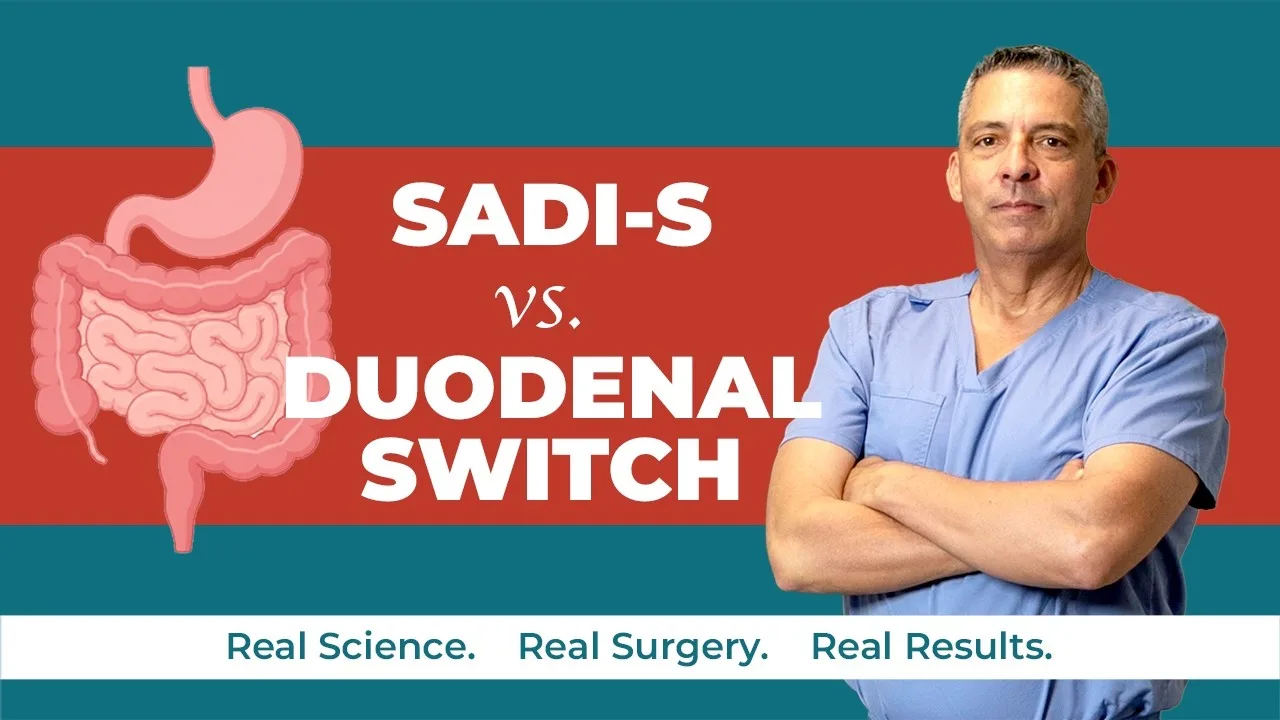
How the Roux DS Differs From the SADI-S
Both operations begin identically: a sleeve gastrectomy that removes about 75 to 85 percent of the stomach including the fundus, with the pylorus preserved. The duodenum is then divided a few centimeters below the pylorus. The difference is in the intestinal reconstruction.
- SADI-S: A single loop of ileum is brought up and connected directly to the duodenum. One connection (anastomosis), with a common channel of about 250 to 300 cm.
- Roux DS: The intestine is divided and rearranged into three separate channels connected by two anastomoses, with a shorter common channel of about 100 to 150 cm.
The shorter common channel is the key physiologic difference. It means more malabsorption, more weight-loss potential, but also more nutritional risk. The Roux DS also takes longer to perform and creates more mesenteric defects to close. Its major advantage is that the Roux-en-Y configuration keeps bile and food in separate channels until far downstream, which prevents bile reflux, a complication that can occur with the SADI-S loop configuration (El Ghazal et al., Surgical Endoscopy, 2025).
How the Duodenal Switch Works
The operation works through three mechanisms:
- Restriction. The sleeve limits how much you can eat and removes the fundus, dramatically lowering ghrelin, the main hunger hormone.
- Hormonal reprogramming. Delivering food rapidly to the distal small intestine drives a large surge in GLP-1 and PYY, which increase fullness and improve insulin secretion and sensitivity, often within days of surgery and before major weight loss occurs. Biliopancreatic diversion has been shown to improve insulin sensitivity roughly 45 percent more than gastric bypass at matched weight loss (Harris et al., Cell Metabolism, 2019).
- Malabsorption. Because food and digestive enzymes only mix in the short common channel, the body absorbs fewer calories and less fat. This is why the duodenal switch produces the most weight loss but also carries the highest nutritional risk.
Because the pylorus is preserved, dumping syndrome is uncommon, a meaningful advantage over Roux-en-Y gastric bypass.
Results: Weight Loss and Health Improvements
Weight loss. The duodenal switch produces the greatest and most durable weight loss of any standard procedure. In patients with BMI 50 or above, excess weight loss at 3 years reached 67.4 percent for BPD/DS versus 54.1 percent for gastric bypass and 40.1 percent for sleeve gastrectomy (Chang et al., Surgery for Obesity and Related Diseases, 2025). In the 10-year ASGARD randomized trial, total weight loss was 33.9 percent after duodenal switch versus 20.0 percent after gastric bypass in patients with BMI 50 to 60 (Sundbom, JAMA Network Open, 2024).
Compared to the SADI-S, weight loss is essentially comparable. In a 10-year cohort, maximum total weight loss was 45.7 percent for BPD/DS versus 47.3 percent for SADI-S, with no significant difference (El Ghazal et al., Surgical Endoscopy, 2025). The first head-to-head randomized trial also found no statistically significant difference at 5 years, with point estimates modestly favoring BPD/DS (Axer et al., Obesity Surgery, 2026).
Diabetes. Diabetes remission is the highest of any procedure. Complete remission reached 79 percent in patients with BMI 50 or above, versus 61 percent for gastric bypass (Chang et al., Surgery for Obesity and Related Diseases, 2025). Both duodenal switch variants significantly outperform gastric bypass for diabetes.
Other conditions and survival. Hypertension, dyslipidemia, and sleep apnea all improve substantially. Bariatric surgery overall is associated with roughly a 40 to 50 percent reduction in long-term all-cause mortality (Cardoso et al., Diabetes, Obesity and Metabolism, 2017).
Risks and Complications: Where the Roux DS Differs Most
The duodenal switch is safe in experienced hands, with mortality around 0.1 to 0.4 percent. But its long-term complication profile is where it differs most from the SADI-S.
- Nutritional deficiencies are the central concern. In a 10-year comparison, deficiencies occurred in 53.5 percent of BPD/DS patients versus 15.6 percent of SADI-S patients (El Ghazal et al., Surgical Endoscopy, 2025). At least one deficiency develops within 4 years in about 70 percent of patients, and up to 90 percent develop some deficiency within 3 years without aggressive supplementation (Finta et al., New England Journal of Medicine, 2024; Homan et al., Obesity Surgery, 2018).
- Fat-soluble vitamin and mineral deficiencies are common: vitamin D (up to 100 percent without supplementation), vitamin A, zinc, copper, and iron are all frequently affected (Pereira et al., Langenbeck's Archives of Surgery, 2023).
- Protein malnutrition is the most serious nutritional complication, occurring in roughly 3 to 18 percent, and sometimes requires hospitalization or surgical lengthening of the common channel (Chakhtoura et al., Cochrane Database of Systematic Reviews, 2024).
- Reoperation for malnutrition occurred in about 10 percent of patients in one long-term study (Finta et al., New England Journal of Medicine, 2024).
- Diarrhea and loose, foul-smelling stools are more common than after less malabsorptive procedures (Sundbom, JAMA Network Open, 2024).
On the other hand, the duodenal switch has clear advantages:
- Bile reflux: very uncommon, because of the Roux-en-Y configuration. If a patient develops bile reflux after a SADI-S, conversion to a Roux DS can resolve it (El Ghazal et al., Surgical Endoscopy, 2025).
- Marginal ulcers and dumping are uncommon. In a 919-patient series, marginal ulcers occurred in 0.9 percent and dumping in 0.8 percent, far below the 10 to 16 percent ulcer rate reported after gastric bypass, because the pylorus is preserved (Salame et al., Journal of Clinical Medicine, 2023).
The Bottom Line: Roux DS vs SADI-S vs Gastric Bypass
These three operations serve different patients. The differences are in the details.
- Roux DS advantages over SADI-S: greatly reduces bile reflux, longest track record (20-plus years).
- SADI-S advantages over Roux DS: dramatically fewer nutritional deficiencies (15.6% vs 53.5% at 10 years), shorter operative time, simpler technique, one fewer anastomosis, with comparable weight loss and diabetes remission (El Ghazal et al., Surgical Endoscopy, 2025).
- Roux DS advantages over gastric bypass: significantly greater weight loss and higher diabetes remission, fewer marginal ulcers, less dumping.
- Gastric bypass advantages over Roux DS: simpler operation, far fewer nutritional complications, lower reoperation rate, better reflux control, 30-plus years of data.
For patients with very high BMI who need maximum weight loss, the Roux DS or SADI-S is often the right category. If bile reflux is a concern, the Roux DS has the edge. If comparable metabolic power with fewer nutritional complications is the goal, the SADI-S is increasingly favored. If nutritional compliance is a concern, gastric bypass may be the safer choice.
Life After Surgery
Life after a duodenal switch requires the most commitment of any bariatric operation:
- Protein first, at least 80 to 100 grams per day, higher than after a sleeve or bypass because of the malabsorptive component.
- Diet progresses in stages from liquids to purees to soft foods to solids over about 6 to 8 weeks.
- Lifelong, high-dose vitamin supplementation including a bariatric multivitamin with fat-soluble vitamins in a dry or water-soluble form, calcium citrate (roughly 1,800 to 2,400 mg per day), high-dose vitamin D, vitamin A, iron, zinc, vitamin B12, and copper, all adjusted to blood levels (Homan et al., Obesity Surgery, 2018).
- Blood work every 3 to 6 months in the first year, then at least annually for life. Vitamin A deficiency has caused serious complications years to decades later in patients who stopped supplementation and follow-up (Finta et al., New England Journal of Medicine, 2024).
- Exercise, building to at least 150 minutes per week.
If you stop your vitamins or stop coming to follow-up, you are at real risk for serious and sometimes irreversible nutritional complications. This is the single most important commitment you make after this surgery.
Patients in South Florida, or those traveling to Miami for surgery, can read about consultation, hospital stay and long-term follow-up on our duodenal switch surgery in Miami page.
Further Information
For additional context and a deeper professional perspective, you can read the companion LinkedIn article linked below.
BPD/DS dramatically increases GLP‑1, reduces insulin resistance, accelerates nutrient delivery to the ileum, and produces the strongest hormonal and metabolic effects in bariatric surgery.
Medical Topics Covered


Dr. de la Cruz‑Muñoz specializes in advanced minimally invasive and robotic surgery, metabolic disease management, and comprehensive long‑term patient care. His work integrates clinical expertise, academic leadership, and a commitment to evidence‑based medicine. He has trained surgeons across the country, contributed to national guidelines, and is widely regarded for his outcomes, innovation, and patient‑centered approach.
Patients choose Dr. de la Cruz‑Muñoz for his combination of surgical excellence, metabolic expertise, and lifelong dedication to improving patient health through compassionate, high‑quality care.
Procedures We Offer






Conditions






FAQ
Three ways. MagDI uses magnets instead of staples or sutures to form the connection; the duodenum is left intact rather than divided; and food flows through two pathways (bipartition) instead of being fully rerouted. About 19% of a meal passes through the new magnetic connection while the rest follows the normal route (Cadiere et al., Journal of Gastrointestinal Surgery, 2024).
Yes. Internal hernia is a risk after essentially any bariatric operation that reroutes the small bowel and creates a mesenteric defect — not just the classic Roux-en-Y gastric bypass. It has been documented after one-anastomosis (mini) gastric bypass (OAGB), single-anastomosis duodeno-ileal bypass with sleeve (SADI-S), and biliopancreatic diversion with duodenal switch (BPD/DS) (Khogeer et al., Obesity Surgery, 2021; Davey et al., Obesity Surgery, 2026). What differs is how often it happens, and that difference is driven by how many mesenteric defects each operation creates.
Operations with a single anastomosis and fewer (or essentially unclosed, wide-open) mesenteric defects tend to have lower internal hernia rates. In a network meta-analysis of randomized trials, reported internal hernia rates were about 2.4% for Roux-en-Y gastric bypass, 3.1% for OAGB, 1.8% for duodenal switch, and 0% for SADI-S, with no statistically significant difference between them (Davey et al., Obesity Surgery, 2026). Procedures with an extra bowel connection carry a higher risk: the additional ileo-ileal anastomosis in traditional BPD/DS creates more mesenteric defects, and internal hernia consistently occurs more often after BPD/DS than after the single-anastomosis SADI-S (roughly 8% vs 1.5% in pooled series) (Galvao Goncalves et al., Surgical Endoscopy, 2026; El Ghazal et al., Surgical Endoscopy, 2025). OAGB was once thought to almost never cause internal hernia, but larger series have shown it is more common — and more often missed — than previously believed, so a low threshold for evaluation applies regardless of which bypass a patient had (Petrucciani et al., Obesity Surgery, 2021; Facchiano et al., Obesity Surgery, 2020).
The practical takeaway: any patient with a rerouted gut — OAGB, SADI, DS, or classic gastric bypass — who develops recurrent crampy, postprandial abdominal pain deserves prompt evaluation by a surgeon familiar with their specific anatomy, because the pain can be intermittent and the CT scan can look normal (Khogeer et al., Obesity Surgery, 2021).
Both are malabsorptive revisions that turn your bypass into a sleeve gastrectomy. They differ in how the intestine is reconnected. A duodenal switch uses two intestinal connections and a shorter common channel. SADI-S uses a single connection and a longer channel. In national registry data, converting a bypass to a duodenal switch or to SADI-S produced comparable 30-day complication rates and comparable short-term weight loss (Serra et al., Surgical Endoscopy, 2026).
The main difference is long-term evidence. The duodenal switch has more than a decade of data, with average total weight loss of about 36% and diabetes resolution in 78% of patients at 10 years or more (Azizi et al., Obesity Surgery, 2026). SADI-S also shows sustained weight loss, but 10-year data are limited, and the available long-term studies report notable reoperation rates for nutritional complications (Azizi et al., Obesity Surgery, 2026).
Which operation is right for you depends on your starting BMI, bowel length, diabetes status, reflux history, and how reliably you can keep up with supplements and labs. A full comparison is on the Gastric Bypass to SADI-S Conversion page, and every option is reviewed on the Gastric Bypass Revision for Weight Regain hub.
It can, and that's why reflux testing comes first.
DS keeps your sleeve and pylorus, so it doesn't remove the high-pressure anatomy that causes reflux after sleeve. In pooled data:
- 18% of patients developed new reflux after DS
- 14% with existing reflux got worse
- About half improved
- 4–12% eventually needed reflux surgery (Brand et al., Surgical Endoscopy, 2025)
If you have reflux, esophagitis, Barrett's esophagus, or a hiatal hernia, conversion to Roux-en-Y gastric bypass is generally the better choice (Merz et al., Surgery for Obesity and Related Diseases, 2019). See Sleeve Gastrectomy to Roux-en-Y Gastric Bypass Conversion.
People Also Ask
Obesity is recognized as a chronic disease by major medical organizations, including the American Medical Association. It is influenced by genetics, hormones, brain signaling, environment, sleep, stress and medications — not simply willpower. Like other chronic diseases, it often requires long-term treatment, which may include nutrition, activity, behavioral support, medications and surgery. Lifestyle matters, but biology largely determines how the body responds.
The body has powerful systems that defend its weight. When you lose weight, hunger hormones rise, fullness hormones drop, the brain becomes more focused on food and metabolism slows — a process called metabolic adaptation. Genetics, sleep, stress, medications and the modern food environment add to the challenge. These are biological forces, not character flaws, which is why medical treatment is often needed.
Genetics play a major role. Studies of twins and adopted children suggest that roughly 40–70% of the variation in body weight is inherited, influencing appetite, fullness, metabolism and where fat is stored. Many genes each contribute a small effect, and a few rare single-gene forms cause severe early obesity. Genes interact with environment, sleep, stress and medications, so a family history raises risk but does not determine destiny.
GLP-1 medications mimic a natural gut hormone released after eating. They act on the brain to reduce hunger and increase fullness, slow stomach emptying so meals last longer, quiet "food noise," and improve insulin release and blood sugar. Tirzepatide also acts on a second hormone, GIP. In clinical trials, these medications produced average weight loss of about 15–20% (Wilding et al., New England Journal of Medicine, 2021; Jastreboff et al., New England Journal of Medicine, 2022).
Yes. Obesity is associated with more than 200 health conditions, including type 2 diabetes, high blood pressure, high cholesterol, heart disease, stroke, sleep apnea, fatty liver disease, reflux, osteoarthritis, infertility and PCOS, depression and at least 13 types of cancer. Losing weight — through medical treatment or bariatric surgery — improves or resolves many of these conditions.
Dieting alone usually cannot overcome the body's biological defenses against weight loss. As weight falls, hunger hormones rise, fullness hormones fall and metabolism slows — changes that can last for years. Most people regain the majority of diet-related weight loss within several years. That is not a failure of willpower, and it is why treatments that address appetite biology, such as GLP-1 medications and bariatric surgery, are more effective for many people with obesity.
Consider medical evaluation when excess weight affects your health, mobility or quality of life, or when you have related conditions such as prediabetes, diabetes, high blood pressure, sleep apnea, fatty liver or joint pain. Guidelines support medications for adults with a BMI of 30 or higher, or 27 or higher with a weight-related condition, and surgery for a BMI of 35 or higher, or 30 or higher with metabolic disease. Early treatment can help prevent complications.
Yes. Bariatric surgery treats the biological drivers of obesity, changing hunger and fullness hormones, insulin sensitivity and the weight the body defends. It is the most effective and durable treatment for severe obesity, producing large, sustained weight loss and improving or resolving diabetes, high blood pressure, sleep apnea and fatty liver. Long-term studies show it also reduces the risk of heart disease, cancer and early death.