How to Choose a Bariatric Surgeon: What the Data Actually Says

Quick Answer
Watch Related Video
Most patients choose their bariatric surgeon the way they choose a restaurant.
Online reviews. Whoever is closest. Whoever their coworker used. Whoever shows up first on Google. Whoever had the earliest available appointment.
Not one of those things has ever been shown to predict whether your surgery will go well.
I've spent over 25 years in bariatric surgery — more than 9,000 bariatric operations, a fellowship program I directed, national accreditation applications I reviewed, research I published, and committees I sat on. I've seen what separates a program that changes someone's life from one that just performs an operation.
The gap is enormous. And patients have almost no access to the information that would tell them which side they're on.
This post is the evidence, organized into seven questions you can actually use.
The study that should change how every patient thinks about this decision
In 2013, researchers at the University of Michigan published a study in the New England Journal of Medicine that had never been attempted before. They collected operative videos from bariatric surgeons — board-certified, credentialed, operating at accredited centers — and had blinded expert reviewers score their technical skill on a validated scale.
Then they matched those skill scores to outcomes.
Surgeons in the bottom quartile of skill had complication rates nearly three times higher than surgeons in the top quartile. Same operation. Same hospitals. Same accreditation. The only variable was the surgeon's hands.
And here is the part that matters most: there is no public scoreboard. You cannot look up your surgeon's technical skill rating. It doesn't exist in any consumer-facing format.
So what can you actually evaluate? More than you think — if you know what to ask.
Question 1: How many of these procedures do you do per year?
Volume is the single most-studied predictor of quality in bariatric surgery. The data is consistent across multiple national registries and spanning decades of research.
Centers performing fewer than 50 bariatric cases per year consistently show higher complication rates. Above 100, outcomes measurably improve — not just in complications, but in length of stay, readmissions, and reoperations.
This isn't about ego. It's about pattern recognition, team coordination, and something harder to measure but just as real: the ability to recognize and manage complications early, when they're still fixable.
Volume alone isn't enough. But it's the floor.
Question 2: Are you fellowship-trained in bariatric surgery? Are you board-certified in obesity medicine?
These are three different credentials, and most patients don't know the difference.
Board certification in general surgery means you completed a general surgery residency and passed the American Board of Surgery exams. It's a baseline — not a specialization.
Fellowship training in bariatric surgery means an additional year (or more) of dedicated, post-residency training in metabolic and bariatric operations, under supervision, at an accredited program. It is not a weekend course or a proctored case. It's structured, immersive training.
Board certification in obesity medicine — through the American Board of Obesity Medicine — means the surgeon understands the disease itself, not just the operation. The pathophysiology. The medications. The behavioral science. The long-term metabolic management.
Surgery is a tool. Obesity is the condition. The ideal surgeon understands both.
Question 3: Is this program MBSAQIP-accredited?
MBSAQIP stands for the Metabolic and Bariatric Surgery Accreditation and Quality Improvement Program. It's a joint initiative of the American College of Surgeons and the American Society for Metabolic and Bariatric Surgery.
Accreditation means the center has met defined structural and process standards, reports its outcomes to a national database, undergoes external site review, and participates in continuous quality improvement.
It doesn't guarantee perfection. No accreditation can. But it guarantees accountability — and it guarantees that someone outside the building is watching the numbers. That distinction alone separates accredited programs from the rest.
You can verify a center's accreditation status online. It takes thirty seconds.
Question 4: Who is on your team besides you?
Bariatric surgery is not a one-person show. The programs with the best long-term outcomes are built around a multidisciplinary team that typically includes:
- A registered dietitian with bariatric-specific training
- A psychologist or psychiatrist for pre- and post-operative behavioral support
- An obesity medicine physician for medical management and medication optimization
- Structured support groups — peer-led or professionally facilitated
- Exercise and lifestyle support
If your surgeon is the only person you'll ever see before and after surgery, that's a red flag. The operation itself takes 45 minutes to an hour. The disease it's treating lasts the rest of your life. The team is what makes the difference between an event and a treatment plan.
Question 5: What is your plan for me at year three? Year five?
This is where most programs quietly fail.
In the first year after bariatric surgery, everyone is paying attention — the surgeon, the dietitian, the patient. Visits are frequent. Weight is dropping. Bloodwork is improving. Everyone feels like it's working.
By year three, most patients have stopped coming back. And most programs have stopped asking them to.
But weight regain, nutritional deficiencies, changes in mental health, and evolving comorbidities are long-term realities. They don't appear at month six. They appear at year three, year five, year ten. A program that doesn't have a structured plan for those years isn't offering bariatric care. It's offering a procedure.
Ask specifically: How often will I be seen after year one? By whom? What gets monitored? What happens if I start regaining weight?
The answer tells you everything about whether this is a program or a transaction.
Question 6: What procedures do you offer — and what do you do when one isn't enough?
A surgeon who only performs one procedure will recommend that procedure. That's human nature, not malice. But obesity is not one disease with one solution.
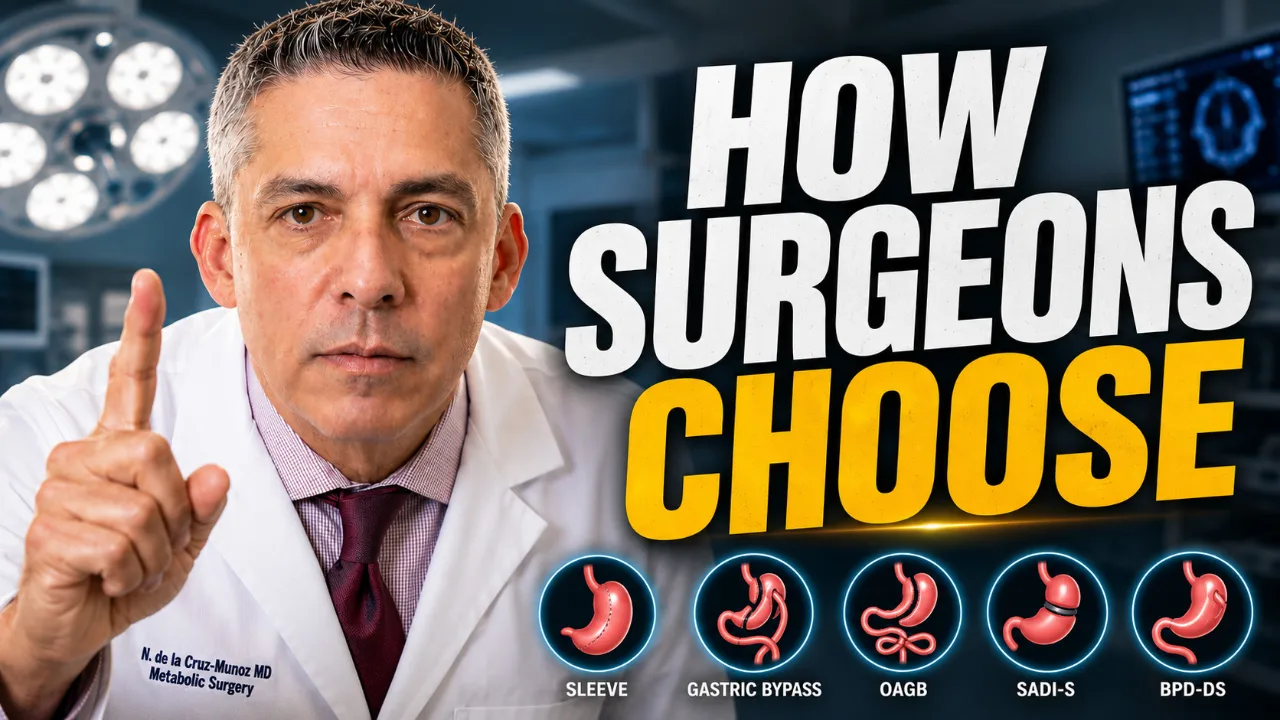
Some patients are best served by a sleeve gastrectomy. Some by a Roux-en-Y gastric bypass. Some by a duodenal switch or SADI-S. Some by an endoscopic procedure — intragastric balloon, endoscopic sleeve gastroplasty. Some by medical management with GLP-1 receptor agonists or other medications. And some will need a revision operation years later when the first procedure is no longer working.
The question isn't just "What will you do?" It's "What happens if this doesn't work? What else can you offer me?"
A surgeon — or at minimum, a program — that offers the full spectrum can evaluate you without a predetermined answer. That's the difference between being matched to the right treatment and being matched to whatever's on the menu.
Question 7: If something goes wrong at 2 AM, who handles it?
This is the question nobody asks and everybody should.
Some surgeons operate at facilities where they personally manage their own complications around the clock. They know your anatomy. They know what they did. They know what to look for.
Others operate at centers where after-hours emergencies are covered by whoever is on call — someone who may never have met you, may not specialize in bariatric surgery, and may not be familiar with the specific anatomy of your procedure.
Both models exist. Neither is inherently wrong. But you deserve to know which one you're walking into before the operation, not after.
Green flags
- The surgeon answers all seven questions without hesitation
- You meet the team — dietitian, psychologist, medical specialist — before surgery
- There's a structured follow-up schedule that extends beyond year one
- The surgeon discusses more than one procedure and explains why one fits you better than another
- Complication rates and outcomes are shared openly
- The program is MBSAQIP-accredited
Red flags
- You meet the surgeon once and are scheduled for surgery at the same visit
- No one mentions a dietitian, psychologist, or long-term follow-up plan
- Only one procedure is offered with no discussion of alternatives
- The center is not accredited
- Your questions about volume, training, or outcomes are deflected or met with irritation
- The emphasis is on before-and-after photos rather than data
The bottom line
Your surgeon matters more than your surgery. The team around your surgeon matters as much as the surgeon. And long-term follow-up isn't a luxury — it's the difference between an operation and a treatment plan.
Ask the seven questions. Listen carefully to the answers. And if a program can't answer them clearly — keep looking.
You deserve to make this decision with the same quality of evidence your surgeon uses to make decisions about you.
For a short video version of this advice, watch The Bariatric Surgery Industry Doesn't Want You to See This: 7 Questions That Predict Your Outcome.
Further Information
For additional context and a deeper professional perspective, you can read the companion LinkedIn article linked below.
Frequently Asked Questions
How many bariatric procedures should my surgeon have performed?
There is no single magic number, but the research consistently shows that surgical volume correlates with better outcomes. Centers performing more than 100 cases per year show measurably lower complication rates, shorter hospital stays, and fewer readmissions. The learning curve for most bariatric procedures flattens around 75–100 cases, but high-volume surgeons continue to refine judgment, speed, and complication management well beyond that. Ask for the annual number, not the lifetime number — what matters is current, active volume.
What is MBSAQIP and why does it matter?
MBSAQIP is the Metabolic and Bariatric Surgery Accreditation and Quality Improvement Program, jointly administered by the American College of Surgeons and the American Society for Metabolic and Bariatric Surgery. Accredited centers must meet defined structural and process standards, report outcomes to a national database, and undergo external site review. It doesn't guarantee a perfect outcome, but it guarantees that the program is being measured and held accountable — which is more than most patients realize is optional.
What's the difference between a fellowship-trained bariatric surgeon and one who isn't?
A fellowship is a structured, post-residency year (or more) of dedicated training in metabolic and bariatric surgery at an accredited program. It includes hands-on operative experience under supervision, not a weekend course or a handful of proctored cases. Many excellent bariatric surgeons are not fellowship-trained — they developed expertise through years of practice and volume. But fellowship training is a reliable signal that the surgeon chose this field deliberately and was trained in it formally.
Does my surgeon need to be board-certified in obesity medicine?
It's not required, but it's a meaningful differentiator. The American Board of Obesity Medicine certification means the surgeon has demonstrated knowledge of the pathophysiology of obesity, pharmacotherapy, behavioral science, and long-term metabolic management — not just surgical technique. Surgery is a tool. Obesity is the disease. A surgeon who holds both surgical and obesity medicine credentials understands the full picture.
Is it safe to choose a surgeon who only does sleeve gastrectomy?
It's common, and many sleeve-only surgeons produce excellent results. But obesity is not one disease. Some patients are better served by a gastric bypass, a duodenal switch, an endoscopic procedure, or medical management. And some will need a revision years later. If your surgeon only offers one procedure, ask explicitly: What happens if this doesn't work for me? Where do I go next? The ideal scenario is a surgeon — or at least a program — that can offer the full range and adjust the plan as needed.
How important are online reviews when choosing a bariatric surgeon?
Online reviews reflect patient experience — bedside manner, office wait times, staff friendliness. Those things matter. But no study has ever shown that online review scores predict surgical outcomes, complication rates, or long-term weight loss success. A surgeon with a 4.9-star rating and a surgeon with a 4.2-star rating may have identical — or reversed — clinical outcomes. Use reviews to gauge the experience. Use the seven questions to gauge the quality.
What should I expect from a multidisciplinary bariatric team?
At a well-structured program, you should meet a registered dietitian with bariatric-specific training, a psychologist or psychiatrist for behavioral evaluation and ongoing support, and ideally an obesity medicine physician for medical optimization before and after surgery. Many programs also offer structured support groups — peer-led or professionally facilitated — and exercise or lifestyle coaching. If the only person you meet before surgery is the surgeon, ask who else is involved in your care. The answer matters.
How long should I expect follow-up after bariatric surgery?
Ideally, for life — or at minimum, five years of structured visits. The first year is typically the most intensive, with visits every few months. But the critical window for weight regain, nutritional deficiencies, and emerging complications is years two through five and beyond. Ask your program specifically: How often will I be seen after year one? By whom? What gets monitored? If there's no answer, that's your answer.
What is the 2 AM question and why does it matter?
It's simple: If something goes wrong in the middle of the night after my surgery, who takes care of me? Some surgeons operate at hospitals where they personally manage their own complications around the clock. Others operate at centers where after-hours emergencies are covered by whoever is on call — a physician who may not do bariatric surgery and may not know your anatomy. Neither model is inherently wrong. But you deserve to know which one you're in before the operation, not during an emergency.
Should I travel for a better bariatric surgeon or stay local?
It depends on what "local" offers. If your local options meet the criteria — high volume, fellowship training or equivalent experience, MBSAQIP accreditation, full multidisciplinary team, long-term follow-up, range of procedures — proximity is a genuine advantage for pre-op visits, post-op follow-up, and emergency access. But if the local option lacks several of these, traveling to a high-quality center is a reasonable and increasingly common choice. Many programs now offer virtual follow-up to support patients who travel for surgery.
Medical Topics Covered


Dr. de la Cruz‑Muñoz specializes in advanced minimally invasive and robotic surgery, metabolic disease management, and comprehensive long‑term patient care. His work integrates clinical expertise, academic leadership, and a commitment to evidence‑based medicine. He has trained surgeons across the country, contributed to national guidelines, and is widely regarded for his outcomes, innovation, and patient‑centered approach.
Patients choose Dr. de la Cruz‑Muñoz for his combination of surgical excellence, metabolic expertise, and lifelong dedication to improving patient health through compassionate, high‑quality care.
Procedures We Offer








Conditions








FAQ
Yes. Bariatric surgery can affect mood, identity, relationships, coping strategies, and body image. Many patients experience improved mood and quality of life, while others may experience grief, anxiety, frustration, or difficulty adjusting as weight loss slows. Contact your care team if emotional changes interfere with eating, sleeping, relationships, work, or daily life.
The most common reason is weak or impaired esophageal motility. When manometry shows reduced esophageal contraction strength, a partial Toupet wrap is favored because it is less likely to cause difficulty swallowing while still controlling reflux (Yadlapati et al., American Gastroenterological Association, 2022). The decision also weighs your priorities: if minimizing swallowing side effects matters most, a Toupet is preferred; if maximal reflux control is the top priority, a Nissen may be chosen (Köckerling et al., Hernia, 2024). This is why objective esophageal testing before surgery is essential — it tailors the operation to your specific anatomy and esophageal function (Yadlapati et al., American Gastroenterological Association, 2022).
Minimally invasive release produces the same long-term symptom relief as open surgery but with far lower complication rates, less ileus, and a shorter hospital stay (about 1.7 vs 4.6 days) (DeCarlo et al., Journal of Vascular Surgery, 2023; Alsabbagh et al., Journal of Vascular Surgery, 2026). Because the operation involves delicate dissection around the aorta and celiac artery, it is recommended that it be done by surgeons who focus on this disease (Park et al., Vascular Medicine, 2025) — the rationale behind a dedicated regional MALS program led by one of the first surgeons in Florida, if not the first, to perform this release minimally invasively.
People Also Ask
Obesity is recognized as a chronic disease by major medical organizations, including the American Medical Association. It is influenced by genetics, hormones, brain signaling, environment, sleep, stress and medications — not simply willpower. Like other chronic diseases, it often requires long-term treatment, which may include nutrition, activity, behavioral support, medications and surgery. Lifestyle matters, but biology largely determines how the body responds.
The body has powerful systems that defend its weight. When you lose weight, hunger hormones rise, fullness hormones drop, the brain becomes more focused on food and metabolism slows — a process called metabolic adaptation. Genetics, sleep, stress, medications and the modern food environment add to the challenge. These are biological forces, not character flaws, which is why medical treatment is often needed.
Genetics play a major role. Studies of twins and adopted children suggest that roughly 40–70% of the variation in body weight is inherited, influencing appetite, fullness, metabolism and where fat is stored. Many genes each contribute a small effect, and a few rare single-gene forms cause severe early obesity. Genes interact with environment, sleep, stress and medications, so a family history raises risk but does not determine destiny.
GLP-1 medications mimic a natural gut hormone released after eating. They act on the brain to reduce hunger and increase fullness, slow stomach emptying so meals last longer, quiet "food noise," and improve insulin release and blood sugar. Tirzepatide also acts on a second hormone, GIP. In clinical trials, these medications produced average weight loss of about 15–20% (Wilding et al., New England Journal of Medicine, 2021; Jastreboff et al., New England Journal of Medicine, 2022).
Yes. Obesity is associated with more than 200 health conditions, including type 2 diabetes, high blood pressure, high cholesterol, heart disease, stroke, sleep apnea, fatty liver disease, reflux, osteoarthritis, infertility and PCOS, depression and at least 13 types of cancer. Losing weight — through medical treatment or bariatric surgery — improves or resolves many of these conditions.
Dieting alone usually cannot overcome the body's biological defenses against weight loss. As weight falls, hunger hormones rise, fullness hormones fall and metabolism slows — changes that can last for years. Most people regain the majority of diet-related weight loss within several years. That is not a failure of willpower, and it is why treatments that address appetite biology, such as GLP-1 medications and bariatric surgery, are more effective for many people with obesity.
Consider medical evaluation when excess weight affects your health, mobility or quality of life, or when you have related conditions such as prediabetes, diabetes, high blood pressure, sleep apnea, fatty liver or joint pain. Guidelines support medications for adults with a BMI of 30 or higher, or 27 or higher with a weight-related condition, and surgery for a BMI of 35 or higher, or 30 or higher with metabolic disease. Early treatment can help prevent complications.
Yes. Bariatric surgery treats the biological drivers of obesity, changing hunger and fullness hormones, insulin sensitivity and the weight the body defends. It is the most effective and durable treatment for severe obesity, producing large, sustained weight loss and improving or resolving diabetes, high blood pressure, sleep apnea and fatty liver. Long-term studies show it also reduces the risk of heart disease, cancer and early death.