
How Much Weight Will You Lose After Bariatric Surgery?

Quick Answer
Watch Related Video
The Question Every Patient Asks
Almost every first visit gets to the same question sooner or later: "How much weight am I going to lose?" Most people walk in with a number already in mind. Some want to get back to what they weighed in high school. Others tell me they don't want to lose "too much," then name a goal weight that would put them at a BMI of 22. That's a target even the strongest operation can't reliably deliver.
That gap between what people expect and what surgery actually does is one of the most overlooked problems in weight loss care. When the expectation is unrealistic, a patient can have an excellent result, lose 80 pounds, come off insulin, stop using a CPAP machine, and still feel like a failure. Some of those patients stop coming to follow-up, and that's when avoidable regain starts.
So here is the honest answer, based on the largest studies we have: not one number, but realistic ranges, a realistic timeline, and the factors that push you toward the better end.
Why Your "Goal Weight" Is Usually the Wrong Target
Studies keep finding that patients expect to lose more weight before surgery than they actually lose. Unrealistic goals are tied to lower satisfaction, even when the health results are outstanding. A few things drive this:
- Anchoring to an old weight. The body you had at 19 isn't a fair benchmark for a metabolism that has spent decades defending a higher set point.
- Online outliers. Social media and forums are full of the most dramatic transformations, not the typical ones.
- Confusing "excess weight loss" with total weight loss. Excess weight loss is calculated from an arbitrary "ideal weight." A 70% excess weight loss sounds like you lost 70% of something, but it often works out to about 30% of your total body weight.
National guidelines from AACE, TOS and ASMBS are clear that very few things measured before surgery predict an individual's weight loss precisely. Anyone who promises you an exact number of pounds is guessing.
Realistic Weight Loss Ranges by Procedure
The most useful measure is percent total weight loss (TWL), the share of your starting body weight you lose. Here is what the large datasets show.
Sleeve gastrectomy
Patients typically lose about 23 to 25% of their total body weight at one year, settling to roughly 17 to 19% at five years. In PCORnet, a national study of more than 65,000 patients, sleeve patients averaged 18.8% TWL at five years. Learn more about the sleeve gastrectomy.
Roux-en-Y gastric bypass
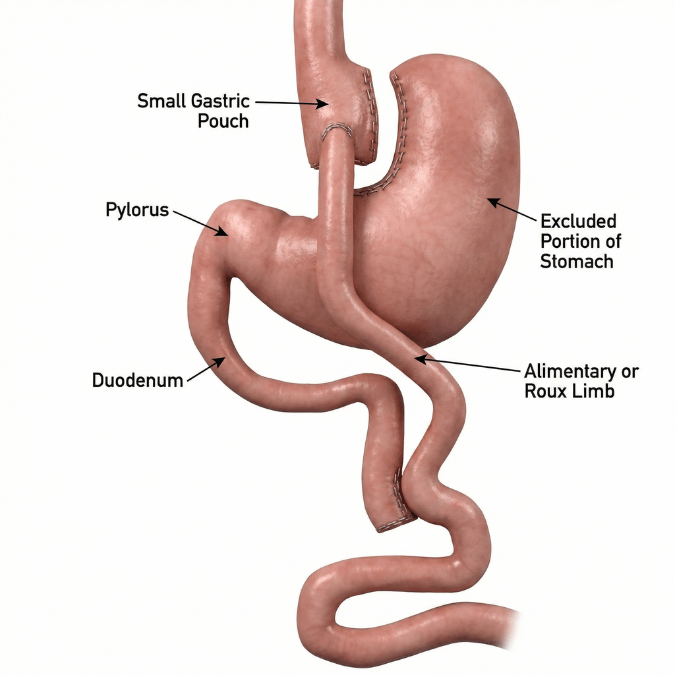
Bypass patients lose about 28 to 31% at one year, 21 to 26% at five years, and 20 to 27% at ten years. PCORnet found 25.5% TWL at five years, and the SM-BOSS randomized trial reported 27.5% at ten years. See the gastric bypass page for details.
One-anastomosis gastric bypass
The OAGB tends to produce the highest early weight loss, and emerging data suggest it may hold up better over time than the sleeve or the standard bypass.
What randomized trials show
In the By-Band-Sleeve trial at three years, bypass patients lost 26.8%, sleeve patients 19.4% and band patients 14.0%. Across nearly every major dataset, the bypass outperforms the sleeve by about 5 to 8 percentage points of total weight loss. If you're trying to decide between them, our sleeve vs. bypass guide walks through the tradeoffs.
Why the Average Can Mislead You
Averages hide a lot of spread. Weight loss after the sleeve in particular is uneven: some patients lose 40% of their body weight and others lose less than 10%. In one analysis at three years, about a quarter of sleeve patients had a minimal response, compared with only about 1% of bypass patients. Even a neural-network model fed every baseline variable predicted outcomes correctly only about 72% of the time, so it was wrong roughly one time in four.
That's why I talk with patients in ranges. Your result will most likely land within the range for your operation, and where you land is partly under your control.
The Weight Loss Timeline
Large cohorts like PCORnet and LABS give a consistent picture of how weight comes off:
- First two weeks: the fastest loss, partly fluid.
- Around month 5: most people have reached about half of their maximum weight loss.
- Months 11 to 13: most people reach their lowest weight (the nadir).
- Years 1 to 5: a modest regain of roughly 7 to 18 pounds is normal.
- Years 3 to 5: weight usually stabilizes.
Some regain after the lowest point isn't failure. It's the natural course of a chronic disease, and it's why follow-up matters. Patients who keep coming to visits regain significantly less. If the scale stalls along the way, read why the scale stops after bariatric surgery. If regain becomes significant, there are good options, covered in our weight regain guide.
What Predicts More (or Less) Weight Loss
Linked to more weight loss
- Younger age and female sex
- Higher starting BMI (for total weight loss)
- Losing some weight before surgery
- Choosing a bypass or OAGB over a sleeve
- Not having type 2 diabetes
- Hitting protein goals and exercising regularly
- Avoiding grazing
- Showing up for follow-up
Linked to less weight loss
- Type 2 diabetes (the most consistent negative predictor)
- Depression, anxiety or binge eating disorder
- Age over 60 and a heavier burden of other medical conditions
- Emotional eating and grazing
- Dropping out of follow-up
Look at how many of those are things you can change. You can't choose your genes, your age or your hormonal response. You can choose your protein intake, your activity, your sleep, how you handle stress, whether you graze, and whether you keep your appointments. Our guides on protein and exercise after surgery are a good place to start.
A Better Question to Ask Your Surgeon
Instead of "How much will I lose?", ask: "What's the realistic range for my operation, and what can I do to land at the top of it?" That question gets you an honest answer and a plan.
Weight Is One Measure of Success, Not the Only One
The Swedish Obese Subjects study found a 29% reduction in deaths from any cause in surgical patients compared with usual care. That's the real goal. Success also looks like diabetes remission, normal blood pressure, resolved sleep apnea, fewer medications, less joint pain and more energy.
A patient who loses 20% of their body weight and puts diabetes into remission has had a successful operation. A patient who loses 35%, stops follow-up and regains half of it hasn't done as well. The scale is one data point, not the whole story. For more on this, see diabetes remission after bariatric surgery and why body composition matters more than the scale.
Talk Through Your Own Numbers
After over 25 years and about 9,000 bariatric operations, I'd rather give you an honest range than a number that sets you up to feel disappointed. If you'd like to talk through which bariatric procedure fits your health goals and what result is realistic for you, schedule an in-office or virtual visit. Call 305-692-0392 or email appt@delacruzmunoz.com.
Prefer to watch? I cover this topic in a short video: How Much Weight Will You Lose After Bariatric Surgery?
Further Information
For additional context and a deeper professional perspective, you can read the companion LinkedIn article linked below.
Read on LinkedIn: How Much Weight Will You Lose After Bariatric Surgery?
18.8%
Average total weight loss five years after sleeve gastrectomy in PCORnet (65,000+ patients)
25.5%
Average total weight loss five years after gastric bypass in PCORnet
29%
Reduction in deaths from any cause with bariatric surgery in the Swedish Obese Subjects study
After bariatric surgery, weight loss isn't driven only by a smaller stomach. The operations change gut hormones such as ghrelin, GLP-1 and PYY, which lowers hunger and increases fullness, and they shift the weight your body tries to defend (its set point). Your genes, age, diabetes status and hormonal response affect how strongly that reset happens, which is why two people having the same operation can end up with different results.
Medical Topics Covered


Dr. de la Cruz‑Muñoz specializes in advanced minimally invasive and robotic surgery, metabolic disease management, and comprehensive long‑term patient care. His work integrates clinical expertise, academic leadership, and a commitment to evidence‑based medicine. He has trained surgeons across the country, contributed to national guidelines, and is widely regarded for his outcomes, innovation, and patient‑centered approach.
Patients choose Dr. de la Cruz‑Muñoz for his combination of surgical excellence, metabolic expertise, and lifelong dedication to improving patient health through compassionate, high‑quality care.
Procedures We Offer




Conditions





FAQ
People Also Ask
Obesity is recognized as a chronic disease by major medical organizations, including the American Medical Association. It is influenced by genetics, hormones, brain signaling, environment, sleep, stress and medications, not simply willpower. Like other chronic diseases, it often requires long-term treatment, which may include nutrition, activity, behavioral support, medications and surgery. Lifestyle matters, but biology largely determines how the body responds.
The body has powerful systems that defend its weight. When you lose weight, hunger hormones rise, fullness hormones drop, the brain becomes more focused on food and metabolism slows, a process called metabolic adaptation. Genetics, sleep, stress, medications and the modern food environment add to the challenge. These are biological forces, not character flaws, which is why medical treatment is often needed.
Genetics play a major role. Studies of twins and adopted children suggest that roughly 40–70% of the variation in body weight is inherited, influencing appetite, fullness, metabolism and where fat is stored. Many genes each contribute a small effect, and a few rare single-gene forms cause severe early obesity. Genes interact with environment, sleep, stress and medications, so a family history raises risk but does not determine destiny.
GLP-1 medications mimic a natural gut hormone released after eating. They act on the brain to reduce hunger and increase fullness, slow stomach emptying so meals last longer, quiet "food noise," and improve insulin release and blood sugar. Tirzepatide also acts on a second hormone, GIP. In clinical trials, these medications produced average weight loss of about 15–20% (Wilding et al., New England Journal of Medicine, 2021; Jastreboff et al., New England Journal of Medicine, 2022).
Yes. Obesity is associated with more than 200 health conditions, including type 2 diabetes, high blood pressure, high cholesterol, heart disease, stroke, sleep apnea, fatty liver disease, reflux, osteoarthritis, infertility and PCOS, depression and at least 13 types of cancer. Losing weight, through medical treatment or bariatric surgery, improves or resolves many of these conditions.
Dieting alone usually cannot overcome the body's biological defenses against weight loss. As weight falls, hunger hormones rise, fullness hormones fall and metabolism slows, changes that can last for years. Most people regain the majority of diet-related weight loss within several years. That is not a failure of willpower, and it is why treatments that address appetite biology, such as GLP-1 medications and bariatric surgery, are more effective for many people with obesity.
Consider medical evaluation when excess weight affects your health, mobility or quality of life, or when you have related conditions such as prediabetes, diabetes, high blood pressure, sleep apnea, fatty liver or joint pain. Guidelines support medications for adults with a BMI of 30 or higher, or 27 or higher with a weight-related condition, and surgery for a BMI of 35 or higher, or 30 or higher with metabolic disease. Early treatment can help prevent complications.
Yes. Bariatric surgery treats the biological drivers of obesity, changing hunger and fullness hormones, insulin sensitivity and the weight the body defends. It is the most effective and durable treatment for severe obesity, producing large, sustained weight loss and improving or resolving diabetes, high blood pressure, sleep apnea and fatty liver. Long-term studies show it also reduces the risk of heart disease, cancer and early death.