MagDI + Sleeve Gastrectomy Explained: A Complete Patient Guide

Quick Answer
Watch Related Video
Does Bariatric Surgery Really Need Staples? Meet MagDI
For decades, every intestinal connection in bariatric surgery has been built the same way: cut the bowel, then rejoin it with staples or sutures. Those staple and suture lines are also the source of the most feared early complication in metabolic surgery, an anastomotic leak.
MagDI, short for magnetic duodeno-ileostomy, takes a different approach. Instead of cutting and stapling, two small magnets are placed on opposite sides of the bowel wall. They pull toward each other, gently compress the tissue between them, and over about two to three weeks a natural, living connection forms as the compressed tissue remodels. The magnets then detach and pass on their own. No bowel incision at the connection. No staples. No sutures left behind (Gagner et al., Surgical Endoscopy, 2023).
When MagDI is paired with a sleeve gastrectomy, the goal is to capture the metabolic power of a duodenal switch, strong weight loss and strong diabetes control, with a simpler, incisionless connection. The first human magnetic duodeno-ileostomy procedures were performed in late 2021, and early multicenter data from Europe, the Americas, and the Middle East suggest the approach is feasible and, so far, safe (Gagner et al., Surgery for Obesity and Related Diseases, 2024).
One honest caveat up front: MagDI is new. Most follow-up is at one year, the studies are small, it is not yet endorsed by IFSO or the ASMBS the way the SADI-S and duodenal switch are, and its long-term durability is still unknown. This article explains what MagDI is, how it works, what the early data show, and how it stacks up against the SADI-S and the traditional (Roux) duodenal switch, so you can have an informed conversation with your surgeon.
Who Qualifies?
MagDI plus sleeve follows the same broad eligibility framework as other metabolic operations. The 2022 ASMBS/IFSO guidelines recommend metabolic and bariatric surgery for adults with a BMI of 35 or higher regardless of other conditions, for a BMI of 30 to 34.9 with metabolic disease such as type 2 diabetes, and, for individuals of Asian descent, at a BMI of 27.5 or above (Eisenberg et al., Surgery for Obesity and Related Diseases, 2022).
In clinical studies, MagDI has been performed across a wide BMI range, from about 30 up to 50 (Gagner et al., Surgery for Obesity and Related Diseases, 2024). It has been especially studied in three groups:
- Patients with type 2 diabetes, because rerouting food to the distal ileum produces powerful metabolic effects.
- Patients who already had a sleeve gastrectomy and need additional weight loss or diabetes control. MagDI can be added as a second stage without redoing the sleeve, although weight loss when added after a prior sleeve is more modest, roughly 8 kg additional loss at 6 months (Gagner et al., Surgery for Obesity and Related Diseases, 2024).
- Patients who want duodenal-switch-type metabolic benefit but prefer a less invasive, incisionless intestinal connection.
Because MagDI is still emerging, candidacy is best determined case by case, and in many settings it is offered within a study or specialized program.
How MagDI Differs From the SADI-S and Duodenal Switch
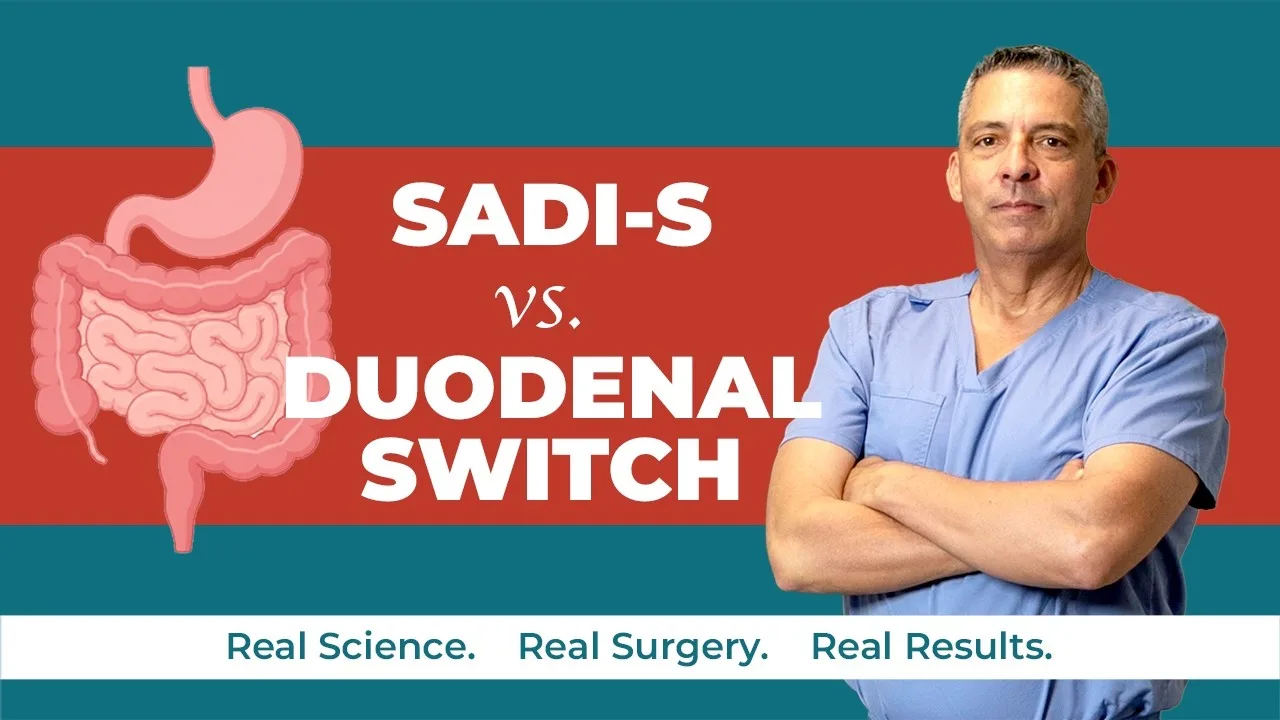
All three operations, MagDI plus sleeve, SADI-S, and the traditional (Roux) duodenal switch, start with the same sleeve gastrectomy (removing roughly 75% to 85% of the stomach, including the fundus, while preserving the pylorus). The differences are entirely in how the intestinal connection is built and how food flows afterward.
Difference 1: How the connection is created
- SADI-S: one stapled or hand-sewn anastomosis.
- Duodenal switch: two stapled or hand-sewn anastomoses.
- MagDI: a magnetic compression connection, no staples or sutures. A magnet is positioned in the first part of the duodenum and a second magnet in the ileum about 250 cm from the ileocecal valve. They self-align, compress the tissue, and form a patent connection as the entrapped tissue remodels over two to three weeks, after which the magnets detach and pass (Palermo et al., Journal of Laparoendoscopic and Advanced Surgical Techniques, 2026).
This is the origin of the most striking early finding: across the 43-patient multicenter series there were no device-related anastomotic leaks, and a broader systematic review of magnetic compression anastomosis reported a 0% leak rate and zero deaths across 106 patients (Gagner et al., Surgery for Obesity and Related Diseases, 2024; Kaur et al., Surgical Endoscopy, 2026). A useful way to think about the mechanism: the tissue heals first and the channel opens second, the opposite of a stapled connection that is open under pressure from the moment it is created.
Difference 2: Whether the duodenum is divided
- SADI-S and duodenal switch: the duodenum is transected (cut completely) a few centimeters below the pylorus, so food is forced entirely through the bypass.
- MagDI: the duodenum is never divided. It stays intact, and the magnetic connection creates a new side-to-side pathway while the original route through the duodenum remains open.
This is the single biggest anatomical difference. Keeping the duodenum in continuity also preserves endoscopic access to the biliary and pancreatic system, which becomes very difficult after a SADI-S or duodenal switch.
Difference 3: How food flows (bipartition)
- SADI-S and duodenal switch: food travels exclusively through the bypass; the duodenum is excluded from the food stream.
- MagDI: food splits between two routes. An isotopic transit study found about 19% of a meal passed directly through the magnetic connection into the ileum, while the remainder continued through the normal duodenal route (Cadiere et al., Journal of Gastrointestinal Surgery, 2024).
This dual-pathway design (bipartition) is intended to deliver meaningful ileal hormonal stimulation while keeping normal duodenal transit, which is expected to mean less malabsorption than a full rerouting.
The MagDI portion of the operation adds roughly 50 to 75 minutes when done after a prior sleeve, and the combined MagDI plus sleeve procedure typically takes about 90 to 160 minutes, with most patients staying one to two nights (Cadiere et al., Journal of Gastrointestinal Surgery, 2024).
How It Works
MagDI plus sleeve works through the same core mechanisms as the SADI-S and duodenal switch:
- Restriction: the sleeve limits how much you can eat.
- Reduced hunger: removing the fundus lowers ghrelin, the hunger hormone.
- Hormonal reprogramming: delivering food to the distal ileum triggers a surge in GLP-1 and PYY, the satiety hormones, and improves insulin secretion and sensitivity, often within days, before major weight loss occurs (Pereira et al., Obesity Surgery, 2025).
The key physiological difference is the degree of malabsorption. Because the duodenum is not divided and part of the meal still follows the normal digestive route, MagDI is designed to produce less malabsorption than either the SADI-S or the duodenal switch. That is a deliberate trade-off: fewer nutritional problems and less diarrhea, potentially at the cost of slightly less maximum weight loss in the highest-BMI patients.
The best comparative evidence for that trade-off currently comes from surgical transit bipartition (the same dual-pathway concept, but with a sutured connection). In a comparison with the duodenal switch, frequent loose stools occurred in only about 7% of bipartition patients versus 33% after the duodenal switch, and surgical reintervention for malnutrition or side effects was needed in about 4% versus 10% (Topart et al., Surgery for Obesity and Related Diseases, 2020).
What the Results Show
Because MagDI is new, the data come from prospective, mostly single-arm studies with follow-up largely at one year (and up to four years for a closely related magnetic technique). The early results are encouraging and, at one year, comparable to the SADI-S and duodenal switch.
Weight loss (MagDI plus concurrent sleeve): At 12 months, total weight loss reached about 34% and excess weight loss about 80% in the early multicenter experience (Gagner et al., Surgical Endoscopy, 2023). An isotopic-study cohort reported roughly 34% total weight loss at one year with 70% of patients very satisfied (Cadiere et al., Journal of Gastrointestinal Surgery, 2024). For context, the SADI-S produces roughly 32% to 40% total weight loss and the duodenal switch roughly 34% to 40% at comparable time points (Sample et al., Surgery for Obesity and Related Diseases, 2025; Salte et al., JAMA Network Open, 2024).
Weight loss (MagDI after a prior sleeve): More modest, about 8 kg of additional weight loss and 17% excess weight loss at 6 months, which is expected because the hormonal reset from the original sleeve has already occurred (Gagner et al., Surgery for Obesity and Related Diseases, 2024).
Diabetes: In the first-in-human swallowable biofragmentable magnet study of 15 patients (all with type 2 diabetes), HbA1c fell from 8.2% to 6.6% at one year, with 100% feasibility and no leaks (Gagner et al., Journal of the American College of Surgeons, 2025). All patients with diabetes improved in the multicenter series (Gagner et al., Surgery for Obesity and Related Diseases, 2024). A related magnetic anastomosis technique (SNAP) sustained glycemic improvement out to four years, with HbA1c decreasing from about 8.3% to 6.9% at 48 months (Jirapinyo et al., Obesity Surgery, 2026).
Longer-term (from transit bipartition, the sutured analog): In patients with BMI 50 or above, transit bipartition and the duodenal switch differed in weight loss at 2 and 4 years but were no longer significantly different at 5 years (about 43% versus 45% total weight loss), while bipartition had fewer side effects (Topart et al., Obesity Surgery, 2026).
The Bottom Line: MagDI vs SADI-S vs Duodenal Switch
All three combine a sleeve with intestinal rerouting to the distal ileum, and all three produce strong weight loss and metabolic effects. The differences are in the details.
MagDI potential advantages:
- No bowel division, the duodenum stays intact.
- No stapled or sutured connection, zero device-related anastomotic leaks in early studies (Gagner et al., Surgery for Obesity and Related Diseases, 2024).
- Dual-pathway food flow with expected less malabsorption.
- Preserved endoscopic access to the biliary system.
- No retained hardware at the anastomosis.
SADI-S advantages over MagDI:
- Endorsed by IFSO and increasingly established, with data out to 10 years.
- Proven durability and fewer nutritional complications than the duodenal switch (15.6% versus 53.5% at 10 years) (El Ghazal et al., Surgical Endoscopy, 2025).
- Strong diabetes remission, roughly 60% to 90% depending on population and follow-up (Ponce de Leon-Ballesteros et al., Obesity Surgery, 2024).
Duodenal switch advantages over MagDI:
- The longest track record and the greatest proven long-term weight loss in patients with very high BMI (about 34% total weight loss at 10 years) (Salte et al., JAMA Network Open, 2024).
- A configuration that does not carry the loop-type bile-reflux concern.
MagDI trade-offs and unknowns:
- Performed only since 2021, with small study populations and mostly 1-year follow-up.
- Long-term durability is unproven, and the nutritional and diarrhea advantages are so far extrapolated from transit bipartition and SADI-S rather than demonstrated in head-to-head MagDI trials (Topart et al., Surgery for Obesity and Related Diseases, 2020; El Ghazal et al., Surgical Endoscopy, 2025).
Life After Surgery
The post-operative principles mirror the other duodenal-switch-family operations, with a diet that advances in stages from clear liquids to purees to soft foods and then regular food by about six to eight weeks. Protein comes first, at least 60 to 80 g per day.
Because MagDI preserves duodenal continuity, vitamin requirements are expected to be somewhat less intensive than after the SADI-S or duodenal switch, but they are still essential and lifelong. A typical regimen includes a bariatric multivitamin, calcium citrate (1,200 to 1,500 mg per day), vitamin D adjusted to blood levels, vitamin B12, iron (especially for menstruating women), and monitoring of fat-soluble vitamins A, E, and K. Blood work is done every three to six months in the first year and then at least annually for life. Even with a lower expected nutritional risk, skipping vitamins or follow-up is not safe. Build toward at least 150 minutes of exercise per week.
Patients in South Florida comparing MagDI with SADI-S can find how evaluation and surgery work at our practice on the SADI-S surgery in Miami page.
Further Information
For additional context and a deeper professional perspective, you can read the companion LinkedIn article linked below.
Read on LinkedIn: MagDI + Sleeve: A Sutureless Duodeno-Ileal Bypass
MagDI increases GLP‑1, improves insulin sensitivity, accelerates nutrient delivery to the ileum, and provides DS‑like metabolic power with a simplified, magnet‑based anastomosis.
Medical Topics Covered


Dr. de la Cruz‑Muñoz specializes in advanced minimally invasive and robotic surgery, metabolic disease management, and comprehensive long‑term patient care. His work integrates clinical expertise, academic leadership, and a commitment to evidence‑based medicine. He has trained surgeons across the country, contributed to national guidelines, and is widely regarded for his outcomes, innovation, and patient‑centered approach.
Patients choose Dr. de la Cruz‑Muñoz for his combination of surgical excellence, metabolic expertise, and lifelong dedication to improving patient health through compassionate, high‑quality care.
Procedures We Offer




Conditions





FAQ
MagDI is an emerging, largely investigational procedure. The first human cases were performed in late 2021, and current evidence comes from small prospective and multicenter studies with mostly one-year follow-up. Unlike the SADI-S and duodenal switch, it does not yet have established society endorsement or long-term durability data, so availability is limited and often study-based. Discuss current status directly with a bariatric program (Gagner et al., Surgery for Obesity and Related Diseases, 2024).
Three ways. MagDI uses magnets instead of staples or sutures to form the connection; the duodenum is left intact rather than divided; and food flows through two pathways (bipartition) instead of being fully rerouted. About 19% of a meal passes through the new magnetic connection while the rest follows the normal route (Cadiere et al., Journal of Gastrointestinal Surgery, 2024).
The early signal is encouraging. Across the 43-patient multicenter series there were no device-related anastomotic leaks, and a systematic review of magnetic compression anastomosis reported a 0% leak rate and no deaths across 106 patients. The proposed reason is that magnetic compression lets the tissue heal before the channel opens, unlike a stapled connection that is open under pressure immediately. These are early, small-cohort findings, not long-term proof (Gagner et al., Surgery for Obesity and Related Diseases, 2024; Kaur et al., Surgical Endoscopy, 2026).
At one year, MagDI plus a concurrent sleeve produced roughly 34% total weight loss and 80% excess weight loss, comparable to the SADI-S and duodenal switch at that time point. Diabetes improvement has been strong, with HbA1c falling from 8.2% to 6.6% at one year in the first-in-human study and sustained glycemic improvement out to four years with a related magnetic technique. Long-term weight-maintenance data specific to MagDI are not yet available (Gagner et al., Surgical Endoscopy, 2023; Gagner et al., Journal of the American College of Surgeons, 2025; Jirapinyo et al., Obesity Surgery, 2026).
Yes. Because the sleeve is the first component, MagDI can be added as a planned or revisional second stage without redoing the sleeve. Additional weight loss in that setting is more modest, about 8 kg at 6 months, since the original sleeve already produced much of the hormonal effect (Gagner et al., Surgery for Obesity and Related Diseases, 2024).
People Also Ask
Obesity is recognized as a chronic disease by major medical organizations, including the American Medical Association. It is influenced by genetics, hormones, brain signaling, environment, sleep, stress and medications — not simply willpower. Like other chronic diseases, it often requires long-term treatment, which may include nutrition, activity, behavioral support, medications and surgery. Lifestyle matters, but biology largely determines how the body responds.
The body has powerful systems that defend its weight. When you lose weight, hunger hormones rise, fullness hormones drop, the brain becomes more focused on food and metabolism slows — a process called metabolic adaptation. Genetics, sleep, stress, medications and the modern food environment add to the challenge. These are biological forces, not character flaws, which is why medical treatment is often needed.
Genetics play a major role. Studies of twins and adopted children suggest that roughly 40–70% of the variation in body weight is inherited, influencing appetite, fullness, metabolism and where fat is stored. Many genes each contribute a small effect, and a few rare single-gene forms cause severe early obesity. Genes interact with environment, sleep, stress and medications, so a family history raises risk but does not determine destiny.
GLP-1 medications mimic a natural gut hormone released after eating. They act on the brain to reduce hunger and increase fullness, slow stomach emptying so meals last longer, quiet "food noise," and improve insulin release and blood sugar. Tirzepatide also acts on a second hormone, GIP. In clinical trials, these medications produced average weight loss of about 15–20% (Wilding et al., New England Journal of Medicine, 2021; Jastreboff et al., New England Journal of Medicine, 2022).
Yes. Obesity is associated with more than 200 health conditions, including type 2 diabetes, high blood pressure, high cholesterol, heart disease, stroke, sleep apnea, fatty liver disease, reflux, osteoarthritis, infertility and PCOS, depression and at least 13 types of cancer. Losing weight — through medical treatment or bariatric surgery — improves or resolves many of these conditions.
Dieting alone usually cannot overcome the body's biological defenses against weight loss. As weight falls, hunger hormones rise, fullness hormones fall and metabolism slows — changes that can last for years. Most people regain the majority of diet-related weight loss within several years. That is not a failure of willpower, and it is why treatments that address appetite biology, such as GLP-1 medications and bariatric surgery, are more effective for many people with obesity.
Consider medical evaluation when excess weight affects your health, mobility or quality of life, or when you have related conditions such as prediabetes, diabetes, high blood pressure, sleep apnea, fatty liver or joint pain. Guidelines support medications for adults with a BMI of 30 or higher, or 27 or higher with a weight-related condition, and surgery for a BMI of 35 or higher, or 30 or higher with metabolic disease. Early treatment can help prevent complications.
Yes. Bariatric surgery treats the biological drivers of obesity, changing hunger and fullness hormones, insulin sensitivity and the weight the body defends. It is the most effective and durable treatment for severe obesity, producing large, sustained weight loss and improving or resolving diabetes, high blood pressure, sleep apnea and fatty liver. Long-term studies show it also reduces the risk of heart disease, cancer and early death.