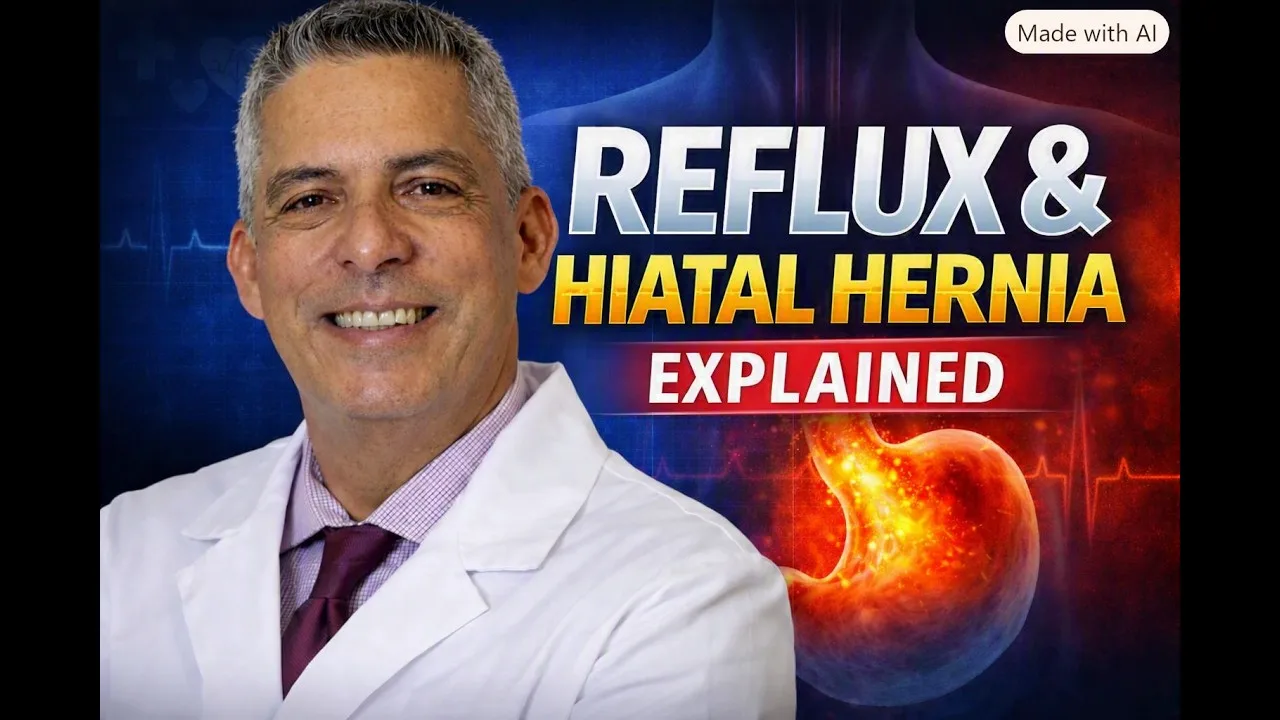
Is a Hiatal Hernia Dangerous? Symptoms, Warning Signs and When Surgery Helps

Quick Answer
Watch Related Video
Many people learn they have a hiatal hernia almost by accident: a line on an endoscopy report, a comment on a CT scan done for something else, or a passing remark from a doctor treating their heartburn. The next question is almost always the same: is it dangerous? The honest answer is that most hiatal hernias are not, but a specific minority can be, and the difference depends on the type of hernia, its size and the symptoms it causes. Here is how I explain it to patients, including the warning signs that need urgent care and the situations in which surgery truly helps.
What Is a Hiatal Hernia?
Your chest and abdomen are separated by the diaphragm, a dome-shaped breathing muscle. The esophagus passes through an opening in the diaphragm called the hiatus to join the stomach just below it. A hiatal hernia occurs when that opening widens and part of the stomach, and occasionally other organs, slides or rolls up into the chest.
Hiatal hernias are common and become more common with age and with excess weight. Many cause no symptoms at all and need nothing more than awareness.
Understanding the Biology Behind the Condition
The junction between the esophagus and the stomach is designed to sit just below the diaphragm. There, two things work together to keep acid in the stomach: the lower esophageal sphincter, a ring of muscle at the end of the esophagus, and the muscular edges of the diaphragm (the crura), which pinch around the esophagus like a second valve. The junction is held in place by a thin sheet of connective tissue.
With age, repeated pressure from the abdomen (from obesity, pregnancy, chronic coughing, heavy lifting or straining), and sometimes previous surgery, that tissue stretches and the hiatus enlarges. Once the junction rides up into the chest, the two valves no longer line up, the barrier against reflux weakens, and the pocket of stomach above the diaphragm can trap acid. In larger hernias, the stomach is pulled further up through a widening gap, where it can fold, twist or be squeezed.
Sliding vs. Paraesophageal: The Distinction That Matters Most
Whether a hiatal hernia is dangerous depends mostly on its type:
- Sliding hiatal hernia (type I). By far the most common type. The junction of the esophagus and stomach slides up into the chest and may slide back down. Its main effect is reflux. A sliding hernia is not prone to twisting or strangulation, and small ones often need no treatment at all.
- Paraesophageal hernia (types II, III and IV). Part of the stomach rolls up beside the esophagus, and in type IV, another organ such as the colon or spleen comes along. A paraesophageal hernia is the type that can cause mechanical problems: food getting stuck, bleeding, twisting of the stomach (gastric volvulus) and, rarely, loss of blood supply to the trapped stomach.
When a report simply says "hiatal hernia," it is worth asking which type and how large. A "small sliding hiatal hernia" and a "large paraesophageal hernia with most of the stomach in the chest" are very different conditions.
Symptoms You Might Notice
Hiatal hernias produce two broad groups of symptoms.
Reflux symptoms
- Heartburn and an acid or bitter taste in the mouth
- Regurgitation of food or liquid, especially when bending over or lying down
- Night-time coughing or choking
- Hoarseness, throat clearing or a chronic cough
Mechanical and pressure symptoms
These are more typical of larger or paraesophageal hernias:
- Chest pressure or fullness after eating, sometimes mistaken for a heart problem
- Feeling full after only a few bites
- Food sticking in the lower chest
- Shortness of breath after meals or with exertion, because the stomach is taking up space in the chest
- Palpitations after large meals
- Fatigue from iron-deficiency anemia, caused by slow bleeding from irritated stomach lining where it rubs against the diaphragm
Chest pain should never be blamed on a hernia until the heart has been considered. If you have chest pain, especially with exertion, sweating or shortness of breath, call 911.
Warning Signs: When a Hiatal Hernia Becomes an Emergency
The rare but serious danger of a paraesophageal hernia is that the stomach twists on itself or becomes trapped, cutting off its own blood supply. Seek emergency care right away if you have:
- Sudden, severe pain in the chest or upper abdomen that does not go away
- Repeated retching or dry heaving with little or nothing coming up
- Inability to swallow anything, including your own saliva
- Vomiting blood or passing black, tarry stools
- Fainting, a racing heart or feeling very unwell along with any of the above
If you already know you have a large paraesophageal hernia, share this list with your family. These situations are time-sensitive, and an emergency operation carries more risk than a planned one.
So, Is a Hiatal Hernia Dangerous?
Putting it together:
- A small sliding hernia without symptoms is not dangerous and usually needs no treatment.
- A sliding hernia with reflux is not dangerous in itself, but uncontrolled reflux over many years can inflame and scar the esophagus and is linked to Barrett's esophagus. Here the concern is the reflux, and treatment is aimed at controlling it.
- A paraesophageal hernia carries a small but real risk of acute complications. A classic decision analysis estimated that people with few or no symptoms who chose watchful waiting faced roughly a 1.1% chance per year of developing acute symptoms that required emergency surgery (Stylopoulos et al., Annals of Surgery, 2002). That is lower than surgeons once believed, which is why observation is a reasonable choice for some older or frail patients with no symptoms.
The most recent guideline from the Society of American Gastrointestinal and Endoscopic Surgeons (SAGES) reflects this balance: for a paraesophageal hernia found without obvious symptoms, repair can be offered when testing shows reflux, aspiration or breathing-related effects and the patient is fit for surgery, while watchful waiting is reasonable when the workup is reassuring and the patient understands the small risk of the stomach twisting (Daly et al., Surgical Endoscopy, 2024).
How a Hiatal Hernia Is Diagnosed
A good evaluation answers three questions: what type of hernia is it, how big is it, and what is it doing to you?
- Upper endoscopy (EGD) shows the hernia from inside, measures it, and checks the esophagus for inflammation, Barrett's esophagus, ulcers or narrowing. Biopsies can be taken during the same procedure.
- Barium swallow is often the best single test for showing the anatomy: the size of the hernia, whether it is sliding or paraesophageal, and whether the stomach is twisted.
- CT scan shows large hernias in three dimensions, including whether other organs are involved, and is the key test when an emergency is suspected.
- High-resolution manometry measures how well the esophagus contracts. It is important before surgery because it helps the surgeon choose the right type of anti-reflux valve.
- pH monitoring measures acid exposure in the esophagus, confirming that reflux is real and is the cause of your symptoms. The American College of Gastroenterology recommends objective confirmation of reflux disease before anti-reflux surgery (Katz et al., American Journal of Gastroenterology, 2022).
Treatment: From Lifestyle to Medication
For sliding hernias whose main effect is reflux, treatment starts without surgery:
- Smaller meals, and no eating within about three hours of lying down
- Raising the head of the bed
- Weight loss when weight is a factor, since abdominal pressure drives both the hernia and the reflux
- Limiting alcohol and stopping smoking
- Acid-reducing medication, usually a proton pump inhibitor
It is important to understand what medication can and cannot do. Acid suppression treats heartburn and helps the lining heal, but it does not shrink a hernia or stop regurgitation of food, and it does nothing for the mechanical problems of a paraesophageal hernia. Acid reflux (GERD) that is well controlled with modest medication, alongside a small sliding hernia, rarely needs an operation.
When Surgery Helps
Surgery is worth considering when:
- You have a paraesophageal hernia that causes symptoms such as chest pressure, food sticking, early fullness, breathing difficulty or anemia
- You have had an episode of gastric volvulus or obstruction
- Reflux persists despite medication, especially regurgitation, which responds poorly to pills
- You do not want to take medication for decades, or you have side effects from it
- Endoscopy shows damage to the esophagus despite treatment
A modern hiatal and paraesophageal hernia repair is performed laparoscopically or robotically through small incisions. The surgeon brings the stomach back into the abdomen, removes the hernia sac, frees enough esophagus so that the junction rests without tension below the diaphragm, and closes the enlarged opening with sutures, sometimes reinforced. SAGES suggests that patients undergoing paraesophageal hernia repair may benefit from adding a fundoplication, in which the top of the stomach is wrapped around the lower esophagus to rebuild the valve, and notes that the evidence on routine mesh is mixed, so that decision is individualized (Daly et al., Surgical Endoscopy, 2024).
The type of valve is tailored to you. A full (Nissen) wrap, a partial (Toupet) wrap, magnetic sphincter augmentation with the LINX device in carefully selected patients, and, for people with significant obesity, a gastric bypass are all part of modern anti-reflux surgery. Most patients go home within a day or two and follow a soft diet for a few weeks while swelling settles.
Will a Hiatal Hernia Come Back After Repair?
This deserves a straight answer. Large hiatal hernias can recur, and small recurrences are common on X-ray. In a long-term follow-up of a randomized trial, about half of patients had evidence of a recurrent hernia on barium study roughly five years after paraesophageal hernia repair, whether or not a biologic mesh was used, yet the repair continued to provide lasting symptom relief, with no significant difference in symptoms or quality of life between the groups (Oelschlager et al., Journal of the American College of Surgeons, 2011). In other words, a small recurrence seen on imaging is not the same as a failed operation.
Some patients, however, do develop a symptomatic recurrence or a wrap that slips, loosens or becomes too tight. Redo and revisional foregut surgery after a failed fundoplication or a recurrent hiatal hernia is a specialized field that relatively few surgeons focus on. These operations are a central part of my practice, and you can read more about revisional foregut surgery here.
When to See a Foregut Surgeon
Ask for a surgical opinion if you have a paraesophageal hernia, a hernia large enough to cause pressure, breathing or swallowing symptoms, iron-deficiency anemia without another explanation, reflux that medication does not control, or symptoms that have returned after a previous repair. Foregut surgery is a field where experience matters, because the right operation depends on the hernia type, how well your esophagus moves and your overall health.
Across over 25 years of practice and over 15,000 minimally invasive procedures, my experience is that most people with a hiatal hernia need reassurance and good reflux control, not an operation, while the smaller group who do need surgery benefit most from a planned repair rather than an emergency one. We see patients from across the country, and much of the testing can be arranged before you travel. For readers in South Florida, here is more about our hiatal hernia and reflux surgery in Miami. To schedule an evaluation, call 305-692-0392.
Further Information
The junction of the esophagus and stomach normally sits below the diaphragm, where the sphincter muscle and the diaphragm work together as a reflux barrier. When the opening in the diaphragm stretches, the stomach slides or rolls into the chest, weakening that barrier and, in larger hernias, allowing the stomach to fold, twist or become trapped.
Medical Topics Covered


Dr. de la Cruz‑Muñoz specializes in advanced minimally invasive and robotic surgery, metabolic disease management, and comprehensive long‑term patient care. His work integrates clinical expertise, academic leadership, and a commitment to evidence‑based medicine. He has trained surgeons across the country, contributed to national guidelines, and is widely regarded for his outcomes, innovation, and patient‑centered approach.
Patients choose Dr. de la Cruz‑Muñoz for his combination of surgical excellence, metabolic expertise, and lifelong dedication to improving patient health through compassionate, high‑quality care.
Procedures We Offer


Conditions



FAQ
In a common sliding hiatal hernia, the junction between the esophagus and stomach slides up into the chest, mainly causing reflux. In a paraesophageal hernia, the top of the stomach rolls up beside the esophagus, and over time much of the stomach — and sometimes other organs — can move into the chest. Paraesophageal hernias are less common but more likely to cause chest pressure, early fullness, anemia and, rarely, a twisted stomach, so they are treated as a mechanical problem rather than a reflux problem.
Yes. Because the esophagus and stomach sit directly behind the heart and lungs, a hiatal hernia can produce chest pain that closely mimics a heart attack, and gastrointestinal causes account for roughly 10–20% of chest pain in outpatients (Anderson et al., Journal of the American College of Cardiology, 2022; Sanderson & Escudier, Burket's Oral Medicine, 2021). Large hernias in particular can cause shortness of breath through several mechanisms — compression of the lungs, reduced lung volumes, obstruction of blood flow into the heart, and microaspiration — and this cardiorespiratory connection has historically been underappreciated (Mahendravarman et al., ANZ Journal of Surgery, 2026). Heart racing and palpitations can also occur, and when they appear suddenly alongside severe chest/abdominal pain, severe vomiting, or inability to pass anything, they may signal that the stomach has twisted or lost its blood supply (volvulus/strangulation) — a medical emergency requiring immediate care (Baiu & Lau, JAMA, 2019). Any new chest pain should be evaluated to rule out a cardiac cause first, but a known large hernia is a recognized and often reversible contributor to these symptoms (Mahendravarman et al., ANZ Journal of Surgery, 2026).
A hiatal hernia will not disappear or heal on its own — the diaphragm opening does not close back down without an operation, so surgery is the only way to actually repair the hernia (Gonda & Krikhely, Yamada's Textbook of Gastroenterology, 2022). That said, most hiatal hernias never need surgery. The large majority are small, sliding (type I) hernias, and their symptoms are controlled very effectively without repairing the hernia itself — using proton pump inhibitors plus lifestyle measures such as weight loss, elevating the head of the bed, avoiding meals within 2–3 hours of lying down, and limiting trigger foods (Callaway & Vaezi, Clinical Gastroenterology and Hepatology, 2018; Sanderson & Escudier, Burket's Oral Medicine, 2021). Surgery becomes the treatment of choice when medication and lifestyle changes fail to control symptoms (especially regurgitation or difficulty swallowing), when a patient prefers not to take lifelong medication, or for larger paraesophageal hernias at risk of mechanical complications (Gonda & Krikhely, Yamada's Textbook of Gastroenterology, 2022; Callaway & Vaezi, Clinical Gastroenterology and Hepatology, 2018).
Symptomatic paraesophageal hernias — including those causing anemia — are generally repaired, because they tend to grow and do not resolve on their own (Kohn et al., Surgical Endoscopy, 2013). For older patients with truly no symptoms, careful watchful waiting can be reasonable, since the risk of developing emergency symptoms is about 1% per year (Stylopoulos et al., Annals of Surgery, 2002). Planned surgery is much safer than emergency surgery, so the decision should be made with a surgeon experienced in hiatal repairs.
It depends on your age, health, and hernia. Expert opinion has shifted.
• Older view: decision models favored watchful waiting for patients with no symptoms (Callaway and Vaezi, Clinical Gastroenterology and Hepatology, 2018).
• Newer view: an updated model supports elective repair, because it appears to increase life expectancy (Schlottmann et al., JAMA Surgery, 2025).
• Why timing matters: emergency repairs have far worse outcomes. Only 46.7% had a complication-free recovery, compared with 88.1% after elective repair, and emergency mortality was 6.7% (Crnkovic et al., Journal of the American College of Surgeons, 2026).
Any symptoms warrant repair, including anemia, breathing problems, chest pressure, or vomiting (Callaway and Vaezi, Clinical Gastroenterology and Hepatology, 2018).
Yes. Where the stomach is pinched by the diaphragm, it can develop small ulcers called Cameron lesions that bleed slowly. The blood loss is often invisible but leads to iron-deficiency anemia, fatigue and shortness of breath. Many patients are first diagnosed with a hernia during an evaluation for unexplained anemia. Iron replacement helps in the short term, but repairing the hernia usually resolves the bleeding.
Age alone is rarely a reason to avoid repair. Paraesophageal hernias are most common in people in their 70s and 80s, and elective laparoscopic repair is performed safely in patients in their 80s and 90s when their heart and lung health allow. Because emergency surgery for a twisted or obstructed stomach carries much higher risk in older patients, a planned repair is often the safer choice for those with symptoms. Preoperative testing helps decide whether surgery is right for you.
Overall, recurrence after hernia repair in bypass patients is reported at about 5–6.5% (Bregion et al., Surgery for Obesity and Related Diseases, 2026). Pouch migration into the chest is different. Suture-only repairs can fail at very high rates, while repairs reinforced with mesh or the ligamentum teres (the round ligament of the liver) have been associated with much lower recurrence: about 20% versus 72% in gastric bypass patients in one study (Kermansaravi et al., Obesity Surgery, 2026). Because these data are observational, the repair technique should be tailored to your hernia size and tissue quality. Keeping your weight stable also helps protect the repair (Kermansaravi et al., Obesity Surgery, 2026).
No. Mesh is used selectively based on the size of the hernia and the quality of the tissue. The foundation of hiatal hernia repair is closing the diaphragm opening with sutures and getting enough esophagus into the abdomen without tension. Mesh reinforcement may reduce early recurrence in large hernias, but long-term benefits are less clear (Oelschlager et al., Journal of the American College of Surgeons, 2011), so the decision is individualized.
A complete foregut workup is essential and improves outcomes: upper endoscopy to examine the esophagus and rule out other problems, esophageal manometry to confirm normal muscle function and exclude achalasia, ambulatory pH monitoring to objectively confirm acid reflux, and usually a barium esophagram to map the anatomy and hernia (Maret-Ouda et al., JAMA, 2020; Yadlapati et al., AGA Clinical Practice Update, 2022; Andolfi & Fisichella, JOMI). These tests confirm the diagnosis and determine which operation is best for you.
Most patients go home within one to two days after laparoscopic or robotic fundoplication, LINX or hiatal hernia repair. You will follow a liquid and then soft-food diet for about two to four weeks, because mild swallowing tightness is common while swelling at the repair settles. Walking starts right away; most people return to desk work within one to two weeks and avoid heavy lifting for about six weeks to protect the repair. Revisional operations may take a little longer. Many patients are able to stop acid medication after surgery.
People Also Ask
Obesity is recognized as a chronic disease by major medical organizations, including the American Medical Association. It is influenced by genetics, hormones, brain signaling, environment, sleep, stress and medications — not simply willpower. Like other chronic diseases, it often requires long-term treatment, which may include nutrition, activity, behavioral support, medications and surgery. Lifestyle matters, but biology largely determines how the body responds.
The body has powerful systems that defend its weight. When you lose weight, hunger hormones rise, fullness hormones drop, the brain becomes more focused on food and metabolism slows — a process called metabolic adaptation. Genetics, sleep, stress, medications and the modern food environment add to the challenge. These are biological forces, not character flaws, which is why medical treatment is often needed.
Genetics play a major role. Studies of twins and adopted children suggest that roughly 40–70% of the variation in body weight is inherited, influencing appetite, fullness, metabolism and where fat is stored. Many genes each contribute a small effect, and a few rare single-gene forms cause severe early obesity. Genes interact with environment, sleep, stress and medications, so a family history raises risk but does not determine destiny.
GLP-1 medications mimic a natural gut hormone released after eating. They act on the brain to reduce hunger and increase fullness, slow stomach emptying so meals last longer, quiet "food noise," and improve insulin release and blood sugar. Tirzepatide also acts on a second hormone, GIP. In clinical trials, these medications produced average weight loss of about 15–20% (Wilding et al., New England Journal of Medicine, 2021; Jastreboff et al., New England Journal of Medicine, 2022).
Yes. Obesity is associated with more than 200 health conditions, including type 2 diabetes, high blood pressure, high cholesterol, heart disease, stroke, sleep apnea, fatty liver disease, reflux, osteoarthritis, infertility and PCOS, depression and at least 13 types of cancer. Losing weight — through medical treatment or bariatric surgery — improves or resolves many of these conditions.
Dieting alone usually cannot overcome the body's biological defenses against weight loss. As weight falls, hunger hormones rise, fullness hormones fall and metabolism slows — changes that can last for years. Most people regain the majority of diet-related weight loss within several years. That is not a failure of willpower, and it is why treatments that address appetite biology, such as GLP-1 medications and bariatric surgery, are more effective for many people with obesity.
Consider medical evaluation when excess weight affects your health, mobility or quality of life, or when you have related conditions such as prediabetes, diabetes, high blood pressure, sleep apnea, fatty liver or joint pain. Guidelines support medications for adults with a BMI of 30 or higher, or 27 or higher with a weight-related condition, and surgery for a BMI of 35 or higher, or 30 or higher with metabolic disease. Early treatment can help prevent complications.
Yes. Bariatric surgery treats the biological drivers of obesity, changing hunger and fullness hormones, insulin sensitivity and the weight the body defends. It is the most effective and durable treatment for severe obesity, producing large, sustained weight loss and improving or resolving diabetes, high blood pressure, sleep apnea and fatty liver. Long-term studies show it also reduces the risk of heart disease, cancer and early death.