

ESG vs. Sleeve: Which One Is Right for You?

Quick Answer
Watch Related Video
Article
INTRODUCTION
Patients often come to me asking:
- “Should I do ESG or a sleeve?”
- “Is ESG safer?”
- “Is the sleeve more effective?”
- “How do I know which one is right for me?”
These are excellent questions — and the truth is that both procedures are powerful, but they are designed for different patients, different goals, and different metabolic needs.
This article breaks down the differences clearly, honestly, and scientifically so you can understand which option aligns with your biology, your goals, and your longterm success.
1. What Is ESG (Endoscopic Sleeve Gastroplasty)?
A nonsurgical, incisionless procedure.
ESG uses an endoscope (a flexible camera) inserted through the mouth to place internal sutures that reduce the stomach’s volume by about 60–70%.
Key features:
- No incisions
- No external scars
- No removal of stomach tissue
- Outpatient procedure
- Faster recovery
- Lower risk profile
How it works metabolically:
- Reduces stomach volume
- Slows gastric emptying
- Enhances early satiety
- Mild increase in GLP1
- Mild reduction in ghrelin
ESG is a restrictive + hormonal procedure, but with a milder metabolic effect than surgical options.
2. What Is Sleeve Gastrectomy (VSG)?
A surgical procedure with powerful metabolic effects.
The sleeve removes ~75–80% of the stomach, including the fundus — the area that produces most of the hunger hormone ghrelin.
Key features:
- Minimally invasive laparoscopic surgery
- Permanent anatomical change
- Strong hormonal impact
- Strong metabolic improvement
- Stronger weightloss durability
How it works metabolically:
- Dramatic reduction in ghrelin
- Significant increase in GLP1 and PYY
- Improved insulin sensitivity
- Reduced inflammation
- Faster metabolic improvement
The sleeve is a restrictive + powerful hormonal procedure.
3. WeightLoss Comparison: ESG vs. Sleeve
ESG:
- 15–20% total body weight loss
- Best for patients with lower BMI or early metabolic disease
- Weight loss is slower and more gradual
Sleeve:
- 25–30% total body weight loss
- Best for patients with higher BMI or significant metabolic disease
- Faster and more powerful weight loss
In simple terms:
- ESG = moderate weight loss
- Sleeve = strong weight loss
Both are effective — but not equally powerful.
4. Metabolic Impact: ESG vs. Sleeve
ESG metabolic effect:
- Mild GLP1 increase
- Mild ghrelin reduction
- Mild insulin sensitivity improvement
- Good appetite control
- Good satiety
Sleeve metabolic effect:
- Dramatic ghrelin suppression
- Strong GLP1 and PYY increase
- Significant insulin sensitivity improvement
- Strong appetite suppression
- Strong satiety
- Strong antidiabetic effect
In simple terms:
- ESG = metabolic improvement
- Sleeve = metabolic transformation
If metabolic disease is a major concern, the sleeve is usually the better tool.
5. Safety Profile: ESG vs. Sleeve
ESG safety:
- Very low complication rate
- No incisions
- No leaks
- No stapling
- No removal of tissue
- Quick recovery (2–3 days)
Sleeve safety:
- Very safe in experienced hands
- Small risk of leak
- Small risk of bleeding
- Recovery 1–2 weeks
In simple terms:
- ESG = lowest risk
- Sleeve = low risk, but higher than ESG
If a patient wants the safest possible option with the least downtime, ESG is ideal.
6. Reflux: ESG vs. Sleeve
ESG and reflux:
- Does not typically worsen reflux
- May improve reflux in some patients
Sleeve and reflux:
- Can worsen reflux
- Can cause new reflux
- Not ideal for patients with severe GERD
In simple terms:
- ESG = refluxfriendly
- Sleeve = refluxsensitive
If reflux is a major issue, ESG or gastric bypass may be better choices.
7. Durability: ESG vs. Sleeve
ESG durability:
- Good durability
- Some patients may need touchups
- Sutures can loosen over time
- Weight regain is possible
Sleeve durability:
- Strong longterm durability
- Sleeve can stretch slightly over years
- Weight regain possible but less common
In simple terms:
- ESG = durable but may need reinforcement
- Sleeve = more durable longterm
8. Who Is a Good Candidate for ESG?
ESG is ideal for:
- BMI 30–40
- Patients wanting a nonsurgical option
- Patients wanting lower risk
- Patients wanting faster recovery
- Patients with mild metabolic disease
- Patients with reflux
- Patients not ready for surgery
- Patients who want a reversible option
ESG is a great “first step” for many patients.
9. Who Is a Good Candidate for Sleeve?
Sleeve is ideal for:
- BMI > 40
- BMI 35–40 with metabolic disease
- Patients needing stronger weight loss
- Patients needing stronger metabolic improvement
- Patients without severe reflux
- Patients ready for surgery
- Patients wanting longterm durability
The sleeve is a powerful tool for patients who need more than restriction.
10. ESG vs. Sleeve: My Decision Framework
When I help patients choose, I look at:
1. BMI
- 30–40 → ESG
- 40+ → Sleeve
2. Reflux
- Severe → ESG or bypass
- Mild → Either
- None → Either
3. Diabetes
- Mild → ESG or sleeve
- Moderate/severe → Sleeve
4. Weightloss goals
- Moderate → ESG
- Strong → Sleeve
5. Risk tolerance
- Lowest risk → ESG
- Accepts surgical risk → Sleeve
6. Recovery time
- Needs fast recovery → ESG
- Can take 1–2 weeks → Sleeve
7. Longterm durability
- Wants maximum durability → Sleeve
- Comfortable with potential touchups → ESG
There is no “onesizefitsall” answer — only the right answer for your biology and goals.
CONCLUSION
ESG and sleeve gastrectomy are both excellent tools — but they are designed for different patients and different metabolic needs.
Choose ESG if you want:
- A nonsurgical option
- Lower risk
- Faster recovery
- Moderate weight loss
- A reversible procedure
- A refluxfriendly option
Choose Sleeve if you want:
- Stronger weight loss
- Stronger metabolic improvement
- Longterm durability
- A permanent solution
- A powerful hormonal effect
The right procedure is the one that matches your biology, your goals, and your longterm vision for your health.
Obesity By The Numbers
Medical Topics Covered
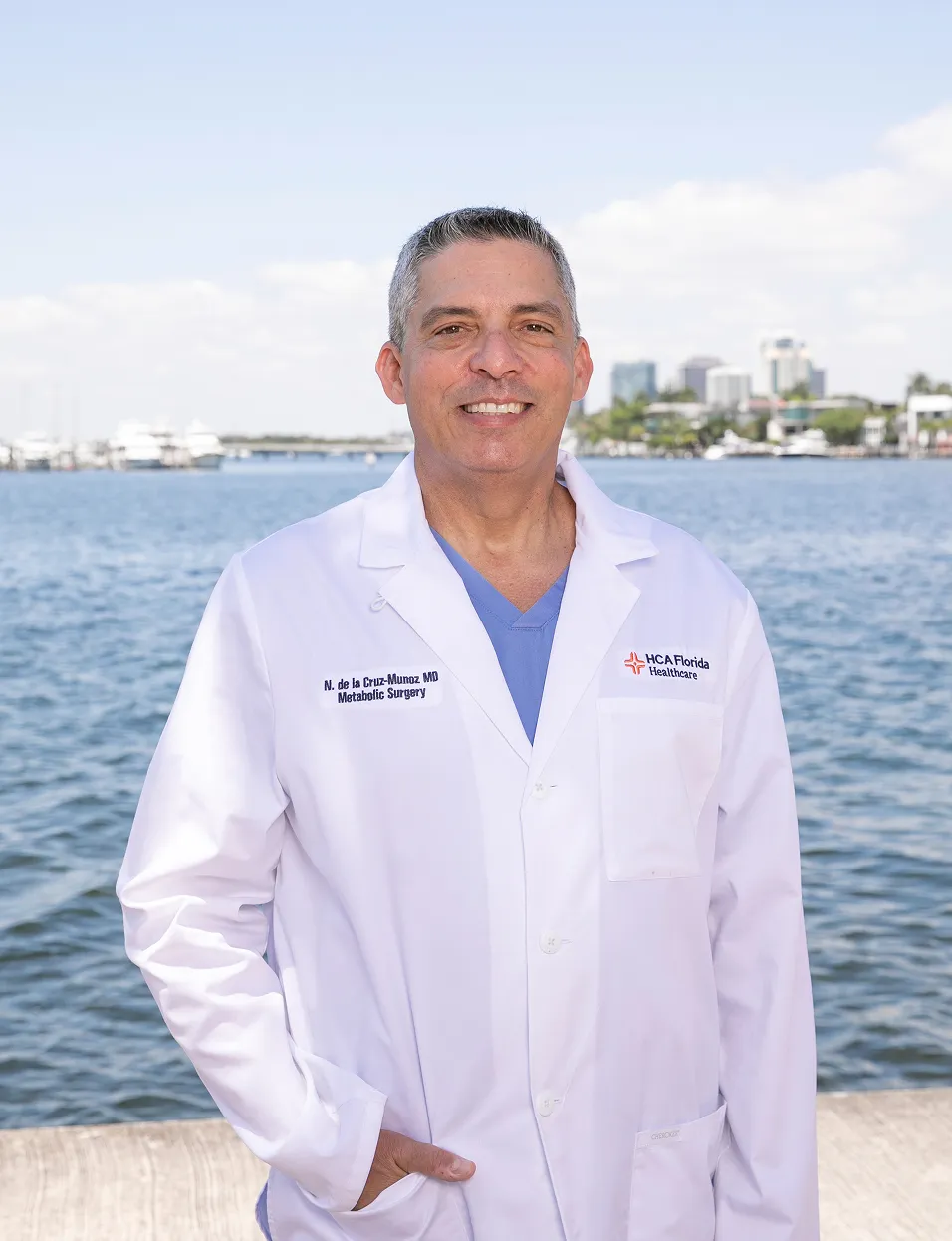

Dr. de la Cruz‑Muñoz specializes in advanced minimally invasive and robotic surgery, metabolic disease management, and comprehensive long‑term patient care. His work integrates clinical expertise, academic leadership, and a commitment to evidence‑based medicine. He has trained surgeons across the country, contributed to national guidelines, and is widely regarded for his outcomes, innovation, and patient‑centered approach.
Patients choose Dr. de la Cruz‑Muñoz for his combination of surgical excellence, metabolic expertise, and lifelong dedication to improving patient health through compassionate, high‑quality care.
Procedures We Offer




FAQ
People Also Ask
Obesity is recognized as a chronic metabolic disease influenced by genetics, hormones, environment, and biological factors — not simply lifestyle choices.
The body has built-in mechanisms that defend weight, including hunger hormones and metabolic adaptations that make long-term weight loss challenging.
Yes. Genetics can significantly influence body weight regulation, appetite, metabolism, and an individual's susceptibility to obesity.
GLP-1 medications help regulate appetite, slow stomach emptying, improve satiety, and support sustainable weight management.
Yes. Obesity is associated with conditions such as Type 2 diabetes, hypertension, sleep apnea, fatty liver disease, and cardiovascular disease.
Dieting alone often cannot overcome the biological adaptations that increase hunger and decrease energy expenditure after weight loss.
Medical evaluation may be appropriate when excess weight affects health, quality of life, or contributes to obesity-related medical conditions.
Yes. Bariatric surgery addresses biological and metabolic factors involved in obesity and can lead to significant long-term health improvements.
Video