
"Will I be able to eat normal food with my family again?"

Quick Answer
Watch Related Video
Article
"Will I be able to eat normal food with my family again?"
It is one of the most common questions patients ask, usually quietly, at the very end of a visit. And it is often the fear standing between someone and a potentially lifesaving operation.
So let me answer it directly: Yes. After bariatric surgery, you can still enjoy food. You do not have to live on a bizarre, restrictive diet that leaves you feeling deprived. Many people are terrified they will never enjoy food the way they used to, and they start grieving that loss before anything has even changed. That fear may be stopping you from pursuing an intervention that could give you your life back.
Here is what actually happens, and why the reality is far more reassuring than the fear.
The First Six Weeks Are Temporary
The strict early diet is the part that scares people the most, and it is also the part that ends the soonest.
Right after surgery, your stomach is healing. There is a fresh staple line, the tissue is swollen, and your new anatomy needs time to recover before it can safely handle regular food. That is why we move through a series of stages, and each stage has a purpose (Mechanick et al., Obesity, 2020):
- Clear liquids
- Full liquids
- Purees, foods blended until smooth
- Soft foods, things you can mash with a fork
- Regular textured foods, usually beginning around six weeks
Every stage has a job. The early stages protect the healing process, help keep you hydrated (especially important during that first week), and let you get protein even before you can chew normally.
During those first few days, your priority is fluids: at least 60 ounces a day, taken in small sips throughout the day. This is not to make your life difficult. Dehydration is one of the most common reasons patients return to the hospital after surgery (Aguas-Ayesa et al., Reviews in Endocrine and Metabolic Disorders, 2023).
Remember this during those six weeks: this phase is not your new life. It is recovery.
And do something that surprises a lot of people. Even while you are drinking liquids and eating purees, come to the table. Sit with your family. Have your protein shake while they eat dinner. Stay part of the meal. The table was never really just about the food. It was about the people.
This phase ends. I promise you, it ends.
What "Normal" Actually Means Now
Let me set an honest expectation. Even after we clear you for regular food, at first you will only tolerate a few bites. That is normal. The swelling is still settling. Your capacity will gradually increase over the coming months, but it will never return to what it was, and that is the entire point of the operation.
"Normal eating" after surgery comes down to three changes: how much, how fast, and in what order.
How much. During the first week, you may take in only around 400 calories a day. Over the following months that climbs, and long term most patients settle somewhere around 1,200 to 1,800 calories a day, in much smaller portions than before. A meal might be the size of what used to be an appetizer. That is not deprivation. That is your new normal working exactly as designed.
How fast. A meal should take 20 to 30 minutes. Chew thoroughly, roughly 20 to 30 times per bite, and put your fork down between bites (Guth and Murali, JAMA, 2017). Fast eating causes trouble. Slow eating keeps you comfortable.
What order. Protein first. Always. Every meal, every time. Your long-term target is roughly 60 to 80 grams of protein a day (Mechanick et al., Obesity, 2020). With a small stomach you fill up fast, so if you lead with bread, rice, or filler, you run out of room before you get the protein your body needs to preserve muscle and keep your metabolism strong. So: protein first, then vegetables, then fruit, and only a small amount of high-fiber starch if there is room.
Protein Shakes Are a Bridge, Not a Destination
This is one of the biggest misconceptions patients carry with them: that they will be chained to protein shakes forever.
The shakes and liquid supplements we use early exist for one reason. In those first weeks, your stomach is simply too small to eat enough food to hit your protein goal, so we bridge the gap. But they are a bridge, not a destination.
As your tolerance improves, we transition you off shakes and onto real protein from real food: eggs, fish, chicken, Greek yogurt, cottage cheese, beans, and legumes. The goal has always been to get your protein from your plate, not from a blender. If you are two years out and still relying on shakes, something has gone sideways, and we need to talk about it.
What You Think You Will Miss Will Probably Change
Here is the most reassuring part, and almost no one expects it. The foods you are sitting there afraid of losing? There is a very good chance you will not want them the way you want them today. And that is not willpower. That is biology.
Bariatric surgery does not just make your stomach smaller. It rewires the conversation between your gut and your brain (Guerrero-Hreins et al., Reviews in Endocrine and Metabolic Disorders, 2022). Your stomach and intestine release a set of hormones after you eat, including GLP-1, PYY, and ghrelin, the same hunger and fullness signals people discuss with the newer weight-loss medications. Surgery changes those signals dramatically. Ghrelin, your main hunger hormone, drops. Your fullness hormones surge. And those signals travel straight to the reward centers of your brain, the same circuits that light up today when you smell fried food or see dessert.
After surgery, those circuits respond less strongly to high-fat, high-sugar foods, and we can see this on brain imaging. Much of what we know began with laboratory research. In the classic rodent studies from Randy Seeley's group and others, rats that underwent gastric bypass voluntarily shifted away from high-fat, high-sugar foods toward lower-calorie choices, even when the richer foods were freely available. They were not restricted. Their preferences changed.
The same pattern appears in people. When researchers surveyed hundreds of patients a year after surgery, large numbers reported that sweets and fatty foods had simply lost their appeal, and cravings decreased, most strongly after gastric bypass (Nance et al., Appetite, 2020; Aukan et al., Obesity, 2024). Many patients describe favorite foods that now taste too sweet, too greasy, or simply do not appeal to them anymore.
So the thing you imagine mourning for the rest of your life is being predicted by the brain you have today, a brain shaped by years of eating these foods. The person you will be a few months after surgery has a different appetite, different cravings, and a different relationship with those exact foods.
One honest caution: these changes are strongest in the first year and can fade over time. That is exactly why the habits we build early matter so much.
You Will Eat More Often, Not Less Often
Here is a practical point that surprises people. To get enough protein and fiber with a small stomach, most patients need to eat more often, not less often. Three large meals a day no longer work, because you physically cannot fit enough food into three sittings to reach your targets.
So we structure your day around four to six small, planned meals or mini-meals, each built around protein, with fiber worked in through vegetables and, as you advance, small amounts of whole, high-fiber foods.
Hear the word planned, because there is a trap. Eating more often does not mean grazing. Grazing, constant unstructured nibbling on convenient snack foods, is one of the strongest predictors of weight regain (Farias et al., Nutrition, 2020). So: structured, protein-forward mini-meals, yes. Mindless, all-day snacking, no.
And remember the fluid rule. You do not drink with meals. Stop fluids about 30 minutes before you eat, and wait about 30 minutes afterward. Your small meals and your sipping have their own separate lanes. It takes a little planning at first. Within a few weeks, it becomes second nature.
Vomiting Is Not Normal
I need to correct a myth that too many patients accept as fact. Somewhere along the way, people started believing that throwing up is simply part of the deal after bariatric surgery. That is wrong. When you eat correctly, you should be able to eat without pain and without vomiting.
If you are vomiting, the first thing we look at is technique, because that is the most common cause and it is completely fixable. Are you eating too quickly? Are your bites too large? Are you chewing thoroughly? Are you drinking with meals? Are your portions too large for your new stomach? Fix those factors, and the vomiting usually stops.
But if you are vomiting regularly despite doing everything right, do not push through it. That is a signal. Persistent vomiting can mean a stricture (a narrowing where the stomach was operated on), an ulcer, a blockage, or a hernia. These are problems we can identify with a scope and treat, so persistent vomiting is a reason to call us and be evaluated, not a reason to suffer quietly.
A critical safety point: repeated vomiting can rapidly deplete your body of thiamine (vitamin B1), and that deficiency can cause serious, sometimes permanent, neurological damage (Nuzzo et al., Lancet Gastroenterology and Hepatology, 2021). If you ever go through a period of frequent vomiting and cannot keep fluids down, that is not a "wait and see" situation. That is a "call your team now" situation. We would much rather see you early.
Foods That Get Easier Over Time
Let me reassure you about the foods patients worry about most. In the early months, certain foods really can be hard to tolerate. The usual suspects are red meat and steak, dense or doughy bread, dry rice, pasta, and raw, crunchy vegetables. They can feel like they get stuck. Many patients quietly panic and think they will never eat those foods again.
That is not true. Food tolerance is usually worst during the first few months, then steadily improves. Over the first year, most patients find their range of comfortable foods expands dramatically. A few years out, tolerance is often close to what it was before surgery, just in much smaller portions.
The strategy with difficult foods is simple: cook them moist, chew them thoroughly, and take your time. A well-cooked, tender piece of fish or chicken may go down easily. A dry, rushed piece of steak may not. The menu reopens. You just have to be patient while your body adapts.
Ultra-Processed Foods: The One Thing to Take Seriously
Now the single most important dietary decision you will make for your long-term results. It is not about a stage or a timeline. It is about the quality of what goes on your plate for the rest of your life.
Ultra-processed foods, the packaged, engineered, ready-to-eat products (chips, sodas, packaged sweets, fast food, reconstituted meats, snack foods designed to be almost impossible to stop eating) need to be severely limited for your best long-term results. Here is why, because once you understand the mechanism, the decision gets easier.
Calories. When people eat a diet built around ultra-processed foods, they tend to eat more without meaning to and without feeling more full. In tightly controlled studies that matched meals for calories, sugar, fat, and fiber, people given ultra-processed foods ate about 500 additional calories per day and gained weight compared with those eating whole foods (Hall et al., general-population inpatient study). That is the engineering working against you.
Texture and fullness. These foods are often soft and low in fiber, so you eat them quickly and chew them less, bypassing the very fullness signals we rely on. The satiety hormones boosted by your surgery appear to be blunted by these refined, structureless foods.
Your gut microbiome. Whole foods and fiber support healthy, protective bacteria. Ultra-processed foods and certain additives such as emulsifiers can shift that balance toward dysbiosis, reduce microbial diversity, drive low-grade inflammation, and increase the calories your body extracts from food. Weight regain after surgery has been directly linked to this kind of microbial imbalance.
Metabolic memory. Your fat cells and metabolism carry a kind of biological memory of obesity that can prime your body to regain weight. Diet quality influences that memory at the level of gene expression. A diet rich in whole, minimally processed foods, plenty of plants, and good protein helps keep it quiet. A diet high in ultra-processed foods helps wake it back up.
And the punchline from bariatric research specifically: when we follow patients to five years, ultra-processed food intake often drops during the first honeymoon year, but in patients who struggle it climbs back to where it was before surgery, and it climbs alongside the weight. Study after study shows that the patients who regain the most are eating the most processed food, with every additional 100 calories per day from these foods meaningfully raising the odds of regain (Lobao et al., Obesity Surgery, 2024; Farias et al., Nutrition, 2020).
I am not telling you to eat perfectly. Nobody does, and I do not expect you to. The single highest-leverage habit for keeping your weight off for good is to build your meals around whole, real foods and treat ultra-processed foods as an occasional exception, not a daily staple. This is the shift from thinking about how little you eat to thinking about how well you eat. Quality over quantity is the whole game long term.
The Family Table Is Part of the Treatment
Let me come back to where we started: your family and your table. Your family is not a side issue here. Family support is one of the measurable predictors of long-term success after bariatric surgery (Tymoszuk et al., Obesity Surgery, 2018; Dionisi et al., Obesity Surgery, 2025). When the household eats better together, patients do better. When spouses and partners are supportive, patients tend to keep more weight off, out to five years and beyond. This is not just feel-good advice. It shows up in the data.
So do not hide your eating. Do not sneak away to eat alone out of shame. Do not become the person who sits apart at every meal. Stay at the table. Let your new way of eating become a healthier way of eating for the entire family. You would be amazed how often one person's surgery becomes the reason an entire household gets healthier. You can lead them without saying a word, simply by the way you eat.
And let me name something honestly. Emotional eating is real, and it does not disappear just because your stomach is smaller. For many of us, food has been a source of comfort, celebration, and coping for a long time. After surgery, some patients experience a genuine sense of loss or grief around food. That is normal, and it is treatable. Counseling can help. Support groups can help. Building that support early, before you need it, is one of the smartest things you can do.
One more safety point, because I would be failing you if I left it out. When food is no longer available as a coping tool, some people unconsciously reach for something else, including alcohol. The risk of drinking too much can increase after this surgery, particularly after gastric bypass (Sjoholm et al., British Journal of Surgery, 2025). So if you ever feel that pull, tell us. There is no judgment here. Only help.
The Long-Term Picture
Let me bring it all together.
- At six weeks, you are eating solid food again.
- At one year, the foods that felt impossible early on are becoming easier.
- Several years out, your tolerance is close to normal, your portions are smaller, and, most importantly, your healthy habits have become part of who you are.
That means yes, you will have a bite of your daughter's birthday cake. Yes, you will sit down for Thanksgiving. Yes, you will go to a restaurant, order a meal, and enjoy it. Yes, you will cook in the kitchen with your children. The difference is that you will do all of it with a body that finally feels in control, instead of a body that felt controlled by food.
That is what this surgery really gives back to you. Not just weight loss. It gives you the table again, without the shame, without the loss of control, and without the disease slowly taking your health.
So when you quietly ask at the end of the visit, "Will I be able to eat normal food with my family again?" the answer is yes. And more than that: you will be there for those meals, present, healthy, and around for many more of them.
Obesity By The Numbers
A full, expanded LinkedIn article on this topic is in the platform. It will include deeper insights into post‑bariatric eating behavior, gut–brain hormonal changes, long‑term nutritional strategy, and the role of family support in sustained metabolic health.
(1) Will I Be Able to Eat Normal Food With My Family Again? | LinkedIn
After bariatric surgery, eating changes not just because your stomach is smaller — but because your gut‑brain biology is different.
1. Hormonal Rewiring of Hunger and Fullness
Your stomach and intestine release hormones like GLP‑1, PYY, and ghrelin, which regulate appetite and fullness. Surgery dramatically shifts these signals:
- Ghrelin drops, reducing hunger.
- GLP‑1 and PYY surge, increasing fullness.These hormones also influence the reward centers of the brain — the same circuits that light up for high‑fat, high‑sugar foods. After surgery, those reward responses weaken, and cravings naturally decline.
2. Changes in Food Preference
Classic studies show that animals and humans voluntarily shift away from high‑fat, high‑sugar foods after gastric bypass. They are not restricted — their preferences change. Many patients report that foods they once loved now taste “too sweet,” “too greasy,” or simply unappealing.
3. Fullness Signals and Meal Structure
Because your stomach is smaller and your hormones respond differently, you feel full faster and stay full longer. This is why:
- Meals must be slow (20–30 minutes).
- Bites must be small and thoroughly chewed.
- Protein first is essential to protect muscle and metabolism.These rules align with your new physiology and prevent discomfort.
4. Why Ultra‑Processed Foods Cause Problems
Ultra‑processed foods bypass fullness signals, disrupt the gut microbiome, increase calorie extraction, and activate metabolic “memory” pathways linked to weight regain. Whole foods support the hormonal and microbial environment your surgery creates — making long‑term success far more likely.
Medical Topics Covered
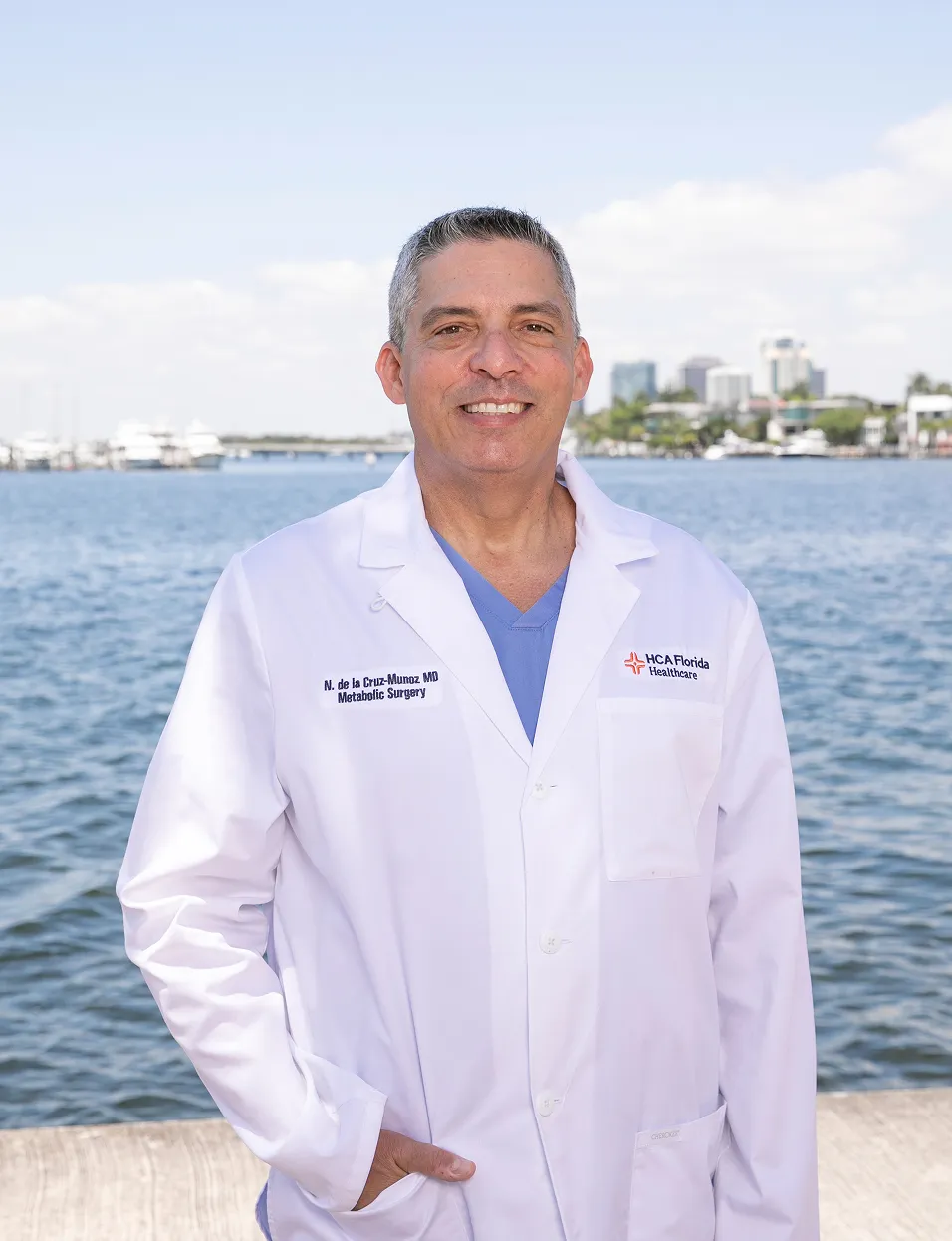

Dr. de la Cruz‑Muñoz specializes in advanced minimally invasive and robotic surgery, metabolic disease management, and comprehensive long‑term patient care. His work integrates clinical expertise, academic leadership, and a commitment to evidence‑based medicine. He has trained surgeons across the country, contributed to national guidelines, and is widely regarded for his outcomes, innovation, and patient‑centered approach.
Patients choose Dr. de la Cruz‑Muñoz for his combination of surgical excellence, metabolic expertise, and lifelong dedication to improving patient health through compassionate, high‑quality care.
Procedures We Offer







FAQ
Most patients transition back to regulartextured foods around six weeks, after progressing through clear liquids, fullliquids, purees, and soft foods. At first you will only tolerate a few bites,and your capacity increases gradually over the following months.
Most patients aim for 60 to 80 grams of proteinper day long term. Protein shakes are a temporary bridge used early, when yourstomach is too small to eat enough food. As tolerance improves, the goal is toget your protein from whole foods rather than a blender
No. When you eat correctly, you should be ableto eat without pain or vomiting. The most common cause is technique (eating toofast, bites too large, not chewing enough, drinking with meals, or portions toobig). Persistent vomiting despite good technique can signal a stricture, ulcer,or blockage and can cause dangerous vitamin B1 (thiamine) deficiency, so itshould be evaluated promptly.
Yes. Long term, most patients enjoy a wide rangeof foods in smaller portions, including celebrations and restaurant meals.Staying connected to the family table is actually linked to better long-termresults, so the goal is to stay part of meals rather than eating alone or inshame.
People Also Ask
Obesity is recognized as a chronic metabolic disease influenced by genetics, hormones, environment, and biological factors — not simply lifestyle choices.
The body has built-in mechanisms that defend weight, including hunger hormones and metabolic adaptations that make long-term weight loss challenging.
Yes. Genetics can significantly influence body weight regulation, appetite, metabolism, and an individual's susceptibility to obesity.
GLP-1 medications help regulate appetite, slow stomach emptying, improve satiety, and support sustainable weight management.
Yes. Obesity is associated with conditions such as Type 2 diabetes, hypertension, sleep apnea, fatty liver disease, and cardiovascular disease.
Dieting alone often cannot overcome the biological adaptations that increase hunger and decrease energy expenditure after weight loss.
Medical evaluation may be appropriate when excess weight affects health, quality of life, or contributes to obesity-related medical conditions.
Yes. Bariatric surgery addresses biological and metabolic factors involved in obesity and can lead to significant long-term health improvements.
Video