Gastric Band Removal

Overview
The adjustable gastric band (Lap-Band or Realize band) was once one of the most common weight-loss operations in the United States and in Latin America. Over the long term, though, many bands cause problems or stop working. In a 12-year follow-up study, band erosion occurred in 28% of patients and nearly half of the patients eventually needed their band removed (Himpens et al., Archives of Surgery, 2011). If your band is giving you trouble, you are not alone, and it can be safely taken out.
Gastric band removal is a minimally invasive (laparoscopic or robotic) operation to take out the band, the tubing and the access port under the skin. It can be done by itself, or combined with a conversion to another weight-loss operation, either in the same operation or in a second, planned stage. This page explains why bands are removed, how we evaluate you, what happens to your weight after removal and how to decide whether to convert.
Dr. de la Cruz-Muñoz performs band removals and band conversions for patients from Miami, from across the United States and from many countries in the Caribbean and Latin America, where bands were widely placed. For an overview of every option after a previous weight-loss operation, see revisional bariatric surgery.
How the Procedure Works
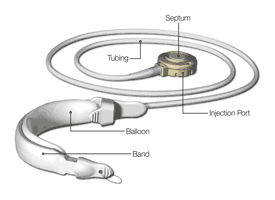
A gastric band is a silicone ring placed around the top of the stomach to create a small pouch. It is connected by thin tubing to a port under the skin, which is used to tighten or loosen the band. Over time, the body forms a capsule of scar tissue around the band.
During removal, the surgeon opens that capsule, unbuckles or cuts the band, and takes the band and tubing out through one of the small incisions. The port is removed from under the skin. Once the band is gone, the squeeze on the top of the stomach is released, so swallowing problems, regurgitation and band-related reflux usually improve. The restriction the band provided is also gone, which is why weight tends to return unless another operation is done (Aarts et al., Surgery for Obesity and Related Diseases, 2014).
Benefits
- Relief of band complications, such as slippage, erosion, pain or infection at the port, and leaking or broken tubing.
- Better swallowing and less regurgitation once the pressure on the top of the stomach and the esophagus is released.
- No more adjustments or fills, and no device left in the body.
- A path to a more durable operation. Removal can be paired with a sleeve gastrectomy, a gastric bypass or a SADI-S or duodenal switch conversion, now or later.
- Minimally invasive, usually through the same small incisions used to place the band.
Who Is a Candidate
Band removal may be right for you if you have an adjustable gastric band and any of the following:
- Band slippage (the stomach slides up through the band), often with vomiting, pain or food getting stuck.
- Band erosion, when the band wears into the wall of the stomach (Himpens et al., Archives of Surgery, 2011).
- Port or tubing problems: a flipped port, infection, leaks, or tubing that has disconnected.
- Difficulty swallowing, regurgitation or reflux, including night-time coughing or choking.
- A dilated pouch or esophagus above the band seen on testing.
- Intolerance: you can only eat soft or liquid foods, or you are vomiting often.
- Not enough weight loss or weight regain, in which case removal is usually combined with a conversion.
Some patients simply want the device out. That is a reasonable choice, and we will talk with you about what to expect afterward.
How the Procedure Is Performed
Evaluation first
Before surgery we review how and when your band was placed, your weight history and your symptoms. Most patients need an upper GI (barium swallow) study, which shows the position of the band, the size of the pouch and whether the esophagus is dilated, and an upper endoscopy, which is the best test to look for erosion of the band into the stomach. If your band was placed in another country and you do not have the records, that is fine: these tests show us the anatomy we need.
The operation
Under general anesthesia, the surgeon works through several small incisions with a camera. Scar tissue is gently freed, the capsule around the band is opened, and the band and tubing are removed. The port is taken out through its small incision. If the band has eroded into the stomach, the opening is repaired, and in some cases an eroded band is removed endoscopically or in stages.
Removal alone or with a conversion
If you want or need another weight-loss operation, there are two ways to do it:
- One stage: the band is removed and the new operation (often a sleeve or a gastric bypass) is done in the same surgery. This avoids a second operation and is a common choice when the stomach tissue is healthy.
- Two stages: the band is removed first and the conversion is done a few months later, once swelling and scar tissue have settled. This is usually preferred after erosion, an acute slip or a very thick capsule.
The choice is made for your safety, based on testing and on what the surgeon sees during the operation.
Risks and Considerations
Band removal is generally a lower-risk operation than the original surgery or a conversion, but every operation has risks. These include bleeding, infection (especially at the port site), injury to the stomach or nearby organs while freeing scar tissue, blood clots, and the usual risks of anesthesia. When a band has eroded, the stomach wall must be repaired, and there is a risk of a leak.
When removal is combined with a conversion, the risks of that operation apply as well, such as a staple-line leak after a sleeve or problems at the connections of a bypass. Your surgeon will review your personal risks, which depend on your health, the reason the band is being removed and the operation you choose.
The most common long-term downside of removing a band without a conversion is weight regain (Aarts et al., Surgery for Obesity and Related Diseases, 2014).
Recovery Timeline
After removal alone, many patients go home the same day or the next morning. Most return to light activity within a few days and to desk work in about a week. You will start with liquids and move back to regular food over a short period, as guided by the team.
If the band is removed together with a conversion, recovery follows that operation, with a hospital stay of one to two nights in most cases and the staged bariatric diet over several weeks. Walking early and often helps prevent blood clots and speeds healing.
Long-Term Expectations
Symptoms caused by the band, such as food getting stuck, regurgitation and band-related reflux, usually improve after removal. Weight is the main thing to plan for. In a study of patients who had their band removed without another operation, the weight they had lost with the band came back over the following years: excess weight loss dropped from 41% at removal to 0% at two years, and none of the patients kept the weight loss they had achieved with the band (Aarts et al., Surgery for Obesity and Related Diseases, 2014). The authors recommended a second weight-loss operation when it is feasible and safe.
That does not mean everyone has to convert. Some patients choose removal alone and manage their weight with nutrition, activity and, when appropriate, medication. Others plan a conversion at the same time or later. We will help you choose based on your goals and health.
More in gastric band conversions
Related procedures: Gastric Band to Sleeve Gastrectomy Conversion, Gastric Band to Roux-en-Y Gastric Bypass Conversion, Band to SADI-S Conversion, Gastric Band to Duodenal Switch Conversion, Gastric Band to OAGB Conversion and Adjustable Gastric Band Surgery. For an overview of all options, see Revisional Bariatric Surgery.
Conditions treated: Dysphagia, Acid Reflux (GERD), Weight Regain, Inadequate Weight Loss.
Why Choose Dr. de la Cruz-Muñoz
Removing a band safely, and deciding whether and how to convert, takes experience with both the band itself and the operations that can follow it. Dr. de la Cruz-Muñoz was a national proctor for the Realize gastric band from 2007 to 2010, teaching other surgeons how to place and manage it. He has also been performing bariatric surgery for over 25 years and has performed more than 9,000 bariatric operations, a volume few surgeons reach, including the full range of band conversions to sleeve, gastric bypass, SADI-S and duodenal switch.
Every band patient starts with a careful evaluation, including imaging and endoscopy when needed, so the plan fits your anatomy, your symptoms and your goals. To schedule an evaluation, call 305-692-0392 or contact the office.
Total Body Weight Loss (TBWL) Expectations
Band removal by itself is not a weight-loss operation. Without a conversion, most patients regain the weight they lost with the band over the following years (Aarts et al., Surgery for Obesity and Related Diseases, 2014). If continued weight loss is a goal, a conversion to a sleeve, gastric bypass, SADI-S or duodenal switch is usually recommended, and each of those pages describes the weight loss you can expect.
Expected Metabolic Improvements
Weight Regain Prevention Strategy
If you choose removal alone, plan ahead for weight regain: keep protein-focused meals and portion control, stay active, keep your follow-up visits, and ask about anti-obesity medications, which can help some patients after removal. If weight starts to return, a conversion can still be done later.
GERD / Reflux Considerations
A band that is too tight, has slipped or has stretched the esophagus can cause heartburn, regurgitation and night-time coughing. These symptoms usually improve once the band is removed. If reflux is a major problem and you are also planning a conversion, a gastric bypass is often the better choice than a sleeve, because a sleeve can make reflux worse. Testing before surgery helps make this decision.
Revision Options
After testing, the main choices are:
- Band removal alone (this page): best when the main goal is to fix band problems or remove the device.
- Band to sleeve gastrectomy: a common conversion when weight is the issue and there is no significant reflux.
- Band to Roux-en-Y gastric bypass: often preferred when reflux or swallowing problems are present.
- Band to OAGB: a one-anastomosis bypass option for selected patients.
- Band to SADI-S or band to duodenal switch: the strongest options for higher BMI or diabetes.
Any of these conversions can be done in the same operation as the removal or as a second stage.
Body Composition & Muscle Preservation
Insurance & Qualification Requirements
Many insurance plans cover band removal when the band is causing a medical problem, such as slippage, erosion, port or tubing problems, swallowing trouble or reflux. Coverage for a conversion to another weight-loss operation depends on your plan and often requires separate approval. Records of your band surgery, imaging and endoscopy reports help support the request.
Preparing for Surgery (Pre-Op Requirements)
Preparation usually includes bloodwork, an upper GI study, an upper endoscopy, and a review of your medications and medical conditions. If you are planning a conversion, you will also complete the usual bariatric evaluation, including nutrition counseling and, when required, a psychological evaluation. Please bring or send any records you have from your band surgery and adjustments; if you do not have them, testing will show us what we need. If you smoke, you will be asked to stop before surgery.
Post-Op Nutrition Overview
After removal alone, you will start with liquids and soft foods and return to a regular, balanced diet over a short period. Many patients find they can eat foods they could not tolerate with the band, so it helps to plan meals with a dietitian to avoid regaining weight. If a conversion was done, you will follow the staged bariatric diet for that operation, with lifelong vitamins and lab checks.
Post-Op Activity & Exercise Guidance
Walk the same day or the day after surgery and often after that. After removal alone, most light activities can resume within a few days; avoid heavy lifting for about two to four weeks while the incisions heal. After a conversion, follow the activity plan for that operation.
Special Considerations for International Patients
Our practice sees many patients from the Caribbean and Latin America who had a gastric band placed elsewhere. You can start with a virtual first visit, and our entire staff is bilingual in English and Spanish, so you can be cared for in your language from the first call. Send any records you have from your band surgery; if they are not available, testing in Miami will show the anatomy.
If you are having bariatric or revisional surgery, such as removal with a conversion, plan to stay in Miami for about 7 to 9 days after surgery. Ask the team how long to plan for removal alone.
Quick Procedure Details
Our office verifies your benefits and helps prepare the documentation your plan needs. If you are paying for care yourself, including patients traveling from abroad, the team can give you information on self-pay options.
Featured Procedures


Conditions






FAQ
You have several good options. If the band is simply too tight or too loose, an in-office adjustment may fix it. If you have reflux, difficulty swallowing, slippage, erosion, inadequate weight loss, or weight regain, the usual path is to remove the band and convert to a more effective operation — commonly a sleeve gastrectomy, Roux-en-Y gastric bypass, or duodenal switch, chosen based on your reflux status, metabolic health, and goals (Dayan et al., Obesity Surgery, 2023). These conversions are more complex than first-time surgery and should be done by a surgeon experienced in revisional bariatric care. Anti-obesity medications can also help with weight regain (Acosta et al., American Gastroenterological Association, 2017).
Removing a gastric band without converting to another procedure leads to significant weight regain, because the band was the only thing restricting intake (Zhou et al., Obesity Surgery, 2019). Converting to a sleeve gastrectomy at the same time — or in a planned second stage — replaces the failed, high-maintenance device with a permanent, modern operation that restricts intake and reduces hunger hormones, producing reliable and durable weight loss (Rashdan et al., Medicine, 2026).
Yes. Removing a gastric band and converting to another operation is one of the most common bariatric revisions. Bands are often removed because of slippage, erosion, reflux, swallowing problems or inadequate weight loss. Most patients convert to a sleeve gastrectomy or gastric bypass, and selected patients to SADI-S or duodenal switch. Depending on the condition of the stomach, removal and conversion can often be done in one operation; sometimes they are staged for safety.
Gastric bands are commonly converted because of inadequate weight loss or weight regain, food intolerance and vomiting, reflux, esophageal dilation, or mechanical problems such as slippage, erosion or port issues. Converting to a sleeve gastrectomy, gastric bypass, OAGB, SADI-S or duodenal switch provides more effective, durable weight loss. The choice depends on your reflux, weight goals and the condition of your stomach.
Yes. For most elective cases, performing band removal and sleeve gastrectomy in a single operation is as safe as doing them in two stages, with comparable complications, weight loss, and quality of life — and it avoids a second surgery and hospitalization (Perry et al., Obesity Surgery, 2022; Spaniolas et al., Annals of Surgery, 2021). A two-stage approach is preferred when there is band erosion or acute slippage (Perry et al., 2022).
The band is the least invasive and lowest-risk bariatric operation in the short term, and for highly committed patients with excellent follow-up it can produce durable weight loss — about 18% maintained at 5 years in dedicated programs (Lee and Dixon, Nature Reviews Gastroenterology & Hepatology, 2017). However, long-term data show more modest and variable weight loss, more weight regain, and much higher reoperation rates than the sleeve or gastric bypass, so its use has fallen to only a few percent of bariatric procedures in the United States (Heymsfield and Wadden, New England Journal of Medicine, 2017; Gadde et al., Journal of the American College of Cardiology, 2018). For most patients with severe obesity — and especially those with significant reflux or diabetes — a sleeve gastrectomy or gastric bypass is generally recommended over the band today (Dayan et al., Obesity Surgery, 2023). Because of the poorer long-term outcomes, we no longer offer the band in our practice.